






Comparison of 4D-DIA and 4D-PRM: Which Quantification Method is More Suitable for Your Project?
In modern proteomics research, Data-Independent Acquisition (DIA) and Parallel Reaction Monitoring (PRM) have become two mainstream quantitative strategies for targeted and non-targeted analysis. With the introduction of Ion Mobility technology, the 4D proteomics solution based on the timsTOF Pro platform incorporates the dimension of ion mobility into the analytical framework, greatly enhancing separation and quantitative performance. In this technical context, 4D-DIA and 4D-PRM are important options that many researchers need to weigh during the project design stage.
1. Basic Principles of 4D-DIA and 4D-PRM
1. What is 4D-DIA?
4D-DIA (Data-Independent Acquisition with Ion Mobility) is a full-spectrum acquisition strategy that includes the dimension of ion mobility (CCS) on the basis of DIA. Compared to DIA, 4D-DIA has higher spectral separation, noise suppression capability, and the ability to detect low-abundance proteins. Its principles are as follows:
-
Ions migrate in the tims cell based on the charge-to-volume ratio (1/K0), adding an extra separation dimension;
-
MS acquisition no longer relies on preset targets, and all fragment information is recorded;
-
Data deconvolution and quantification can be performed using library-driven or library-free software such as DIA-NN and Spectronaut.
2. What is 4D-PRM?
4D-PRM (Parallel Reaction Monitoring with Ion Mobility) combines the high specificity of PRM with the high resolution of Ion Mobility to perform quantitative monitoring based on known target proteins or peptides:
-
Preset m/z, CCS, and retention time windows to precisely isolate targeted ions;
-
All fragment information is recorded sequentially by high-resolution mass spectrometry (such as QTOF);
-
Greatly reduces background interference, suitable for biomarker research with strict validation or regulatory requirements.
Comparison of Applicable Scenarios: Discovery vs. Validation Studies
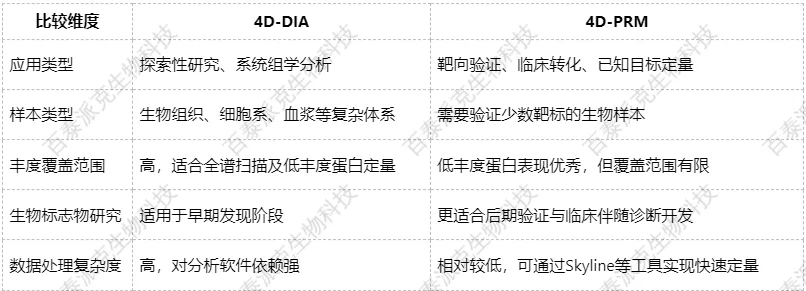
It can be seen that if your project is at the stage of protein screening, mechanism research, or omics exploration, 4D-DIA is more advantageous; if you have already identified targets and wish to perform high-specificity quantification across multiple batches or centers, 4D-PRM will be the ideal choice.
Comparison of Technical Performance: Balancing Quantitative Precision and Depth
1. Throughput and Coverage
4D-DIA naturally has high throughput characteristics. Thanks to its non-targeted full-scan strategy, it can obtain information on more than 6000 proteins and over 50000 peptides in a single analysis, suitable for large-scale sample comparison and differential expression analysis.
In contrast, although 4D-PRM has a limited number of targets (generally recommended not to exceed 200 peptides per run), it has extremely high sensitivity for monitoring target peptides, suitable for proteins that are difficult to detect due to a large quantitative range and low abundance.
2. Quantitative Accuracy and Reproducibility
Studies have shown that under optimized parameters, the CV value of 4D-DIA can be controlled within 15%, which is suitable for semi-quantitative research; while 4D-PRM, due to its specific selection and high-resolution acquisition, can usually achieve CV values of less than 10%, providing higher quantitative precision.
Data Processing and Method Development Complexity
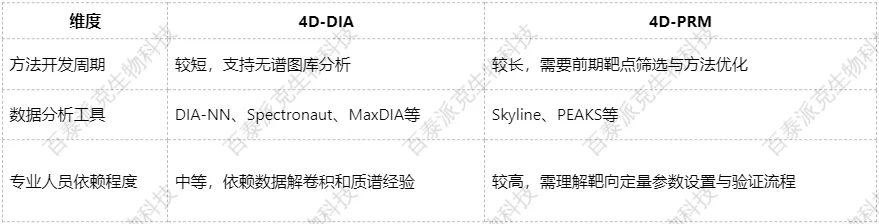
It is worth noting that 4D-DIA has high requirements for software and computing power, and it is recommended to use GPU-accelerated analysis processes; 4D-PRM is more suitable when the methodology is mature and batch samples need to be quantified quickly.
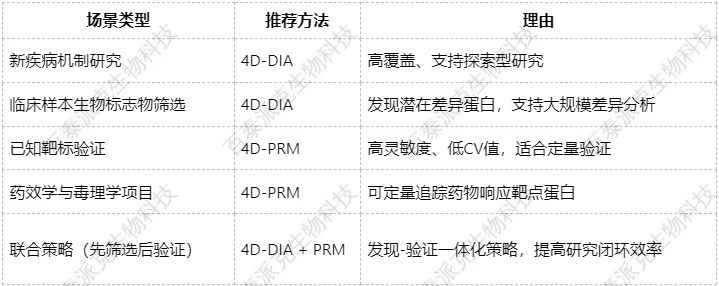
How to Choose? Develop Strategies Based on Research Goals
Biotree Biotech: Helping You Customize the Best Mass Spectrometry Quantification Strategy
At Biotree Biotech, we have been deeply involved in proteomics and metabolomics for over ten years. Combined with the Bruker timsTOF Pro 2 platform and customized analytical processes, we have successfully supported hundreds of scientific and industrial projects, including tumor biomarker discovery, exosome research, stem cell differentiation, and synthetic biology.
Whether you are at the stage of scientific exploration or facing clinical transformation challenges, our technical experts can provide you with:
-
Project evaluation and method selection recommendations (DIA vs PRM)
-
Library strategy design and DIA depth optimization
-
PRM method development and quantitative linear validation
-
Bioinformatics integration analysis and pathway enrichment
It is important to emphasize that 4D-DIA and 4D-PRM are complementary rather than competing technical routes. The former is more suitable for large-scale screening and data mining, while the latter focuses on high-precision quantification and target validation. In practical research, many successful projects have adopted a combination strategy of DIA initial screening + PRM validation. At Biotree Biotech, we are committed to matching the best technical path for each research project. If you still have questions about quantitative method selection in proteomics, please contact our expert team for one-on-one technical support.
Biotree Biotech—Characterization of Bioproducts, Multi-Omics Mass Spectrometry Detection Quality Service Provider
Related Services:
How to order?




