






How to Use ABPP for Small Molecule Screening and Mechanism Research?
In the early stages of drug discovery and mechanism research, traditional high-throughput screening (HTS) methods can identify active compounds from tens of thousands of small molecules but struggle to answer a key question: 'How does it work?' This is where activity-based protein profiling (ABPP) technology comes in—activity-based protein profiling (ABPP) is a protein-centric approach that uses chemical probes to screen small molecule drugs, identify targets, and study mechanisms. It focuses on using activity site-specific probes to label certain enzyme classes or protein families, and then analyzes them using proteomics methods. Unlike methods that depend on protein abundance, ABPP directly identifies enzymes in their active functional state, making it a powerful tool for screening new small molecules, target identification, and mechanism elucidation. As covalent inhibitors and protein degradation technologies arise, small molecule drugs increasingly emphasize the controllability of 'mode of action.' ABPP serves as a bridge linking protein functional states with small molecule recognition mechanisms. ABPP promises to achieve higher throughput and finer resolution functional protein mapping in the future.How to conduct small molecule screening and mechanism research using ABPP in conjunction with chemical genetics, AI-assisted structure prediction, and single-cell mass spectrometry is an important topic for researchers redefining early drug screening.
1. Key Elements of ABP Structure
1. Reactive Group (Warhead):Covalently binds to enzyme active sites, commonly including fluorophosphonate, epoxides, sulfonyl fluoride, etc.
2. Linker:Adjusts probe spatial conformation to reduce nonspecific binding.
3. Reportable Tag:Used for subsequent enrichment (e.g., biotin) or detection (e.g., fluorophores, photo-crosslinking groups).
II. Application of ABPP in Small Molecule Screening
1. Select the appropriate ABPP probe,The probe structure generally consists of three parts:
(1) Reactive Group (Warhead):Specifically binds to active sites (e.g., fluorophosphonate for serine esterases).
(2) Linker:Provides spatial flexibility.
(3) Tag:Used for detection (e.g., fluorophores, biotin) or subsequent click reactions (e.g., alkynes/azides).
2. Design competitive ABPP experiments
Incubate the small molecule of interest with cell lysates or purified enzymes first, then add the ABPP probe. If the small molecule binds to the enzyme's active site, it will competitively inhibit probe labeling, thereby reducing the signal.
3. Detection and Screening
UsingSDS-PAGE + fluorescence imaging, biotin labeling + Western blot, or MS mass spectrometry quantificationmethods to detect the degree of probe binding. By comparing differences before and after adding the small molecule, one can determine whether it has inhibitory effects.
III. Brief Workflow Description
1. Probe treatment of samples (cell/tissue lysates or in situ)
2. Covalent bond formation with target proteins
3. Enrichment of labeled proteins for mass spectrometry identification
IV. Strategies for ABPP in Small Molecule Screening
1. Competitive ABPP: Identifying small molecule targets
In this strategy, the small molecule drug is incubated with the system before adding ABP.If the small molecule occupies the enzyme's active site, ABP binding will be inhibited, resulting in reduced labeling on the target protein.Quantitative mass spectrometry analysis of differences between treatment groups can:
(1) Screen for enzyme targets that compete with the small molecule
(2) Elucidate possible mechanisms and selectivity of the small molecule
2. Reactivity Profiling: Discover novel active enzymes
ABPP can be used to mapthe 'enzyme activity profile' in specific tissues, cell types, or pathological states. This provides background information for small molecules with unknown targets, aiding in the inference of possible intervention pathways.
3. Selectivity optimization for enzyme families
In covalent inhibitor development, ABPP is especially suitable for screening inhibitors with family member specificity differences.
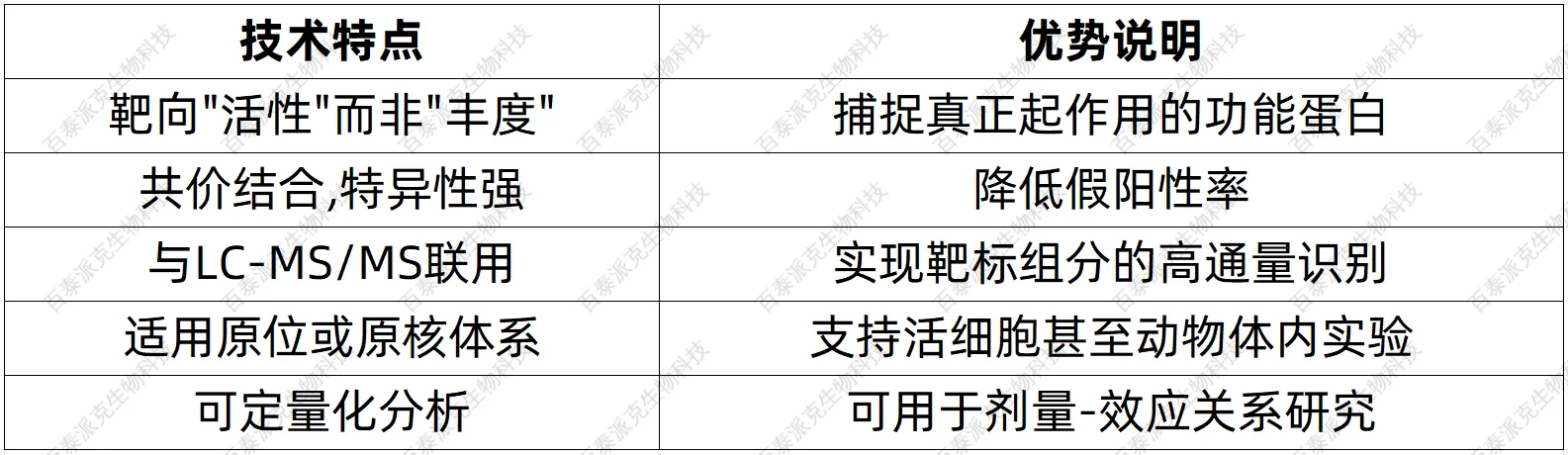
V. Technical Highlights of ABPP Combined with Mass Spectrometry
VI. Precautions
1. Probe selection should be designed according to enzyme specificity (e.g., serine esterases, cysteine proteases, oxidoreductases).
2. The permeability and stability of small molecules greatly affect results.
3. Pay attention to controlling nonspecific binding and background signals.
At Biotopic Biotechnology, we offer advanced quantitative solutions including ABPP+TMT multiplex labeling quantification and ABPP+SILAC stable isotope labeling based on the high-resolution Orbitrap platform. We help clients elucidate precise interactions between small molecules and enzymes. We have established a multi-platform solution including ABPP, DIA quantification, and phosphorylation modification analysis. We are dedicated to assisting researchers in mechanism studies and target discovery, reducing missteps, and quickly validating hypotheses, empowering life sciences and innovative drug development.
Biotopic Biotechnology—A leading service provider in bioproduct characterization, multi-omics mass spectrometry analysis.
Related Services:
Identification and validation of small molecule drug targets.
How to order?




