






Detailed Explanation of the Principles and Methods of Protein Mass Spectrometry Identification
Mass spectrometry analysis technology is characterized by high sensitivity and high precision, allowing for accurate and rapid identification of proteins. Traditional mass spectrometry was limited to the analysis of small analytes. However, with the emergence and development of new ionization technologies such as Matrix-Assisted Laser Desorption/Ionization Time of Flight Mass Spectrometry (MALDI-TOF-MS) and Electrospray Ionization Mass Spectrometry (ESI-MS), it has become more convenient to accurately and rapidly identify proteins and other macromolecules. Currently, enzymatic digestion of proteins, liquid chromatography separation of peptides, tandem mass spectrometry analysis of peptide amino acid sequences, and combined mass spectrometry data analysis have become the preferred solutions for protein identification. This article mainly discusses the principles and applications of protein mass spectrometry identification.
I. MALDI-TOF
The basic principle of Matrix-Assisted Laser Desorption/Ionization Time of Flight (MALDI-TOF) mass spectrometry is that the analyte is dispersed in matrix molecules to form crystals. When the crystals are irradiated with a laser, the energy absorbed by the matrix molecules from the radiation causes energy accumulation and rapid heating, resulting in the sublimation of the matrix crystals. This causes the matrix and analyte to expand and enter the gas phase. The mass spectrum produced by MALDI mostly consists of singly charged ions, and thus the ions in the mass spectrum correspond one-to-one with the mass of peptides and proteins. The ions produced by MALDI are commonly detected using a Time of Flight (TOF) detector. Theoretically, as long as the length of the flight tube is sufficient, the TOF detector can detect molecular masses without an upper limit, making MALDI-TOF mass spectrometry highly suitable for studying biological macromolecules such as proteins and peptides.
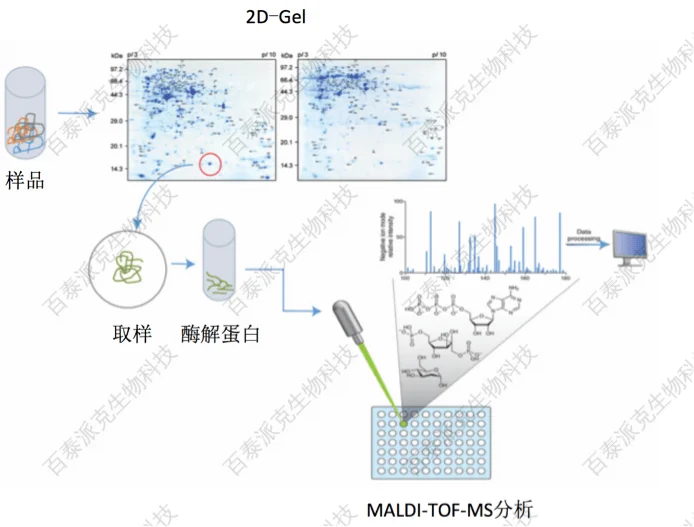
MALDI-TOF-MS Analysis
Technical Features
• MALDI-TOF offers convenient and rapid identification, capable of analyzing hundreds of spots simultaneously.
• Mainly used for the identification of pure proteins or simple samples, such as 2DE spots.
• Relatively low cost.
Sample Requirements
• Protein solution: purity > 90%; total protein amount > 5 ug, concentration > 0.1 ug/ul.
• Two-dimensional gel electrophoresis spots: Coomassie or silver-stained spots must be clearly visible.
• SDS-PAGE gel strips: single protein, Coomassie or silver-stained bands must be clearly visible.
II. ESI-MS
Electrospray Ionization Mass Spectrometry (ESI-MS) involves applying a high voltage at the outlet of a capillary, generating a high electric field that nebulizes the liquid flowing out of the capillary into fine charged droplets. As the solvent evaporates, the charge density on the droplet surface increases, leading to the breakdown of the droplets into numerous ions carrying one or more charges. This allows the analyte to enter the gas phase in the form of singly or multiply charged ions. The feature of electrospray ionization is the generation of high-charge ions rather than fragment ions, reducing the mass-to-charge ratio to a range detectable by most mass analyzers, thereby greatly expanding the range of molecular weight analysis. The true molecular mass of the ions can also be calculated based on the mass-to-charge ratio and charge number.
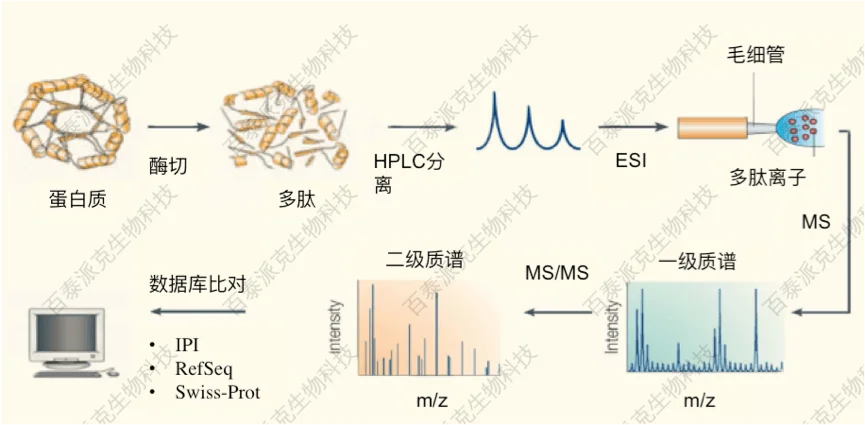
Principles and Methods of Protein Mass Spectrometry Identification
Technical Features
• High throughput: capable of identifying tens to hundreds of proteins in one go.
• High sensitivity: capable of detecting gel spots with extremely low sample concentrations.
• Strong versatility: capable of analyzing various forms of samples such as protein bands, immunoprecipitation eluates, tissue extracts, whole-cell lysates, and subcellular fractions.
Sample Requirements
• Protein solution: total protein amount > 5 ug, concentration > 0.1 ug/ul. The buffer must not contain detergents like NP40, Triton X-100, etc.
• SDS-PAGE gel strips: Coomassie or silver-stained bands must be clearly visible.
Precautions for Preparing Mass Spectrometry Detection Samples:
• Avoid various contaminations and repeated freeze-thaw cycles during the sample preparation process.
• Avoid keratin contamination during gel preparation and cutting. Use dedicated gel preparation reagents and clean disposable cutting tools.
• Protein staining: generally, amounts visible to the naked eye can be identified by mass spectrometry.
• For silver-stained proteins, do not use glutaraldehyde as a fixative, as it causes irreversible cross-linking of proteins, affecting the mass spectrometry identification results.
Applications of Mass Spectrometry Technology
1. Protein Purity Analysis and Molecular Weight Determination
MALDI-TOF is a soft ionization technique that can be used to detect the presence of target proteins or peptides, assess the presence of dimers, and provide a general evaluation of purity. MALDI-TOF identifies a wide range of molecular weights, capable of determining protein molecular weights from 700 to 60,000 Da with an accuracy of 0.1% to 0.01%, far surpassing the currently commonly used SDS-PAGE and high-performance gel chromatography techniques.
2. Protein Fingerprinting Identification (PMF)
Peptide Mass Fingerprinting (PMF) is a mass spectrum of peptide fragments obtained after a protein is hydrolyzed by a specific protease at recognized enzymatic cleavage sites. Since each protein has a unique amino acid sequence (primary structure), the peptide fragment sequence produced upon hydrolysis is also unique, resulting in a characteristic peptide mass fingerprint. By comparing the peptide mass spectrum with theoretical peptide spectra in a database, the identity of the protein can be determined. Therefore, the accuracy of molecular mass is a key indicator in PMF, but post-translational modifications of proteins may cause discrepancies between PMF mass values and theoretical values, affecting the accuracy of protein identification.
3. MS/MS Tandem Mass Spectrometry Sequencing
Tandem Mass Spectrometry (MS/MS) is a commonly used method for mass spectrometry identification. MS/MS first measures the mass of peptide segments using primary mass spectrometry, then selects high-abundance peptide segments for secondary mass spectrometry analysis. In secondary mass spectrometry, peptide segments collide, causing amino acid bonds to break and produce fragment ions, which are analyzed by the detector to obtain amino acid sequence information of the selected peptide segments. MS/MS utilizes the precise mass information of abundant peptide fragments, providing higher specificity and reliability, greatly enhancing the reliability of database searches.
How to order?




