






iTRAQ/TMT Label Structure and Relative Quantification Principle Explained
Guide
• iTRAQ/TMT Quantitative Proteomics Technology
• Molecular Composition of iTRAQ/TMT Tags
• Principles of iTRAQ/TMT Technology
Introduction to iTRAQ and TMT Tags
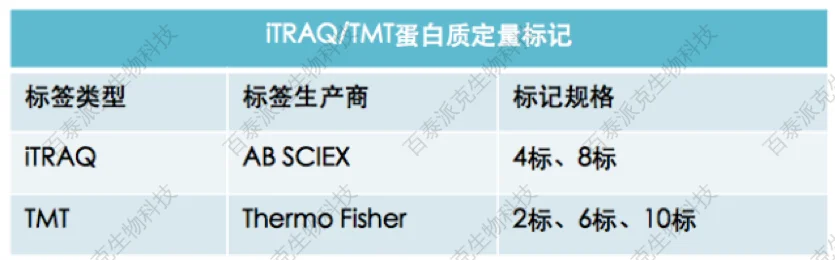
When it comes to iTRAQ and TMT, many people might think these are two different quantitative omics technologies. However, iTRAQ and TMT technologies are only produced by different manufacturers. Apart from minor differences in labeling specifications and molecular structure of the tags, the principle of labeling peptides is essentially the same. iTRAQ was developed by AB SCIEX, followed by Thermo Fisher developing TMT. They differ only in patents, but their usage principles are basically consistent.
iTRAQ: Isobaric Tag for Relative and Absolute Quantitation
TMT: Tandem Mass Tag
Detailed Explanation of iTRAQ-TMT Tag Structure and Relative Quantification Principles - Biotech-Pack
iTRAQ and TMT tags are essentially chemical in vitro labeling reagents that can specifically label peptides produced by protein digestion. iTRAQ and TMT labeled protein samples differ in their specifications. Comparatively, TMT can label a broader range of samples and can quantitatively analyze multiple protein samples simultaneously, from as few as 2 to as many as 10 protein samples. By labeling different groups of samples, TMT and iTRAQ can simultaneously compare the protein level differences between normal and tumor tissue samples, as well as accurately detect protein level changes at different stages of tumor development.
Although iTRAQ and TMT share the same labeling principle, their tag structures have some differences. Next, let's look at the subtle differences in the tag structures of iTRAQ and TMT.
Comparison of iTRAQ and TMT Molecular Structures
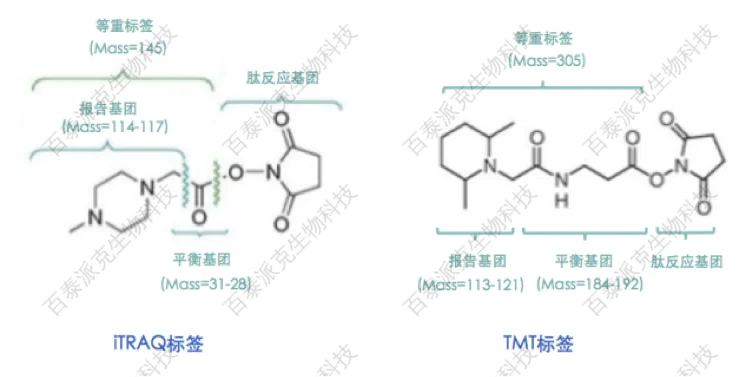
Comparison of iTRAQ and TMT Molecular Structures
From the diagram above, we can see that iTRAQ and TMT tags have distinct structural differences, but also some commonalities. Firstly, both tags are composed of a reporter group, a balance group, and a peptide reactive group. The total weight of the respective reporter and balance groups of the two tags is constant. Additionally, the peptide reactive group structure of both tags is the same. The difference between iTRAQ and TMT tags lies in the structure of the balance group. From the diagram below, we can see that TMT's balance group structure is more complex than that of the iTRAQ tag. The balance group of the iTRAQ tag is only a few dozen Da, while TMT's balance group is close to 200 Da, which is also the reason for the mass difference between iTRAQ and TMT tags.
After briefly introducing the structure of the two tags, let's take the iTRAQ 4-plex tag as an example to get a detailed understanding of the structural composition of the iTRAQ molecular tag.
Molecular Structure of iTRAQ
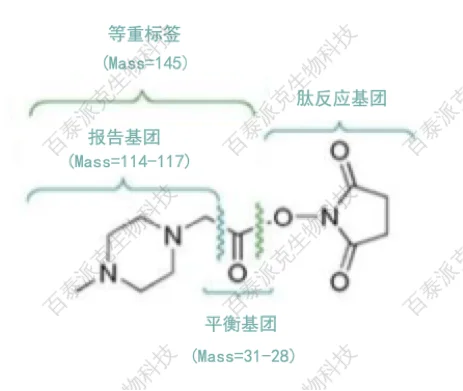
Structure of iTRAQ 4-plex Tag
The molecular framework of the iTRAQ tag is composed of three core components: the reporter group, the balance group, and the peptide reactive group. The reporter and balance groups form equal groups. The weight of the reporter group of different iTRAQ tags varies, with the reporter group weights of the 4-plex tag being: 114, 115, 116, and 117 Da; the balance group masses are: 31, 30, 29, and 28 Da, making the total weight of the reporter group of the 4 iTRAQ tags 145 Da. Another core component is the peptide reactive group, whose main function is to undergo a displacement reaction with the free N-terminal amino of the peptide, covalently linking the isotope tag to the N-terminal of the peptide.
Previously, we mentioned the mass of the tag's reporter and balance groups. Many people might wonder how the tag's reporter groups differ by only a few Da. This is actually achieved through the principle of isotope labeling. Let's use the iTRAQ tag as an example to explain.
As shown in the diagram, the reporter group with a mass of 114 contains 1 C13, increasing the mass of the reporter group by 1 Da. Meanwhile, the balance group contains 1 C13 and 1 O18, increasing the total mass by 3 Da, thus increasing the total mass of the 114 tag by 4 Da. Similarly, the 115 reporter group increases by 2 Da, and the balance group by 2 Da; the 116 reporter group increases by 3 Da, and the balance group by 1 Da; the 117 reporter group increases by 4 Da, and the balance group by 0 Da. Through different isotope labeling of the reporter and balance groups, the increased mass of each is different, but the total increased mass is the same, making the total weight of the tags equal.
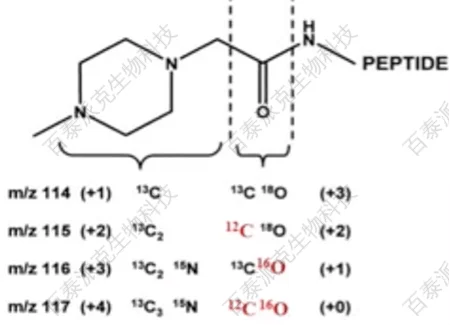
Isotope Labeling of iTRAQ Tags
Process of Tag and Peptide Reaction
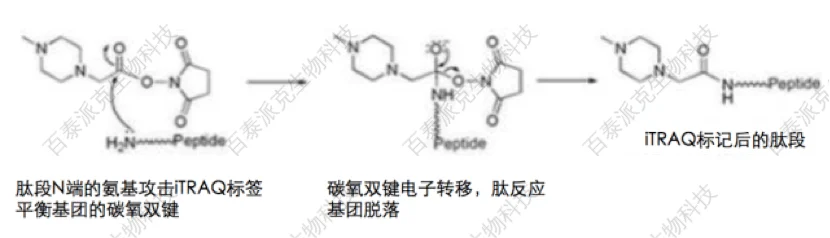
Process of Peptide Labeling Reaction
Principles of iTRAQ Relative Quantification Study
Proteins are first cleaved into peptides, then differentially labeled with iTRAQ reagents. Since the iTRAQ reagents are isobaric, that is, different isotopes have the same molecular weight after labeling the same peptide, they are detected in the first stage of mass spectrometry with identical molecular weights. Using tandem mass spectrometry, precursor ions detected in the first stage undergo collision-induced dissociation, and product ions are analyzed in the second stage. During secondary mass spectrometry analysis, the bonds between the reporter group, balance group, and peptide reactive group break, with the balance group being lost, producing low mass-to-charge ratio (m/z) reporter ions. Since secondary mass spectrometry can analyze reporter groups differing by 1 Dalton in relative molecular mass, the intensity differences of different reporter ions represent the relative abundance of the peptide they label. Meanwhile, the amide bonds within the peptide break, forming a series of b ions and y ions, and the mass numbers of these ion fragments can be queried and compared in databases to identify the corresponding protein precursor.
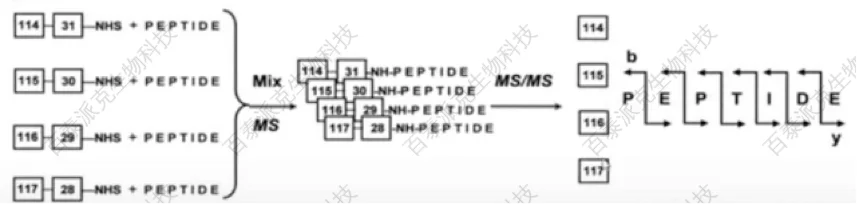
Principles of iTRAQ Quantitative Analysis
Workflow of iTRAQ Relative Quantification Study
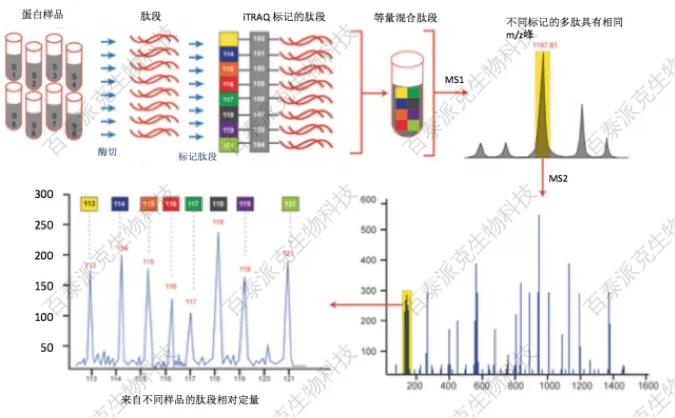
Workflow of iTRAQ Quantitative Analysis
1. Enzymatically digest different protein samples into peptide fragments.
2. Use different iTRAQ tags to separately label the peptide fragments produced by digesting different protein samples, but the total weight of different iTRAQ tags is the same.
3. Mix the labeled samples in proportion.
4. The labeled peptide fragments go through first-stage mass spectrometry separation. In the first stage, iTRAQ tags with the same total weight from different protein samples cannot be distinguished, thus they enter the second-stage mass spectrometry analysis together.
5. In the second-stage mass spectrometry, under high-energy collision, the iTRAQ balance group is fragmented, releasing the reporter group, and the peptide is also released, fragmenting into secondary fragments. By analyzing the amino acid sequence of the peptides, the protein sequence can be inferred; simultaneously, the signal intensity of each reporter group in the mass spectrometry represents the relative abundance of the peptide in the 4 sample groups, reflecting the relative expression level of the corresponding protein in the 4 sample groups.
How to order?




