






Post-Translational Modification Research Strategies
What is post-translational modification of proteins?
Post-translational modification (PTM) of proteins refers to the chemical modification of proteins after translation. For most proteins, this is the final step in protein biosynthesis. PTM is an important component of cellular signal transduction. It is a crucial step in the expression of biological functions of proteins, achieved by adding one or more amino acid residues to the modification group or by proteolytic cleavage of the group to alter protein properties. Post-translational modification of biological proteins greatly increases the diversity of protein structures and functions. This process regulates the cell cycle and protein transcription, and affects epigenetics.
Types of post-translational modifications
Types of post-translational modifications include the removal of N-terminal fMet or Met, disulfide bond formation, chemical modifications, and peptide bond cleavage, with phosphorylation being the most common. Chemical modification reactions of proteins are obtained by chemical reactions based on their amino acid residues while maintaining protein integrity and functionality, resulting in new biological conjugates.
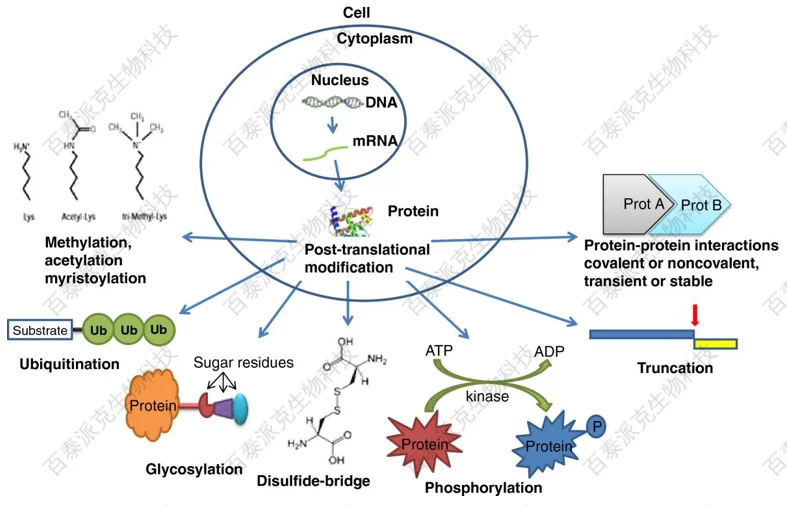
Modification
Where does post-translational modification occur?
Post-translational modifications primarily occur on the side chains of amino acids or on the C-terminus or N-terminus of the protein. Existing functional groups or newly introduced functional groups can be used to modify proteins, extending the chemical composition of the 20 standard amino acids. Sites for post-translational modifications often have functional groups that can act as nucleophiles in chemical reactions, such as hydroxyl groups of serine, threonine, and tyrosine; amine forms of lysine, arginine, and histidine; and also asparagine at the N-terminus and C-terminus of proteins can serve as glycosylation sites in post-translational modifications. Modifications also occur on oxidized methionine and some methylene sites on side chains.
Research strategies for post-translational modifications
Currently, there are several strategies for analyzing protein post-translational modifications, including mass spectrometry (MS), Eastern blotting, radioactive labeling, and Western blotting. Radioactive labeling and Western blotting are the most traditional, specific, and relatively quantitative methods. The process requires prior knowledge of the type of post-translational modification. Limitations include antibody specificity and availability. Mass spectrometry is also commonly used for PTM analysis and is not constrained by existing knowledge of modification types and related modification sites.
Bottom-up
The bottom-up technique is one of the mass spectrometry strategies used in proteomics research. Before sequencing peptides based on sequences, proteins need to be digested with proteases. This technique cannot guarantee the integrity and stability of the detected peptides during the detection process, thus making it impossible to obtain information on the relationship between different protein post-translational modifications, meaning it cannot detect certain modifications. Therefore, this method is not suitable for analyzing the combinatorial PTMs of histones.
Middle-down
The middle-down analysis method is an alternative to bottom-up analysis, and its principle is similar to the bottom-up strategy when analyzing histones. In this analysis method, proteins are usually digested into peptide segments within the range of 3-9 kDa, which also cannot guarantee the integrity of detected peptides. However, due to advances in instrumentation and the retention of combinatorial modifications of histone tails, middle-down analysis is gradually gaining popularity. It is closer to the sensitivity of the bottom-up method.
Top-down
Top-down technology allows direct sequencing of intact proteins, including post-translationally modified proteins and other large protein fragments, rather than just peptide segments. This maximizes the retention of information related to PTMs, making it suitable for comprehensive characterization and analysis of histones. The effective resolution of top-down technology for proteins has reached 229 kDa, and the number of proteins that can be detected at once is also increasing. Currently, top-down technology is mainly used for the analysis of individual proteins, and high-throughput analysis technology has not yet been widely applied.
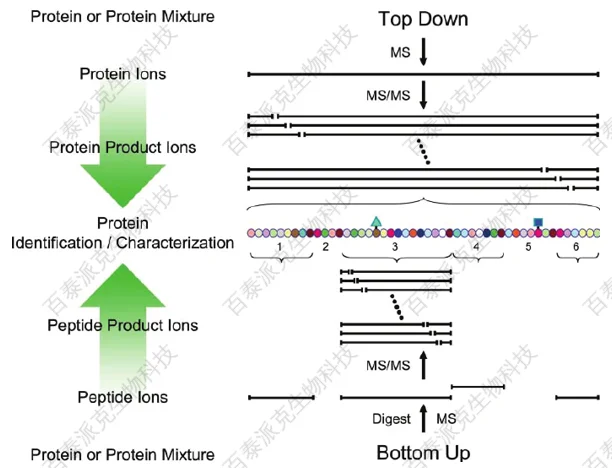
Schematic diagram of bottom-up and top-down strategies for protein identification and characterization (Scherperel et al., 2007)
References
1. Wang Y C, Peterson S E, Loring J F. Protein post-translational modifications and regulation of pluripotency in human stem cells. Cell research, 2014, 24(2): 143.
2. Silva, André MN, et al. "Post-translational modifications and mass spectrometry detection." Free radical biology and medicine, 2013(65): 925-941.
3. Drazic A, Myklebust L M, Ree R, et al. The world of protein acetylation. Biochimica et Biophysica Acta (BBA)-Proteins and Proteomics, 2016, 1864(10): 1372-1401.
4. Woods, A.G., Ngounou Wetie, A.G., Sokolowska, I. et al. Mass spectrometry as a tool for studying autism spectrum disorder. J Mol Psychiatr, 2013, (1): 6.
5. Scherperel G, Reid G E. Emerging methods in proteomics: top-down protein characterization by multistage tandem mass spectrometry. Analyst, 2007, 132.
Related Services
How to order?




