






Comparison of Peptide Mapping Analysis and Tandem Mass Spectrometry in Protein Identification
Proteins are the core executors of life activities, involved in almost all biological processes such as signal transduction, metabolic regulation, immune response, and more. In the era of precision medicine, in-depth analysis of the identity, structure, and function of proteins is not only a critical aspect of basic research but also a cornerstone for driving innovation in biomedicine. Protein identification technologies play an irreplaceable role in both research and industry, from new drug target discovery, disease mechanism research, to quality control of biologics and clinical diagnosis.
Among the numerous analytical strategies, Peptide Mapping and LC-MS/MS Protein Identification are the two most widely used and complementary technologies. Their common goal is to establish an 'identity profile' for proteins, but they each have distinct features in terms of technical principles, data types, information depth, and application scenarios. Peptide Mapping excels in structural consistency verification when reference sequences are available and is the 'gold standard' for biologics quality control. Conversely, LC-MS/MS can identify unknown proteins in the absence of prior sequences by sequence analysis and provide comprehensive structural and modification information.
I. Peptide Mapping
Peptide Mapping is a technique that utilizes specific enzymatic digestion combined with chromatographic or mass spectrometric analysis to verify a protein's primary structure and consistency. Under controlled conditions, the protein is cleaved into a set of peptides with specific sequences and physicochemical properties. These peptides have highly unique distribution patterns in chromatographic retention time and mass-to-charge ratio (m/z), thus are metaphorically referred to as the protein's 'fingerprint map.' By precisely comparing the peptide map obtained from the sample with a reference standard, it can be determined if they are consistent in terms of amino acid sequence, post-translational modifications, and structural integrity, thereby providing a reliable basis for protein identity confirmation and quality monitoring.
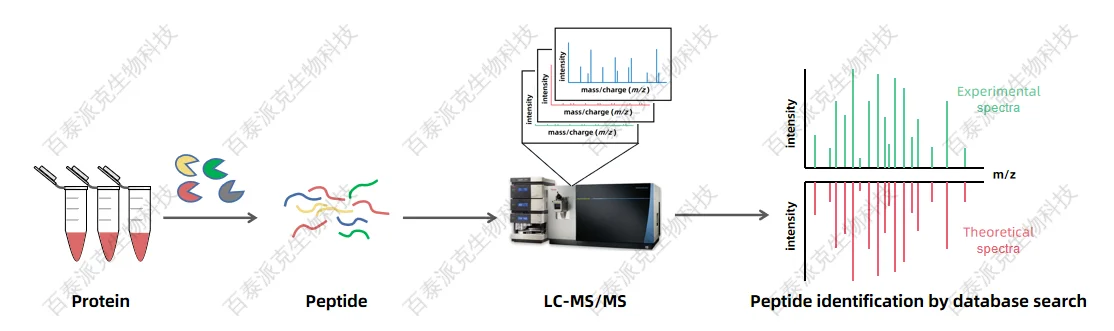
Figure 1. Peptide Mapping Process
This method in mass spectrometry detection usually relies on high-resolution accurate mass (HRAM) spectrometers, such as Orbitrap and quadrupole time-of-flight mass spectrometry (Q-TOF), to ensure long-term running mass accuracy (better than 1–5 ppm) and resolution (Orbitrap can reach 500,000+ FWHM, Q-TOF stable at 30,000–60,000 FWHM). The principle is to introduce peptide fragments separated by liquid chromatography into the mass analyzer through electrospray ionization (ESI), precisely measuring the mass-to-charge ratio (m/z) and signal intensity, and generating a two-dimensional peptide fingerprint (Retention Time × m/z) combined with retention time. Under fixed enzymatic digestion and analytical conditions, different proteins will present highly unique peptide combinations and peak features, akin to human fingerprints. This uniqueness and reproducibility make Peptide Mapping the gold standard for biologics quality consistency evaluation, batch comparison, and structural stability studies.
1. Advantages
(1) High reproducibility: Peptide fingerprint patterns generated under fixed enzymatic digestion and separation conditions are stable and reproducible, suitable for batch consistency comparison.
(2) Structural consistency verification: Can quickly determine changes in amino acid sequences, degradation products, and post-translational modifications, suitable for biologics quality control.
(3) Simple process: Mainly relies on MS1 data, with relatively low requirements for instruments and data processing, resulting in a short analysis cycle.
(4) Suitable for long-term monitoring: Can track protein structural changes throughout production, storage, and transportation.
2. Limitations
(1) Dependence on known sequences: Requires a reference standard or known sequences for comparison, not applicable to unknown proteins.
(2) Limited information depth: Cannot resolve complete sequences, and modification detection capability is limited.
(3) Poor adaptability to complex samples: Not suitable for mixtures with high background signals or multiple protein types.
II. LC-MS/MS Protein Identification
When the target protein is unknown or the sample components are complex, LC-MS/MS Protein Identification is a better choice. In LC-MS/MS Protein Identification, specific proteases are used to cleave proteins into peptide fragments, which are separated by liquid chromatography and then sequentially enter the mass spectrometer for two-stage detection. The first stage mass spectrometry (MS1) accurately records the mass-to-charge ratio (m/z) and abundance information of each peptide fragment, then selects specific peptide fragments for sequence analysis in the second stage mass spectrometry (MS2). During the MS2 stage, peptide fragments undergo collision-induced dissociation (CID) with inert gas molecules (such as nitrogen or helium), causing peptide bonds to break at multiple potential sites. Although various fragmentation types may theoretically occur, under CID conditions, b-series ions (positively charged and retaining the N-terminus) and y-series ions (positively charged and retaining the C-terminus) are most common and valuable for analysis. By analyzing the m/z distribution of these fragment ions, the amino acid sequence of the peptide fragment can be inferred and compared with the protein database, thereby achieving comprehensive identification of known and unknown proteins in complex systems without reference standards, and accurately locating multiple post-translational modifications.
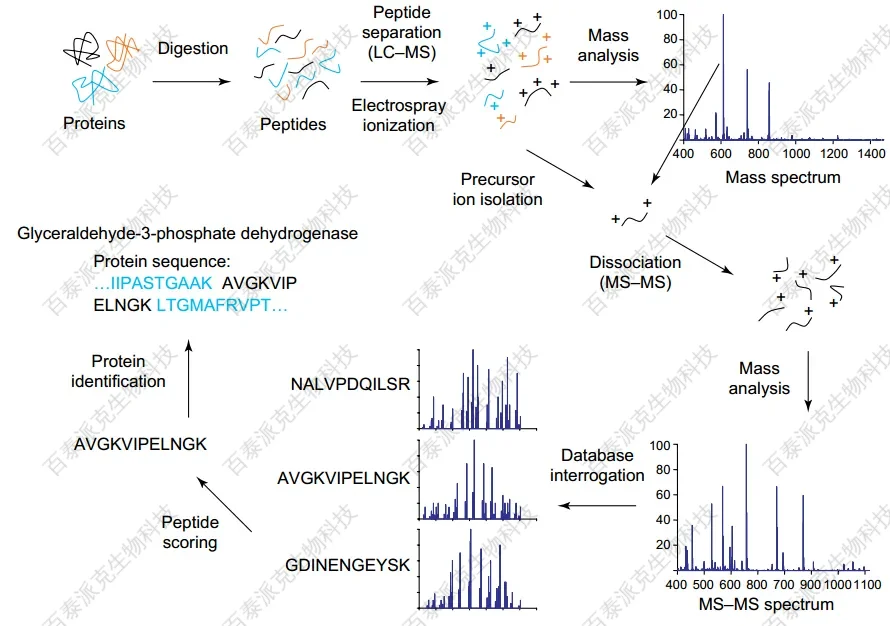
Kolker, E. et al. Trends Microbiol. 2006.
Figure 2. LC-MS/MS Protein Identification Process
LC-MS/MS can not only simultaneously identify and quantify thousands of proteins but also accurately locate multiple post-translational modifications (such as phosphorylation, acetylation, glycosylation), greatly expanding the depth and breadth of proteomics research.
1. Advantages
(1) No prior sequence required: Can directly infer peptide sequences through CID fragment ions, suitable for unknown protein identification.
(2) High-throughput analysis: Can identify and quantify thousands of proteins in one go, with coverage and information far exceeding Peptide Mapping.
(3) Precise modification localization: Can accurately detect and locate multiple post-translational modifications (such as phosphorylation, acetylation, glycosylation).
(4) Broad applicability: Can be used for complex mixtures, biological fluids, tissues, single cells, and other samples.
2. Limitations
(1) Complex data processing: Depends on large databases and high-performance computing, resulting in a long analysis cycle.
(2) High sample requirements: Digestion efficiency, purity, and pre-treatment conditions significantly impact results.
(3) Database dependency: Unknown species or incomplete databases may lead to missed or incorrect identifications.
| Comparison Dimensions | Peptide Mapping | LC-MS/MS Protein Identification |
| Main Purpose | Verify the structural consistency and identity of known proteins | Identify unknown proteins and multiple proteins in complex samples |
| Dependence on Known Sequences | Depends on known sequences, compares with reference standards | No prior sequence information required, can directly search databases |
| Type of Mass Spectrometry Data | Primarily MS1 (retention time + m/z distribution), supplemented by MS2 to verify suspicious peaks if necessary | Simultaneously obtain MS1 and MS2, MS2 fragment spectra used to deduce peptide sequences |
| Depth of Analytical Information | Provides limited information on sequence consistency, modification changes, and degradation products | Provides comprehensive information on full protein sequences, modification types and locations, and abundance quantification |
| Applicable Samples | Highly purified single proteins (such as monoclonal antibodies, recombinant proteins) | Purified proteins, complex mixtures, biological fluids, tissues, single cells, etc. |
| Interpretation of Results | Peak-by-peak comparison with reference peptide maps to determine differences | Database matching orde novo Direct sequencing to identify proteins |
| Advantageous Scenarios | Batch Consistency, Quality Control, Stability Studies of Biologics | Drug Target Discovery, Biomarker Screening, Disease Mechanism Research |
| Detection Throughput | Medium, primarily for single protein | High throughput, capable of identifying thousands of proteins at once |
| Modification Analysis Capability | Capable of detecting some modifications (requires MS integration) | Comprehensive detection and localization of various post-translational modifications |
| Typical Application Objectives | "Is it the protein I am looking for?" | "Who is it? What other proteins are in the sample?" |
Figure 3. Differences Between Peptide Mapping and LC-MS/MS Protein Identification
Peptide mapping excels in batch consistency and quality monitoring of known proteins, while LC-MS/MS is uniquely advantageous for identifying unknown samples and in-depth structural analysis. In practical research and industrial applications, these two technologies are often complementary: first using peptide mapping to confirm the identity and consistency of the target protein, then using LC-MS/MS for comprehensive component analysis and modification localization of the sample, thus providing the most suitable technical support at different research stages.
Biotai Park Biotechnology - Characterization of Biological Products, High-Quality Multi-Omics Biomass Spectrometry Services Provider
Related Services:
How to order?




