






Comprehensive Analysis of Post-Translational Modifications
In life activities, post-translational modifications (PTMs) of proteins are critical mechanisms for regulating protein function, stability, localization, and interactions. They are extensively involved in various life processes, including cell signal transduction, metabolic regulation, immune response, cell cycle, and disease progression. With the development of omics technologies, researchers are increasingly focused on the synergistic effects of PTMs in complex biological systems. However, due to the diversity of modification types, low abundance, and rapid dynamic changes, traditional detection methods often face challenges such as insufficient sensitivity, inaccurate qualitative analysis, and difficulty in modification site resolution.
Post-translational modification refers to a series of covalent modifications that occur on amino acid residues after protein translation is completed, including but not limited to phosphorylation, acetylation, methylation, glycosylation, and ubiquitination. Common research methods include mass spectrometry analysis, especially when combined with high-resolution liquid chromatography-mass spectrometry (LC-MS/MS) technology, which can achieve high-throughput identification, localization, and quantification of modified peptides, making it the mainstream technical approach for current PTM research.
Relying on an advanced mass spectrometry platform and a mature sample preparation system, Biotai Parker offers multi-type post-translational modification omics analysis services, covering mainstream modification types such as phosphorylation, acetylation, methylation, ubiquitination, and glycosylation. We provide researchers with multidimensional information support, including precise identification of modification sites, quantitative analysis of modification levels, and signal pathway enrichment, through high-sensitivity enrichment strategies and professional data analysis processes. This helps explore protein function regulation mechanisms and accelerates research translation from phenotype to mechanism. The types of post-translational modification analysis services we offer include but are not limited to the following aspects:
| Types of Post-Translational Modifications | |
| Phosphorylation | Acetylation |
| Methylation | Ubiquitination |
| SUMOylation | Glycosylation |
| Hydroxylation | Carboxylation |
| Nitration | S-nitrosylation |
| Carbonylation | Polyglutamylation |
| Lipidation | Amidation |
| Oxidation | Lactylation |
| Prenylation | Lipovlation |
| Cysteinylation | Arginylation |
| Selenylation | Adenylylation |
| S-Glutathionylation | Carbamylation |
Technical Platform
High-throughput omics analysis of post-translational modifications requires extremely high demands on instrument resolution, sensitivity, and data accuracy. Biotai Parker Biotechnology relies on multiple high-resolution mass spectrometry platforms, combined with advanced liquid chromatography (LC) and specialized enrichment technologies, to achieve precise identification, site localization, and quantitative analysis of various modification types. This is suitable for different sample types and research needs, ensuring the breadth and depth of data. The types of instruments we use mainly include the following:
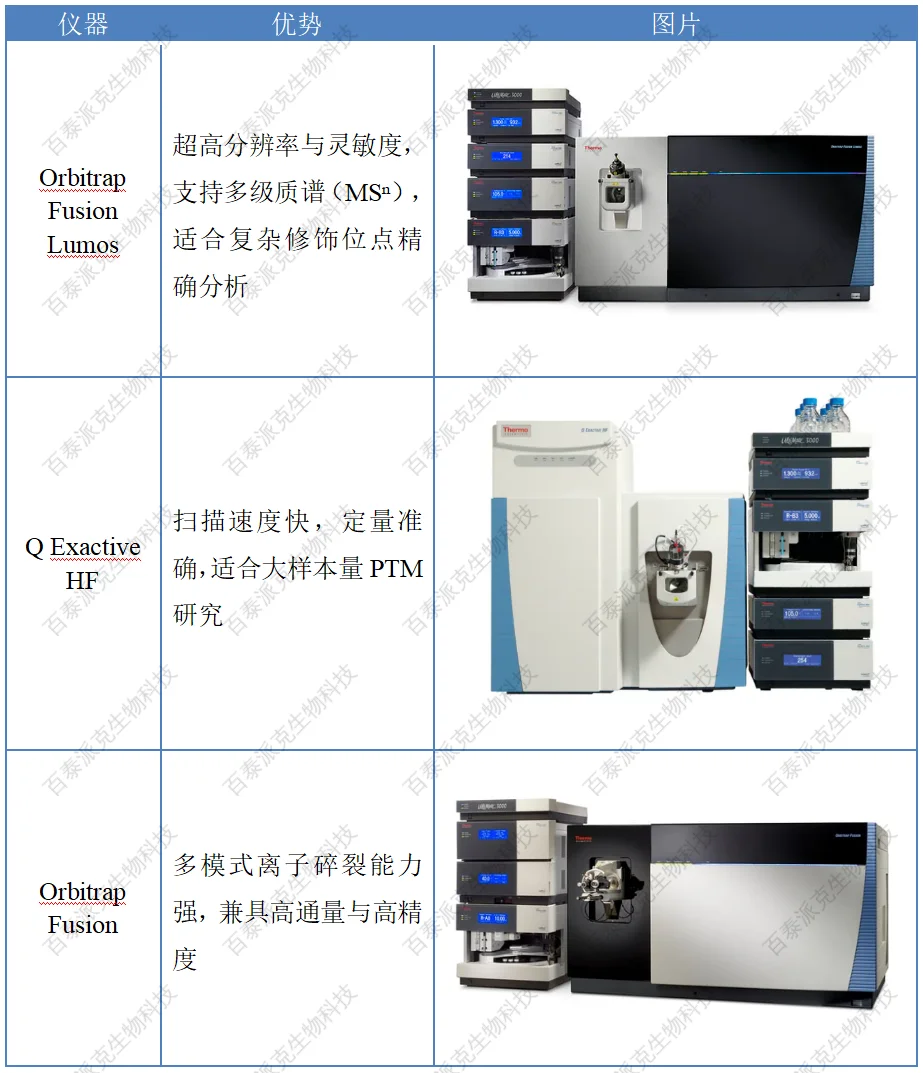
Analysis Process
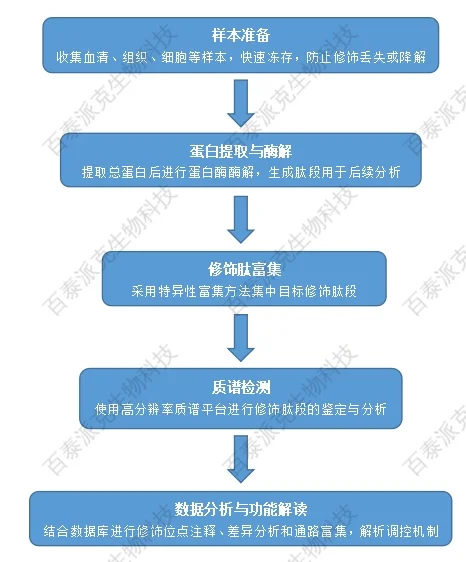
Experimental Roadmap for Post-Translational Modifications
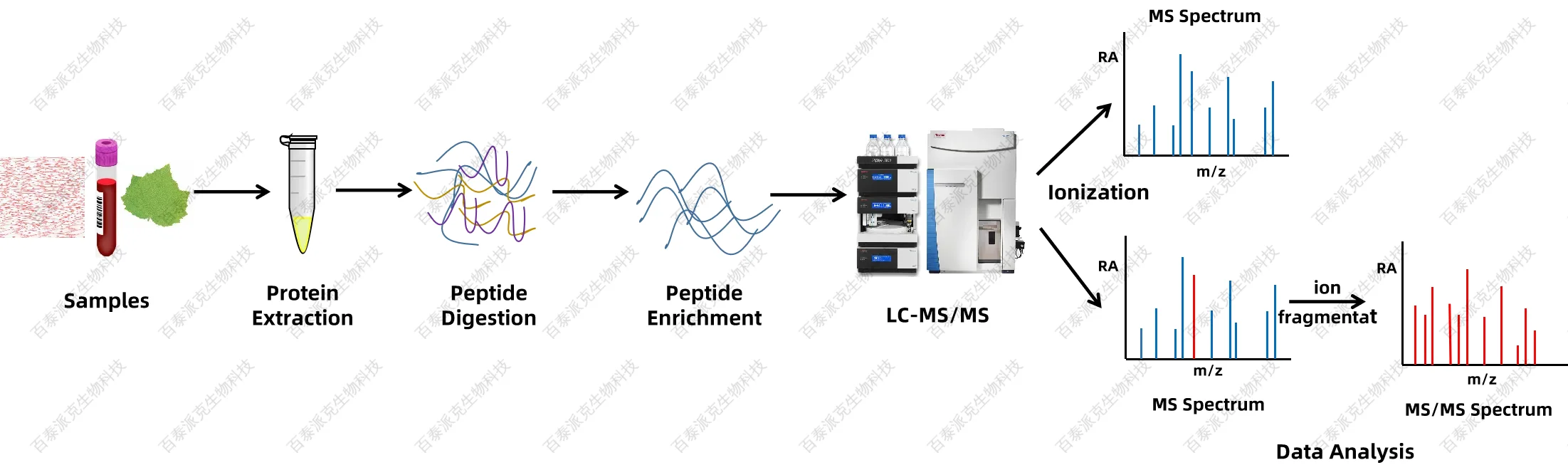
Flowchart of Post-Translational Modification Analysis
Characteristics of Common Types of Post-Translational Modifications
| Modification Types | Modification Sites | Enrichment Methods |
| Phosphorylation | Ser、Thr、Tyr | TiO₂ Enrichment, IMAC Enrichment |
| Acetylation | Lys | Anti-acetyl lysine antibody |
| Methylation | Lys、Arg | Anti-methylation antibody enrichment |
| Ubiquitination | Lys | K-E-GG antibody enrichment |
| SUMOylation | Lys | Anti-SUMO antibody enrichment |
| Glycosylation | Asn(N-type), Ser/Thr(O-type) | Lectin、HILIC |
| Lactylation | Lys | Anti-lactyl lysine antibody enrichment |
Sample Submission Requirements
| Modification Type / Sample Type | Serum/Plasma | Animal Tissue | Plant Tissue | Microorganism | Protein Extracts | Cells |
| Phosphorylation | 50 μL | 100 mg | 2 g | 500 μL | 2 mg | 2×10⁷ |
| Glycosylation | ||||||
| Acetylation | 100 μL | 200 mg | 10 g | 500 μL | 5 mg | 2×10⁸ |
| Ubiquitination | ||||||
| SUMOylation | ||||||
| Lactylation | ||||||
| Methylation |
Service Advantages
-
Equipped with high-resolution mass spectrometry platform to ensure modification detection sensitivity
-
Multiple enrichment strategies to enhance specificity and coverage
-
Supports various sample types to meet different experimental needs
-
Experienced team ensures data accuracy and reliability
-
Provides one-stop analysis services to accelerate research progress
-
Standardized processes ensure stable and highly reproducible results
-
Supports customized solutions to meet diverse research goals
Application Fields
-
Biomedical Research — Tumor Biomarker Screening, Disease Mechanism Analysis
-
Drug Development — Drug Mechanism Validation, Target Modification State Analysis
-
Cell Biology — Cell Cycle Regulation, Transcriptional Regulation Mechanism Analysis
-
Epigenetics — Histone Modification Profiling, Gene Expression Regulation Research
-
Neuroscience Research — Neurotransmitter Regulation, Neurodegenerative Disease Mechanism Exploration
Data Analysis
-
PCA、PLS-DA/OPLS-DA、Volcano Plot、Heatmap
-
GO Enrichment Analysis
-
KEGG Pathway Analysis
-
Cytoscape Network Analysis
-
STRING Protein Interaction Analysis
-
Pathway Enrichment Diagram
-
Enrichment Map
Biotech Pack Biotech — Characterization of Biological Products, High-quality Multi-omics Mass Spectrometry Detection Service Provider
Related Services:
How to order?




