






Electronic Ionization
Electron ionization (EI), also known as electron impact ionization or electron bombardment ionization, is one of the most effective mass spectrometry methods for identifying a given organic compound. It is an ionization method where high-energy electrons interact with atoms or molecules in the solid or gas phase to produce ions. Since this technique uses high-energy electrons to generate ions, it is considered a hard ionization method (high fragmentation). This results in extensive fragmentation, which aids in the structural determination of unknown compounds. EI can be used for the analysis of organic compounds with molecular weights less than 600. Moreover, when combined with various separation methods, the use of electron ionization technology can also detect other thermally stable and volatile compounds in solid, liquid, and gaseous states.
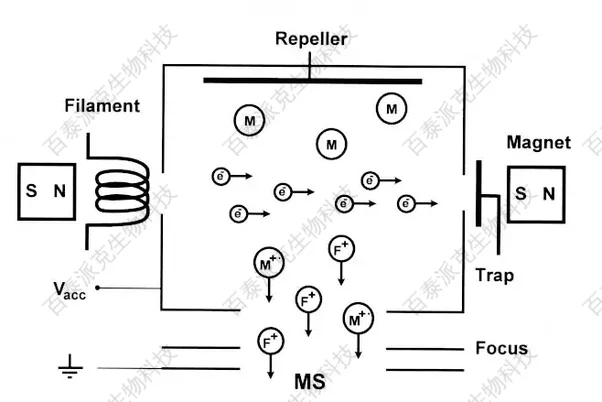
Electron Ionization 1
Principle of Electron Ionization (EI)
Typically, the ion source converts the sample into ions, accelerates the ions, and focuses them into an ion beam, which passes through a slit into the mass analyzer. By observing the different behaviors of ions in an electric or magnetic field, ions are separated by mass-to-charge ratio to obtain a mass spectrum. The qualitative and quantitative results of the sample are obtained by analyzing the mass spectrum.
The EI source generally consists of a cathode (filament), an ionization chamber, an electron receptor, and a set of electrostatic lenses. Under high vacuum conditions, a current is applied to the filament to emit electrons, which are accelerated from the filament to the electron receptor. During this process, sample molecules collide with electrons in the ionization chamber, leading to the ionization or fragmentation of sample molecules into fragments. To stabilize the ion flow produced, the energy of the electron beam is usually set to 70 eV, resulting in stable standard mass spectra.
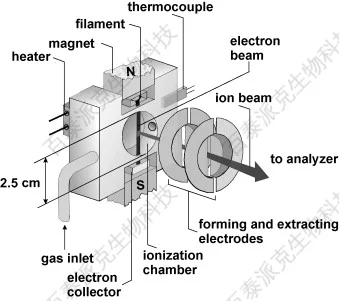
Electron Ionization 2
The gas or vapor being analyzed enters the ion source of the instrument and is converted into ions. Electrons are emitted from a directly-heated cathode (made of multi-purpose wire). A DC voltage (70 V) is applied between the ionization chamber (anode) and the cathode (cathode) to accelerate electrons into the ionization chamber. When these electrons bombard atoms or molecules (M) in the gas (or vapor) in the ionization chamber, the atoms or molecules (M) lose electrons to become positive ions or molecular ions (M+). The molecular ions continue to be bombarded by electrons, causing some chemical bonds to break, or leading to rearrangement, fragmenting into multiple fragment ions or positive ions at an instantaneous rate.
The classic EI method has many advantages:
1. EI is non-selective ionization, and as long as the sample can be vaporized, it can be ionized.
2. EI has high ionization efficiency and sensitivity.
3. EI spectra provide rich structural information, serving as the 'fingerprint' of compounds.
However, EI also has some drawbacks:
1. EI sources are not suitable for volatile, thermally unstable samples.
2. Some compounds are easily fragmented in EI mode and cannot provide accurate mass spectra.
3. The EI method can only detect positive ions, not negative ions.
Applications of EI
EI is one of the earliest ion sources used in mass spectrometry and is widely used in instrumental analysis. GC-MS associated with EI can be used to analyze small molecules, volatile, thermally stable, and vaporized compounds. GC-EI-MS can be used to analyze biological fluids, organic elements, pesticide residues, etc. For example, GC-EI-MS is used in protein turnover studies, where the measured content of d-phenylalanine is very low, indicating the enrichment of amino acids in tissue proteins during human protein synthesis research. EI can also be used for the elemental analysis of organic substances, and Electron Ionization High-Resolution Mass Spectrometry (EI-HRMS) can be used for elemental analysis (EA) of organic molecules (not just single ions). EI-HRMS determines the type of organic elements by measuring the ratio of elements to total organic matter, such as oxygen/carbon (O/C), hydrogen/carbon (H/C), nitrogen/carbon (N/C), and the ratio of organic matter to organic carbon (OM/OC). Through single injection analysis, GC-EI-MS can be applied to determine pesticide residues in fresh food.
How to order?




