






High-throughput detection strategies for histone acetylation, methylation, and other modifications
In eukaryotes, chromatin is not only the 'storage medium' for DNA but also the 'command center' for regulating gene expression. Histone modifications, especially acetylation, methylation, and phosphorylation, are the core mechanisms for dynamic changes in chromatin structure and gene expression regulation. Different combinations of modifications are termed the 'epigenetic code,' which is crucial for processes such as cell fate determination, cancer development, and stem cell differentiation. However, these modifications often have spatiotemporal specificity and low abundance, posing significant challenges for detection technologies. How to decode histone modification patterns in a high-throughput and specific manner is becoming the focus of epigenetics and proteomics research.
1. Biological significance and challenges of histone modifications
1. Histone tails are rich in amino acid residues such as lysine and arginine that can be modified by enzymes. These residues can be modified by histone acetyltransferases (HATs) and methyltransferases (HMTs), affecting chromatin relaxation and transcription factor accessibility.
(1) Acetylation (Ac): Neutralizes the positive charge of lysine, promoting chromatin relaxation and gene activation
(2) Methylation (Me): Can activate or repress gene expression depending on the site and number of modifications (mono-, di-, tri-methylation)
(3) Cross-regulation: Multiple modifications can synergize or antagonize, forming complex regulatory networks
2. Detection challenges include:
① Complex modification sites, potentially with dozens of coexisting modifications
② Low modification abundance, requiring high sensitivity technologies
③ Distinguishing different methylation states (e.g., H3K27me1 vs H3K27me3)
④ Some modifications are highly unstable, difficult to preserve and detect in situ
2. High-throughput detection technology one: Mass Spectrometry
1. Underlying principles and technical advantages
Mass spectrometry is currently the most resolving and quantifying technology for detecting histone modifications, especially suitable for constructing global modification profiles. By enzymatically digesting histones and using LC-MS/MS for peptide identification, it can precisely locate modification sites and types.
2. Workflow overview
(1) Histone extraction: Core histones purified using high salt or acid extraction methods
(2) Chemical derivatization: Block non-modified sites to enhance detection sensitivity of modified peptides
(3) Protease digestion: Typically using specific enzymes like Glu-C or Arg-C to retain modification information
(4) Mass spectrometry analysis: Data collected using DDA or DIA modes, on platforms like Orbitrap or TOF
(5) Data interpretation: Identify modification sites and abundance using specific databases and algorithms like MaxQuant or pFind
3. Advantages and limitations

3. High-throughput detection technology two: ChIP-seq and CUT&Tag/CUT&RUN
1. Antibody-dependent modification localization strategy
Compared to the global analysis of mass spectrometry, ChIP-seq (Chromatin Immunoprecipitation Sequencing) technology emphasizes 'spatial localization'—determining the genomic distribution of a specific modification. Its basic principle involves using modification-specific antibodies to enrich chromatin fragments containing the target modification, followed by high-throughput sequencing.
(1) ChIP-seq: Classic technology, mature and reliable, suitable for large sample sizes
(2) CUT&Tag / CUT&RUN: No crosslinking required, lower sample demand, reduced background signal, suitable for micro or single-cell analysis
2. Comparative summary
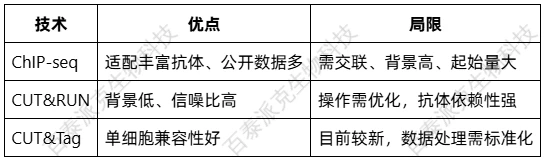
These methods are particularly suitable for studying dynamic changes of activating modifications like H3K27ac and H3K4me3 in promoter and enhancer regions. For example, in tumor epigenomic research, they can identify epigenetic regulatory features of driver genes, providing a basis for drug target development.
4. Multi-omics integration trends and application prospects
1. Integration strategies
A single detection strategy often cannot fully elucidate epigenetic regulatory mechanisms. Current research is gradually advancing towards multi-omics integration of mass spectrometry + sequencing + functional validation:
(1) MS + ChIP-seq: Combining panoramic modification and spatial location information
((2) MS + RNA-seq: Linking modification patterns with transcription output
(3) MS + ATAC-seq: Exploring the interaction between modifications and chromatin openness
2. Application value
This type of comprehensive analysis is especially suited for complex system research such as cancer, immune regulation, and stem cell differentiation. Through data integration and machine learning modeling, 'individualized epigenomic profiling' may be achieved in the future.
High-throughput detection of histone acetylation and methylation modifications is rapidly evolving, with mass spectrometry and sequencing technologies each having their strengths. As a professional platform dedicated to proteomics and epigenomics technology services, Biotech Pioneer provides a one-stop solution from sample processing, mass spectrometry detection to bioinformatics analysis, assisting researchers in efficiently decoding chromatin regulatory mechanisms. We have an experienced epigenomics team equipped with high-end instrument platforms and standardized quality control processes, capable of handling various sample types (cells, tissues, FFPE, etc.) and multi-scale projects. Contact us for customized solutions and technical materials.
Biotech Pioneer—Characterization of biological products, high-quality multi-omics mass spectrometry detection service provider
Related services:
How to order?