






Mass Spectrometry-Based Host Cell Protein Analysis: Principles, Processes, and Advantages
In the field of biopharmaceuticals, recombinant protein drugs (such as monoclonal antibodies and fusion proteins) expressed and purified from mammalian cells (like CHO cells) often introduce an unavoidable impurity—host cell proteins (HCPs). If these HCPs are not thoroughly removed during downstream purification, they may cause immunogenicity, affect drug stability, or even jeopardize patient safety. Therefore, accurate identification and quantification of HCPs is a critical step to ensure the quality and safety of biologics.
I. Why choose mass spectrometry for HCP analysis?
Traditional HCP detection relies heavily on ELISA (enzyme-linked immunosorbent assay), which offers high throughput and low cost but has the following limitations:
1. Limited antibody coverage: ELISA depends on antibody recognition and may miss HCPs not covered by antibodies.
2. Qualitative rather than comprehensive quantitative analysis: ELISA cannot provide specific information on individual HCPs.
3. Lack of species-specific information: Difficulty in identifying host proteins with clear origins.
In contrast, mass spectrometry (MS)-based HCP analysis technology is becoming a more forward-looking and data-rich solution.
II. Principles of Mass Spectrometry-based HCP Analysis
Mass spectrometry is a high-throughput technology that achieves molecular identification and quantification by measuring the mass-to-charge ratio (m/z) of ionized molecules. In HCP analysis, the LC-MS/MS (liquid chromatography-tandem mass spectrometry) platform is commonly used, involving the following key steps:
1. Sample protein digestion
Typically, trypsin is used for digesting proteins in the sample, generating peptides suitable for mass spectrometry analysis. This process is crucial for subsequent HCP identification.
2. Liquid chromatography separation
Digest products are separated using high-performance liquid chromatography (HPLC) to reduce peptide complexity and enhance mass spectrometry detection sensitivity.
3. Tandem mass spectrometry detection
Detection is performed on high-resolution mass spectrometry platforms like Orbitrap and Q-TOF. Fragment spectra are used to deduce peptide sequences, achieving protein identification and quantification.
4. Data analysis and database comparison
Specialized software (such as MaxQuant, Proteome Discoverer) is used to compare the acquired MS/MS data with host species databases, accurately identifying the identity and abundance of each HCP.
III. Standardized HCP Mass Spectrometry Analysis Process
To achieve high reproducibility and comparability, Biotech Park adopts a strictly standardized HCP-MS analysis process covering the following key steps:
1. Sample pretreatment
-
Degradation/Denaturation: Disrupting protein tertiary structures to enhance digestion efficiency;
-
Reduction/Alkylation: Eliminating disulfide bond interference to protect peptide integrity.
2. Protein digestion
-
Optimized digestion conditions ensure both host and drug proteins are digested together, improving overall detection rate.
3. High-resolution mass spectrometry detection
-
Advanced equipment like the Orbitrap Exploris 480 provides ppb-level sensitivity detection;
-
Supports both DDA (Data Dependent Acquisition) and DIA (Data Independent Acquisition) modes to meet different research needs.
4. Data processing and annotation
-
Built-in database comparison identifies host species-specific proteins;
-
Provides dual quantitative data at both protein and peptide levels.
IV. Advantages of Mass Spectrometry-based HCP Analysis
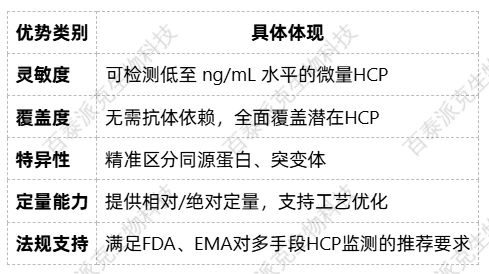
Furthermore, mass spectrometry supports dynamic monitoring at different production stages, such as:
-
Fermentation supernatant HCP profile analysis;
-
Comparison of HCP residues before and after purification;
-
Stability assessment of HCP composition before and after process changes.
V. Application Scenarios: Full Process Support from Research to Clinical
1. Process development stage
Compare the impact of different expression systems, media, or purification processes on the HCP profiles.
2. Quality control stage
As a complementary method to ELISA, identify potential risk HCPs in immuno-blind spots.
3、Registration application stage
Provide FDA review-supporting data reports to enhance approval rates.
VI. Biotech Park: A Reliable Partner for HCP Mass Spectrometry Detection
In the field of HCP detection, Biotech Park offers a comprehensive solution from method development, sample testing to data interpretation, leveraging rich proteomics experience and advanced mass spectrometry platforms. Our advantages include:
1. Ultra-sensitive mass spectrometry platform:Equipped with flagship devices like Orbitrap and TripleTOF;
2. Experienced analysis team:With over 10 years of experience in proteomics research;
3. Customized report output: Compliant with both Chinese and English declaration standards, visually presenting key data;
4. Flexible support for various sample types: Compatible with fermentation liquids, purified samples, and final products.
As regulatory scrutiny on quality and safety in the biopharmaceutical industry becomes increasingly stringent, mass spectrometry-based host cell protein (HCP) analysis is emerging as a critical trend in HCP monitoring. Its comprehensiveness, sensitivity, and high-resolution capabilities provide unprecedented insights at the protein level for biopharmaceutical developers. Biozone Biotech is committed to empowering biopharmaceutical R&D and quality control with cutting-edge proteomics technology. If you have any needs in HCP detection, mass spectrometry analysis, or proteomics research, feel free to contact us for a customized service solution.
Biozone Biotech - A leading service provider for biopharmaceutical characterization and multi-omics mass spectrometry analysis
Related services:
How to order?




