






Application of HCP Detection in the Development of Novel Recombinant Protein Drugs
In recent years, with the continuous advancement of protein engineering and expression system optimization technologies, the types of recombinant protein drugs have become increasingly diverse—from traditional monoclonal antibodies and fusion proteins to emerging bispecific antibodies, multispecific proteins, Fc-fusion proteins, long-acting proteins, enzyme replacement therapies, and more. The field of biopharmaceuticals is witnessing a wave of innovation. However, regardless of how complex the structure or advanced the function, all recombinant protein drug development must address a fundamental and critical challenge—Host Cell Protein (HCP) control. As impurity proteins endogenously released by the expression system during protein production, HCPs not only affect the purity and stability of the formulation but can also trigger immune responses, interfere with pharmacological mechanisms, and even pose safety risks. Therefore, scientifically and systematically conducting HCP detection and risk assessment has become an indispensable part of developing novel protein drugs.
I. Strategic Position of HCP Detection: Shifting from Backend Quality Control to Frontend Research and Development
Traditionally, HCP detection was considered a release testing item in the later stages of production, serving as the 'final checkpoint' for product purity. However, as biopharmaceutical development concepts evolve, particularly driven by ICH Q8/Q11 and FDA/EMA guidelines, HCP analysis is moving upstream to the R&D phase, becoming an important tool for process development, molecular selection, and stability evaluation.
Key application scenarios include:
-
Molecular Design Stage: Identifying domains prone to interacting with HCPs to avoid forming stable complexes;
-
Cell Line Screening Stage: Evaluating differences in HCP profiles across various expression systems (such as CHO vs HEK293);
-
Process Development Stage: Monitoring HCP removal efficiency at each purification step using LC-MS;
-
Stability Study Stage: Tracking residual HCPs that may 'dissociate' during formulation storage;
-
Clinical Submission Stage: Supporting the safety documentation (such as the CMC section in BLA, IND) with data.
II. Why Do Novel Recombinant Protein Drugs Demand More Rigorous HCP Detection?
Compared to classic IgG antibodies, the new generation of protein drugs exhibits significant differences in structural complexity, modification diversity, and expression system selection, posing greater challenges for HCP risk assessment:
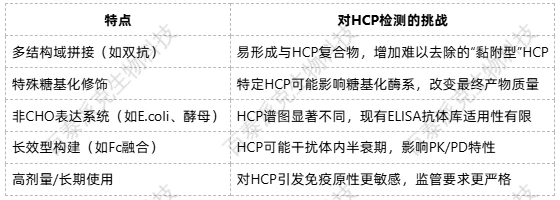
Therefore, relying solely on traditional ELISA methods can no longer fully meet the depth and accuracy requirements of modern biopharmaceutical HCP analysis.
III. Key Technological Pathways Empowering HCP Detection with LC-MS
LC-MS (Liquid Chromatography-Mass Spectrometry) is gradually becoming the mainstream method for HCP analysis, particularly showcasing multi-dimensional advantages in novel recombinant protein drug development:
1. Comprehensive Identification:
Without requiring antibody library support, it can directly identify all visible HCPs from mass spectrometry signals, including unknown proteins.
2. Quantitative Evaluation:
By combining with internal standards or labeling techniques, each HCP can be quantitatively or absolutely quantified to meet regulatory requirements.
3. Strong Process Adaptability:
Capable of real-time monitoring of residual HCP levels across different purification steps and batches, guiding process optimization.
4. Bioinformatics Integration:
Supporting analyses such as GO enrichment, signal peptide prediction, and functional annotation helps evaluate potential risk HCPs.
IV. BioPark Biotech: Empowering the Quality Growth of Every Molecule
In the context of increasingly refined drug development and stringent regulations, a scientifically rigorous HCP analysis strategy has become the 'quality safeguard' and 'submission cornerstone' in recombinant protein drug development.
Leveraging advanced mass spectrometry platforms and an experienced research team, BioPark Biotech provides customers with one-stop HCP detection services from molecular design → process development → stability study → IND/BLA support, covering:
-
Mainstream expression systems such as CHO, HEK293, E. coli, yeast;
-
Various mass spectrometry strategies including DDA, DIA, PRM;
-
Dual analysis reports of quantitative and functional;
-
Support for writing and technical defense of submission materials in both Chinese and English.
In today's increasingly internationalized protein drug research and regulation, HCP detection should not just be a 'passing' threshold but should also be an early-stage decision-making basis and quality assurance tool in research and development. BioPark Biotech is committed to supporting every innovative molecule through each step from the lab to the clinic and to patients with professional mass spectrometry capabilities and a comprehensive technical service system.
BioPark Biotech--A quality service provider for bioproduct characterization and multi-omics mass spectrometry detection
Related Services:
How to order?




