






Tumor Immunopeptidomics Assists in Precise Discovery of Neoantigens
Tumor neoantigens are unique peptide segments expressed only on tumor cells, produced after genetic mutations in cancer cells. They possess high specificity and immunogenicity, making them core targets for individualized cancer immunotherapy. The challenge lies in accurately and efficiently screening for genuine presented neoantigens, crucial for the development of tumor vaccines, TCR-T cell therapies, etc. Neoantigen prediction methods depend on somatic mutations combined with MHC binding prediction algorithms, but this indirect prediction method has significant limitations: high false positive rates and inability to determine whether peptides are truly processed and presented by MHC molecules on the cell surface. Tumor immunopeptidomics, which directly identifies MHC-bound peptides using high-resolution mass spectrometry, is a key technological path to break through the bottleneck of neoantigen discovery.
1. What is tumor immunopeptidomics?
Tumor immunopeptidomics is a mass spectrometry-based method that studies the composition and changes of peptides presented by MHC molecules on the cell surface, enabling:
-
Direct extraction of MHC complexes from tumor tissues or cells
-
Release of bound short peptides (8–15 aa)
-
Identification using high-sensitivity mass spectrometry systems (such as Orbitrap Fusion Lumos, timsTOF SCP)
-
Construction of a true immunopeptidome
This method bypasses the uncertainties of bioinformatics predictions to directly obtain neoantigen candidate peptides presented by MHC in vivo, closer to the real immune environment.
2. Advantages of immunopeptidomics over neoantigen prediction
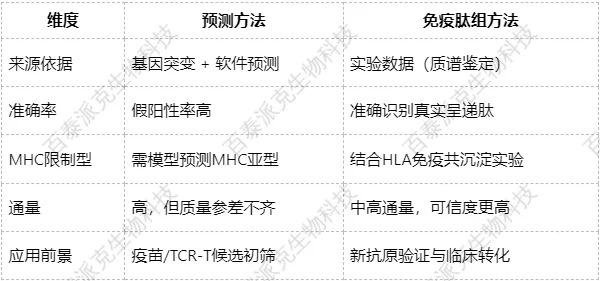
In immunotherapy research and development, especially in personalized tumor vaccines or TCR target development, immunopeptidomics can significantly improve the efficiency and accuracy of neoantigen validation.
3. Immunopeptidomics research process and key technical points
1. Sample preparation: High-quality tumor tissues or cell lines
It is recommended that tissue samples be as fresh as possible or use frozen tissues to avoid repeated freeze-thaw cycles; some studies also use tumor organoids or humanized cell models.
2. MHC immunoprecipitation (IP)
Use monoclonal antibodies targeting specific MHC class I or II (such as W6/32) for immunoprecipitation to enrich MHC complexes.
3. Peptide release and purification
Release MHC-bound peptides through acid wash, purify short peptides using C18 columns or StageTip to remove impurities and large molecular proteins.
4. LC-MS/MS identification
Use high-resolution mass spectrometers, such as Orbitrap Fusion Lumos, Exploris 480, Bruker timsTOF SCP, combined with LC gradients optimized for short peptides to improve detection sensitivity.
5. Data analysis and neoantigen screening
-
Align identified peptides with reference protein databases
-
Combine WES/WGS/SNV data to align mutation sites
-
Accurately locate potential neoantigen peptides
4. Typical application scenarios of immunopeptidomics in tumor immunity
1. Personalized tumor vaccine design
Design personalized vaccines by recognizing true neoantigen peptides from the patient's own tumor tissues, offering greater targeting and immunogenicity.
2. TCR-T target screening
Confirm which mutated peptides are presented by MHC class I molecules for TCR target development, improving T cell efficacy.
3. Antidrug resistance mechanism research
Some resistance mechanisms involve downregulation of MHC expression or abnormal peptide presentation; immunopeptidomics can be used to dynamically monitor changes in antigen presentation.
4. Biomarkers for drug response prediction
Through immunopeptidome analysis, identify presented peptides related to immune therapy response to aid in clinical typing and medication guidance.
5. Challenges and future trends
Although immunopeptidomics provides a revolutionary tool for neoantigen discovery, it still faces the following challenges:
-
Low expression levels of MHC molecules, limited enrichment efficiency
-
Extremely high sensitivity requirements for short peptide mass spectrometry analysis
-
Data analysis standards are not yet unified, and cross-platform comparability needs improvement
In the future, with the development of more sensitive mass spectrometry platforms, AI-assisted peptide recognition algorithms, and integrated immune databases, immunopeptidomics is expected to become a core technology in cancer immuno-precision medicine.
As a high-throughput life sciences platform service provider, Biotech Park Biotechnology has established a comprehensive tumor immunopeptidomics research platform, providing:
-
High-throughput MHC immunoprecipitation and peptide identification
-
High-resolution HLA typing and personalized library construction
-
Data integration + neoantigen screening + customized report services
Assisting researchers and pharmaceutical companies in accelerating the development of individualized cancer immunotherapy. If you have sample testing or project collaboration needs, please contact Biotech Park Biotechnology for one-on-one technical consultation!
Biotech Park Biotechnology--Characterization of biological products, high-quality service provider of multi-omics mass spectrometry detection
Related services:
How to order?




