






Matrix-Assisted Laser Desorption Ionization Time-of-Flight Mass Spectrometer (MALDI-TOF MS)
Mass spectrometry is an analytical technique that ionizes sample molecules into charged particles and measures their mass-to-charge ratio (m/z). In matrix-assisted laser desorption/ionization time-of-flight mass spectrometry (MALDI-TOF MS), the ion source is matrix-assisted laser desorption/ionization (MALDI), and the mass analyzer is a time-of-flight (TOF) analyzer.
Matrix-assisted laser desorption/ionization (MALDI)
MALDI is a soft ionization technique that uses a laser to strike small molecule matrices to vaporize analyte molecules without fragmenting or decomposing them. Some biomolecules are too large and decompose upon heating; traditional techniques would fragment or destroy large molecules. MALDI is suitable for analyzing biomolecules such as peptides, lipids, carbohydrates, or other organic macromolecules.
Principle of matrix-assisted laser desorption/ionization
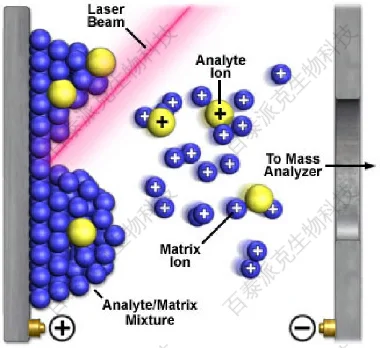
Ionization of analytes by MALDI
The analyte is embedded in a large excess of matrix compound, which is deposited on a solid surface known as a target, typically made of a conductive metal with spots for various samples. After a very short laser pulse, the irradiated spot is rapidly heated and vibrationally excited. Matrix molecules are forcefully ablated from the sample surface, absorb laser energy, and carry the analyte molecules into the gas phase. During the ablation process, analyte molecules are usually ionized by protonation or deprotonation by nearby matrix molecules. The most common form of MALDI ionization results in analyte molecules carrying a single positive charge.
Common types of lasers used in MALDI
Both ultraviolet (UV) and infrared (IR) wavelength lasers are used, but UV lasers are by far the most important light source in MALDI analysis. Specifically, nitrogen lasers and frequency-tripled or quadrupled Nd:YAG lasers are commonly used for most applications. IR-MALDI is primarily dominated by Er:YAG lasers, while TEA-CO2 lasers are rarely used.
Common MALDI matrix substances
The primary function of the matrix is generally considered to be the dilution and separation of analyte molecules, occurring during solvent evaporation and the accompanying formation of solid solutions. Under laser irradiation, it acts as an energy-absorbing medium. Selecting the correct matrix is crucial for MALDI success. Typically, highly polar analytes perform better in highly polar matrices, while non-polar analytes work best with non-polar matrices. As shown in the table below, different matrices have been discovered and widely used. Currently, the most commonly used matrices are α-cyano-4-hydroxycinnamic acid, 2,5-dihydroxybenzoic acid, 3,5-dimethoxy-4-hydroxycinnamic acid, and 2,6-dihydroxyacetophenone.
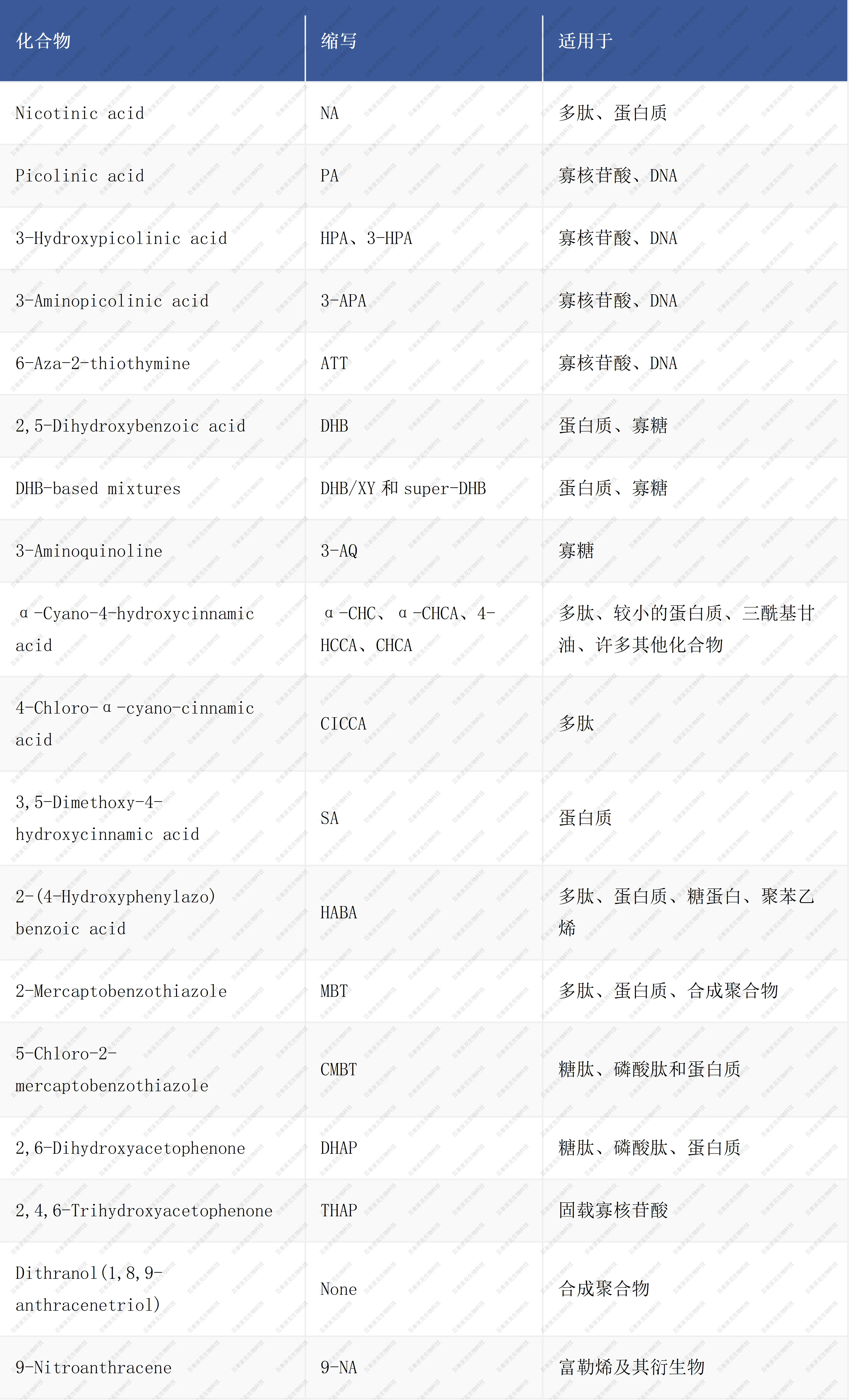
UV-MALDI matrices (Gross J.H., 2006)
Time-of-flight (TOF) analyzer

MALDI-TOF mass spectrometer 2
Principle of time-of-flight
The basic principle of TOF is that ions with different m/z values will disperse in time as they fly along a field-free drift path of known length. Assuming all ions start flying simultaneously or within a sufficiently short time frame, lighter ions will reach the detector earlier than heavier ions.
Linear TOF analyzer and reflectron TOF analyzer
Theoretically, all ions have the same initial kinetic energy, so after drifting through the field-free region, ions with the same m/z arrive at the detector simultaneously. However, not all ions perceive the pulse with the same intensity in practice, so not all ions with the same m/z value can achieve their ideal velocity. To address this issue, a reflectron is usually applied at the end of the drift region. The reflectron consists of a series of ring electrodes with high voltage, which typically deflect ions along the flight tube at a slight angle.
Ions with different kinetic energies penetrate the reflectron to different depths before being reflected in the opposite direction. Faster ions with more kinetic energy travel a longer path than slower ions, so faster ions spend more time in the reflectron compared to slower ions with less energy. In this way, the detector receives ions of the same mass at (approximately) the same time. This design of the TOF mass analyzer greatly enhances its resolution. However, the reflectron TOF analyzer is not suitable for analytes that are unstable under electric fields.
Process of MALDI-TOF mass spectrometry analysis
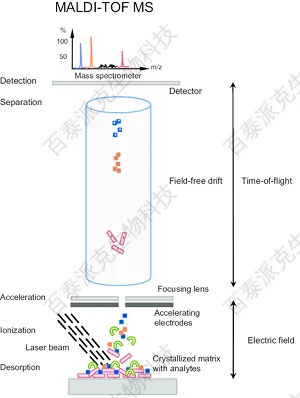
MALDI-TOF mass spectrometer 3
The solubility of the analyte in the solvent should be at least about 0.1 mg/ml. The matrix should be dissolved to a saturated solution or at a concentration of about 10 mg/ml. Then, the analyte solution is mixed with the matrix solution. To optimize the MALDI spectrum, the molar ratio of matrix to analyte is typically adjusted to between 1000:1 and 100,000:1. The mixture is then spotted onto a metal target plate for analysis. After drying, the mixture of sample and matrix co-crystallizes and forms a solid sample deposit embedded in the matrix. The metal plate is then loaded into the MALDI-TOF instrument, and analysis is performed using software corresponding to the system. MALDI causes the sample and matrix to sublimate and ionize. The TOF analyzer separates these generated ions based on m/z, and the MS software generates and analyzes the spectral characterization of these ions, ultimately producing an MS spectrum.
Applications of MALDI-TOF mass spectrometry
Complete mass determination:
Complete mass determination is fundamental and crucial for protein characterization, as the correct molecular weight of a protein can indicate the complete structure. MALDI is a soft ionization technique suitable for proteins that are fragile when ionized by other ionization methods. The performance of MALDI-TOF MS is less affected by buffer composition, detergents, and contaminants. Additionally, it allows for complete protein mass determination with sufficient accuracy (≤500 ppm) for sequence verification. After protein digestion, MALDI-TOF MS can also be used to analyze the obtained peptides and further confirm the primary structure through peptide mass fingerprinting.
Peptide mass fingerprinting (PMF):
MALDI-TOF mass spectrometers are simple to operate and provide high mass accuracy, resolution, and sensitivity. Therefore, they have widespread use in proteomics, identifying proteins from simple mixtures through a method called peptide mass fingerprinting, which is often combined with two-dimensional gel electrophoresis (2-DE). In this method, target proteins are digested with sequence-specific enzymes like trypsin to produce peptides. The peptides are then analyzed by MALDI-TOF mass spectrometry to obtain their masses. The experimentally obtained masses are compared with those in a database containing theoretical peptide masses from a given organism with the same sequence-specific protease.
Post-source decay (PSD) MALDI-TOF analysis:
MALDI-TOF mass spectrometers equipped with reflectors can analyze fragment ions produced by precursor ions that spontaneously decompose in flight. These ions are usually referred to as metastable ions, and the decomposition process in the field-free region between the ion source and the reflector is commonly referred to as PSD. PSD fragment ions form in the field-free region before entering the reflector. By continuously varying the reflector voltage, PSD fragment ions can be separated, collected, and recorded to form a PSD spectrum, providing very rich and effective structural information for the primary structure of peptides and proteins. In proteomics research, certain protein samples separated by 2DE cannot be identified by PMF or yield unclear identification results. The PSD sequencing function can be applied to the identification of these proteins. Using PSD spectroscopy, combined with database searches, proteins can be identified quickly and with high specificity.
Oligonucleotide analysis:
With the development of molecular biology technology and antisense nucleic acid drug technology, more and more oligonucleotide fragments are synthesized for use as primers, probes, and antisense drugs. Rapid detection of these fragments to determine whether the synthesis is complete and whether the synthesized sequence is correct is absolutely necessary. Mass spectrometry, including MALDI-TOF-MS, is by far the best method. Using MALDI-TOF-MS for oligonucleotide analysis is simple, fast, accurate, and sensitive, and it can be used to determine the complete sequence of oligonucleotides.
MALDI imaging:
MALDI-TOF can be used to directly analyze and image proteins from thin tissue sections, known as MALDI imaging mass spectrometry (MALDI-IMS). It provides specific information on the local molecular composition, relative abundance, and spatial distribution of peptides and proteins in the analyzed sections. MALDI-IMS can simultaneously analyze multiple unknown compounds in biological tissue sections in a single measurement, obtaining molecular imaging of tissues while preserving cellular and molecular integrity within the tissue.
MALDI-TOF mass spectrometers can analyze various biomolecules, such as peptides, proteins, carbohydrates, oligonucleotides, etc. Due to the low internal energy of the formed ions, a major advantage of MALDI-TOF is its soft ionization process, which can observe the molecular ions of the analyte without significant fragmentation, even in mixtures. Moreover, it is easy to use and maintain, and data acquisition is fast. Choosing the appropriate matrix substance is crucial for the success of MALDI-TOF mass spectrometry analysis.
Related services
Molecular weight determination
Peptide mass fingerprinting (PMF)
How to order?




