Saccharomyces cerevisiae, commonly known as brewer's yeast, is a model organism widely used in the study of eukaryotic cell physiology and molecular events. Yeast has been used to pioneer research in transcriptomics, proteomics, and interactomics. The study of lipids in yeast, a branch known as 'yeast lipidomics', is particularly notable. Compared to other eukaryotic cells, Saccharomyces cerevisiae has a relatively simple lipidome, containing approximately 150 identified lipid molecules. Yeast possesses a conserved network of lipid metabolic pathways. It mainly contains FAs with 16 or 18 carbon atoms, including saturated (about 20%) or monounsaturated (about 80%) FAs. In contrast to mammalian cells, yeast contains monounsaturated fatty acids with a double bond between C9 and C10, significantly reducing the complexity of the acyl chain combinations in yeast lipids.
Despite the differences in lipid metabolism between yeast and mammals in certain instances, such as ergosterol being the primary sterol in yeast rather than cholesterol (ergosterol is synthesized from a C5 (isoprene) backbone through a series of complex condensation, cyclization, and redox reactions), the yeast model system still offers great opportunities for manipulating and controlling the synthesis, transformation, localization, and degradation of specific lipids. The yeast cell membrane is highly sensitive to various types of stress, such as D-limonene stress, salt stress, hypoxic stress, and nutrient stress. It is speculated that changes in the membrane lipidome play a critical role in stress responses.
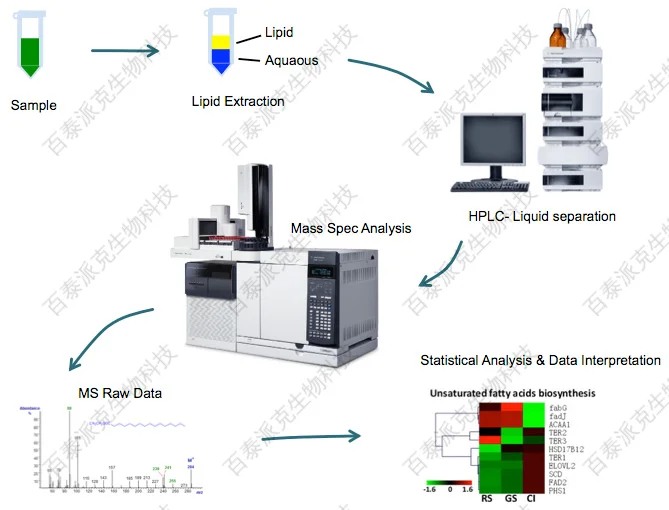
With the development of mass spectrometry technology, the yeast lipidome can be analyzed more accurately and sensitively as a whole. Instruments used for identifying and quantifying yeast lipidomics include MS, GC, HPLC, or LC-MS, GC-MS. The combination of chromatographic methods (such as GC or HPLC) with MS can greatly increase the coverage of lipid analysis. As one of the widely used analytical techniques in yeast lipidomics, LC-MS is employed for the qualitative and quantitative analysis of various lipids in yeast, including PC, PE, PI, PS, PA, and many other lipids.
Yeast Untargeted Lipidomics
Based on a highly stable, repeatable, and highly sensitive system for separation, characterization, identification, and quantitative analysis, Biotage provides reliable, rapid, and cost-effective yeast untargeted lipidomics analysis services in combination with LC-MS.