






Extinction Coefficient Determination Method
The extinction coefficient is a measure of how strongly a chemical substance absorbs light at a particular wavelength. At 280 nm, a protein's molar extinction coefficient is almost entirely dependent on the number of aromatic residues, especially tryptophan, and can be predicted from the amino acid sequence. If the molar extinction coefficient is known, it can be used to determine the concentration of protein in a solution. A common method for measuring the extinction coefficient is spectrophotometry, which is currently the method used by most bioproducts to determine extinction coefficients.
According to the Lambert-Beer law, when a beam of monochromatic light passes through a flow cell, if the mobile phase does not absorb light, the absorbance A is directly proportional to the concentration C of the absorbing component and the path length L of the flow cell. Therefore, by measuring the absolute content of the protein and the extinction value of the test sample at a wavelength of UV 280 nm with a 1 cm path length, the extinction coefficient of the protein can be calculated using the formula ℇ=A/cl.
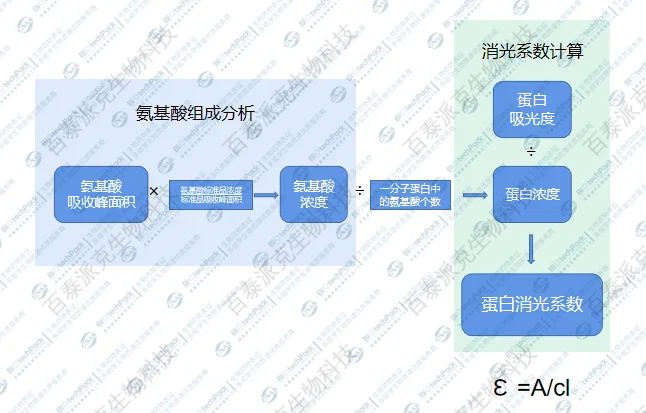
Figure 1
Below are some common methods for determining extinction coefficients:
1. Spectrophotometry:
This method uses a spectrophotometer to measure the absorption of light at different wavelengths through a specific sample. During the experiment, a solution of known concentration is placed in a cuvette, which is placed in the light path of the spectrophotometer. The spectrophotometer measures the difference in light intensity passing through the sample and a reference sample (usually a pure solvent) to determine the sample's absorption at a specific wavelength. Using the Beer-Lambert law, the extinction coefficient can be calculated. This law states that absorbance (A) is directly proportional to concentration (c), path length (l), and the extinction coefficient (ε) of the substance: A = ε * l * c.
2. Transmission Spectroscopy:
Transmission spectroscopy is an analytical technique that determines a substance's extinction coefficient by measuring its transmission or absorption characteristics across a range of different wavelengths. This often involves using a spectrometer, which provides detailed information on how a substance interacts with light of different wavelengths. By analyzing the transmission spectrum, the extinction coefficient at specific wavelengths can be calculated.
3. Reflectance Spectroscopy:
When the sample is solid or poorly transmits light, reflectance spectroscopy can be used to measure the extinction coefficient. This method measures the intensity of light that is reflected back from the surface of the sample after illumination. By analyzing the reflectance spectrum, the extinction coefficient can be indirectly calculated.
4. Infrared Spectroscopy:
For certain types of samples, such as organic compounds with specific functional groups, infrared spectroscopy is a very useful method. This technique relies on the absorption characteristics of a substance in the infrared region, which are related to the molecular structure of the substance. By measuring the infrared spectrum, the extinction coefficient of specific chemical bonds can be determined.
When measuring the extinction coefficient, it is important to ensure the use of appropriate experimental conditions and calibration methods to obtain accurate and reproducible results. Additionally, factors such as sample handling, solvent purity, temperature, and pressure control may also affect measurement results.
BiotechPack, A Biopharmaceutical Characterization and Multi-Omics Mass Spectrometry (MS) Services Provider
Related Services:
Extinction Coefficient Analysis
Analysis of Other Process-Related Impurities
Product-Related Impurity Analysis
Protein Purity Analysis (Size Exclusion/Reverse Phase Chromatography)
How to order?




