






How to detect protein ubiquitination levels by Western blot
Western blot can accurately detect the presence and expression levels of specific proteins in a sample, and it can also be used to detect post-translational modifications of proteins, such as phosphorylation and ubiquitination. The overall workflow of Far-Western Blot is similar to Western Blot, except that Western Blot requires antibodies to detect target proteins, while Far-Western Blot uses purified and labeled 'bait' proteins to probe and detect the target proteins on the membrane. In both Western Blot and Far-Western Blot, proteins are separated using SDS-PAGE and native PAGE gels, then transferred from the gel to a membrane. After transfer, the membrane is blocked with BSA. The proteins on the membrane are denatured and renatured, followed by subsequent detection steps. In Far-Western Blot, the membrane is probed with a commercially available highly purified bait protein. After the bait protein interacts with the target protein, the bands corresponding to the target protein can be detected based on the bait protein used.
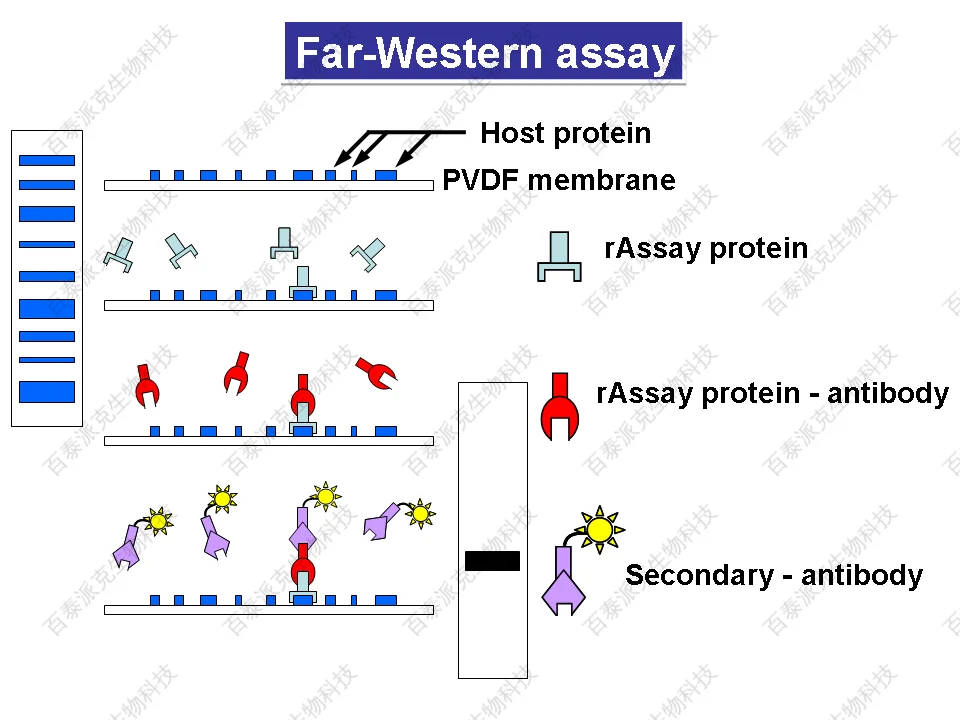 Figure 1. Far-Western Blot Analysis
Western blot detection of protein ubiquitination levels
1. Experimental Materials
- Samples: Cell or tissue extracts
- Western blot kits with ubiquitination-specific antibodies and target protein-specific antibodies
- Running gels and transfer membranes
- Other conventional Western blot-related reagents and equipment
2. Experimental Methods
- Sample Preparation
Extract proteins using a lysis buffer containing ubiquitinase inhibitors to prevent deubiquitination. Then, boil the protein samples in SDS-PAGE sample buffer to break non-covalent protein complexes. - Western Blot Analysis
Separate the protein samples by electrophoresis using SDS-PAGE, then transfer the proteins onto a membrane. After blocking non-specific binding sites, incubate the membrane with ubiquitin antibodies and target protein antibodies. After washing, incubate with the appropriate fluorescent or chemiluminescent secondary antibodies. Finally, develop using a suitable detection system. - Result Analysis
Ubiquitinated proteins appear as higher molecular weight bands compared to the target protein in Western blot. By comparing the ubiquitin signal to the target protein signal, the level of protein ubiquitination can be estimated.
Detecting protein ubiquitination levels requires a thorough understanding of sample treatment and the ubiquitination state of specific proteins. Additionally, these experiments need high-quality antibodies and optimized experimental conditions to obtain reproducible and accurate results.
BiotechPack, A Biopharmaceutical Characterization and Multi-Omics Mass Spectrometry (MS) Services Provider
Related Services:
Mass Spectrometry Analysis of Protein Interactions
Co-immunoprecipitation (CO-IP) combined with mass spectrometry for protein interaction analysis
SILAC combined with Co-immunoprecipitation and Mass Spectrometry for Protein Interaction Analysis
Cross-linking Method for Protein Interaction Analysis
How to order?




