






Exploring CyTOF Mass Cytometry: Revealing Immune Cell Heterogeneity and Functional Regulation
As the field of biopharmaceuticals continues to develop, research on immune cells is becoming increasingly important. Immune cells play a critical role in the body's immune response and disease progression. However, the heterogeneity and complex regulatory mechanisms of immune cells make their study challenging and intricate. In this regard, CyTOF mass cytometry provides us with a powerful tool to reveal the diversity and function of immune cells at high resolution.
1. Principles of CyTOF Mass Cytometry
CyTOF mass cytometry is a method that combines the principles of mass spectrometry and flow cytometry to perform high-resolution analysis of immune cells. The specific principles are as follows:
1. Introduction to Mass Cytometry:
Mass cytometry combines mass spectrometry and flow cytometry, allowing for the simultaneous measurement of multiple cell markers, providing more information for cell analysis.
2. Combination of Atomic Mass Spectrometry and Mass Cytometry:
CyTOF uses time-of-flight mass spectrometry (TOF-MS) from atomic mass spectrometry, linking cell markers with metal isotopes, enabling detection and quantification via mass spectrometry.
3. Working Principle of Time-of-Flight Mass Spectrometer (TOF-MS):
TOF-MS is based on the relationship between the mass-to-charge ratio (m/z) of ions and their flight time, separating and detecting cell markers.
4. Advantages of CyTOF:
Compared to traditional flow cytometry, CyTOF offers higher resolution and more parameters for analysis, capable of simultaneously measuring dozens of markers, reducing overlap and interference, and improving data quality and resolution.
2. Applications of CyTOF Mass Cytometry
CyTOF mass cytometry has extensive applications in immune cell research, including:
1. Immune Cell Phenotype Analysis:
By labeling multiple cell surface molecules, such as cell surface receptors and cell subpopulation markers, a comprehensive phenotype analysis of immune cells can be performed, identifying different cell types and subpopulations, and studying their expression patterns and distribution.
2. Identification and Functional Study of Cell Subpopulations:
CyTOF can help identify and isolate different subpopulations within immune cells, such as T cell subpopulations and B cell subpopulations, and study their functions and interactions in immune responses and diseases.
3. Studies on Immune Cell Development and Differentiation:
By tracking the development and differentiation process of immune cells, it is possible to understand the changes in marker expression at different stages of cell development, revealing the mechanisms and regulatory networks of immune cell differentiation.
4. Research on Immune-Related Diseases:
CyTOF can analyze changes in immune cells during the occurrence and development of diseases, exploring the relationship between immune regulation abnormalities and diseases, providing new insights and targets for the diagnosis and treatment of immune-related diseases.
3. Importance of CyTOF Mass Cytometry in the Biopharmaceutical Field
CyTOF mass cytometry plays an important role in biopharmaceutical research and development, including:
1. Efficacy Evaluation in New Drug Development:
Through CyTOF technology, the impact of candidate drugs on immune cells can be deeply studied, evaluating the drug's effects, side effects, and safety, providing a basis for the selection and optimization of new drugs.
2. Optimization of Immunotherapy Strategies:
For immunotherapy, understanding the functional state and subpopulation distribution of immune cells is crucial. CyTOF can help optimize immunotherapy plans, including selecting appropriate target cell subpopulations, optimizing treatment plans, and monitoring treatment effects.
3. Immune Toxicity Assessment:
Certain biopharmaceuticals may exert toxic effects on immune cells, leading to abnormal immune responses. CyTOF technology can monitor changes in immune cells, assess the impact of drugs on the immune system, and predict and mitigate potential immune toxicity.
4. Personalized Medicine and Treatment Response Monitoring:
Through detailed analysis of a patient's immune cells, combined with clinical data, personalized medicine and treatment response monitoring can be achieved. CyTOF technology can help determine the immune cell status of patients, predict treatment responses, and provide a basis for the formulation of personalized treatment plans.
As an advanced cell analysis tool, CyTOF mass cytometry can reveal the heterogeneity and functional regulation of immune cells at high resolution, bringing significant advances to immune cell research and the biopharmaceutical field. Through this technology, we can better understand the diversity and function of immune cells, providing strong support for new drug development, immunotherapy, and personalized medicine. With continuous technological advancements, we believe that CyTOF mass cytometry will play an increasingly important role in immune cell research.
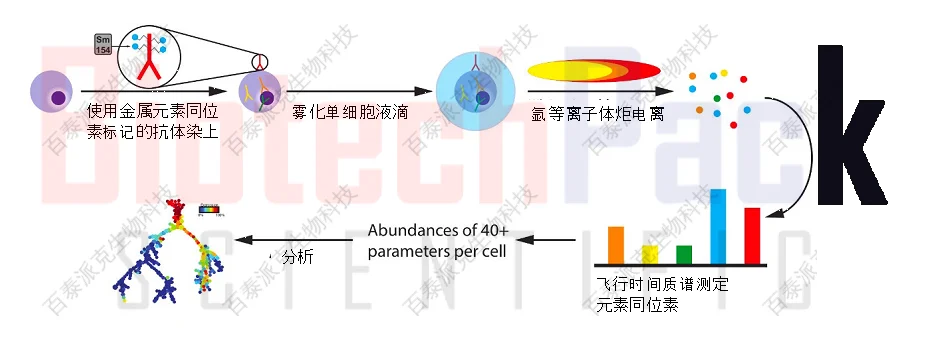
Figure 1
Baite Parker Biotechnology - Characterization of Biologics, Quality Service Provider for Multi-Omics Mass Spectrometry Analysis
Related Services:
How to order?




