






New Strategies and Discoveries in Exploring Protein Disulfide Bonds Using Mass Spectrometry
Chapter 1: The Mysteries of Disulfide Bonds Revealed
"If each person's body is seen as a bustling city, then proteins are the cornerstone of this city." This is a common phrase used to praise proteins. But do you know? In protein molecules, there is a special structure called disulfide bonds. Their existence plays a crucial role in maintaining the stability and function of proteins. This article will unveil the mysteries of disulfide bonds and delve into new strategies and discoveries in exploring protein disulfide bonds using mass spectrometry.
Chapter 2: Unveiling the Mystery of Disulfide Bonds with Mass Spectrometry
Mass spectrometry is a technique used for determining the mass of atoms or molecules, quantitative analysis of substances, and structural analysis. It is now widely used in many fields, including biomedical sciences. Using mass spectrometry, scientists can analyze complex structures of proteins, including disulfide bonds. So, how does mass spectrometry achieve all this?
Chapter 3: New Research Strategies: Deciphering the Charm of Mass Spectrometry
Among the many research strategies of mass spectrometry, "cold spray ionization" and "cysteine labeling technology" are relatively popular new strategies for decoding disulfide bonds in recent years.
"Cold spray ionization" can greatly reduce the fragmentation of protein ions, allowing scientists to study the original structure of proteins, including disulfide bonds.
"Cysteine labeling technology" involves converting disulfide bonds in proteins into cysteine residues using specific chemical reagents. By detecting this modification signal through mass spectrometry, the original position of the disulfide bonds can be determined.
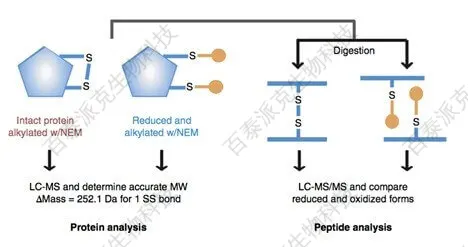
Figure 1
Chapter 4: Latest Discoveries: The Importance of Disulfide Bonds
Research shows that the stability, activity, and enzyme resistance of proteins are closely related to disulfide bonds. Additionally, studies have found that incorrect disulfide bond connections or the absence of disulfide bonds often lead to the development of certain diseases.
Chapter 5: Prospects: The Unlimited Potential of Mass Spectrometry
Although current mass spectrometry has been able to reveal the structure and function of disulfide bonds to a certain extent, there are still many unknowns in the study of disulfide bonds that need to be explored. These include the mechanism of formation, modifications, and their relationship with diseases, all of which require deeper research.
In the future, we look forward to more researchers using mass spectrometry and other tools to explore the deeper mysteries of protein disulfide bonds, uncovering more secrets of life.
Gradually, we begin to understand these seemingly insignificant structures in life, such as disulfide bonds, which are like shining pearls in life, full of mystery and charm. Although we cannot fully understand them now, with the help of scientific methods like mass spectrometry, our understanding of them is becoming deeper, opening a door to exploring the secrets of life.
Baitai Park Biotechnology--BiologicalProductsCharacterization, a high-quality service provider for multi-component biological mass spectrometry detection
Related Services:
Protein Disulfide Bond Identification and Quantitative Analysis
Biopharmaceutical Disulfide Bond/Free Cysteine Detection
Protein Structure Identification
Determination of Protein Primary Structure
How to order?




