






Overview of Post-Translational Modifications
Although proteomics has provided us with a panoramic view of protein expression in cells, information on protein expression levels alone is far from sufficient to explain the dynamic regulatory behavior of living systems. The functional state of a protein is not simply determined by its expression level but is highly dependent on covalent modification events occurring post-translation, known as post-translational modifications (PTMs). These modifications include enzymatic or non-enzymatic addition of chemical groups (such as phosphate, acetyl, methyl, ubiquitin, etc.) to specific amino acid residues, thereby regulating protein conformation, enzyme activity, stability, subcellular localization, and interactions with other biomolecules.
Current research indicates that over 80% of functional proteins exist in some form of post-translational modification in vivo, many of which are dynamic, reversible, and spatio-temporally specific, capable of responding to external stimuli within seconds to minutes. For example, during cell signal transduction, the coordinated action of kinases and phosphatases can amplify signal cascades and provide feedback regulation; while the ubiquitin-proteasome system constructs complex degradation-selective and non-degradation signaling pathways through differences in polyubiquitin chain types. More importantly, multiple modifications often do not occur independently but exhibit 'crosstalk' relationships, constructing highly complex 'PTM codes' on protein surfaces through interaction, competition, and cooperation, significantly impacting cell fate decisions and functional differentiation.
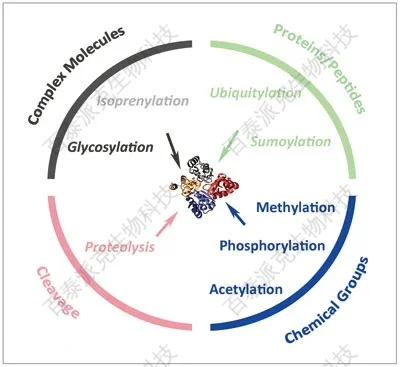
Cell Res 24, 143–160 (2014)
Various reversible and irreversible protein post-translational modification (PTM) mechanisms in eukaryotic cells
From a systems biology perspective, PTMs are considered the key bridge connecting genotypes and phenotypes, representing a fourth layer of regulatory logic beyond expression levels. Their study not only reveals the fine mechanisms of processes such as cellular signaling networks, epigenetic regulation, and stress responses but also provides critical breakthroughs for disease mechanism analysis, drug target screening, and clinical biomarker discovery. In recent years, the continuous discovery of new modifications (such as lactylation, hydroxybutyrylation, glutathionylation, etc.) has further expanded our understanding of metabolic-epigenetic-signaling connectivity, indicating that PTMs are one of the core entry points for understanding the complexity of living systems.
Common types of post-translational modifications
Protein post-translational modifications (PTMs) encompass hundreds of different chemical modification types, some of which are highly conserved in evolution, while others are restricted to specific physiological states or specific species. They primarily occur on the side-chain functional groups of protein chains (especially on residues such as Ser, Thr, Tyr, Lys, Arg, Cys), introducing small molecular groups, polypeptides, or glycan units through enzymatic or non-enzymatic means. Below are several representative types of PTMs in research and clinical settings and their mechanisms of action:
1. Phosphorylation
Phosphorylation is the most extensively studied PTM, catalyzed by protein kinases, transferring phosphate groups from ATP to serine (Ser), threonine (Thr), or tyrosine (Tyr) residues of proteins, generating phosphorylated peptides. This modification is highly dynamic and can be reversibly removed by phosphatases, forming an on/off regulatory system.
This modification dominates most intracellular signal transduction cascades, such as in classical pathways like MAPK, PI3K-Akt, JAK-STAT, where phosphorylation events drive kinase activation, transcription factor nuclear translocation, cell cycle regulation, and other key biological processes. Due to its rapid response and strong amplification effects, phosphorylation is often regarded as the most core form of information transmission modification.
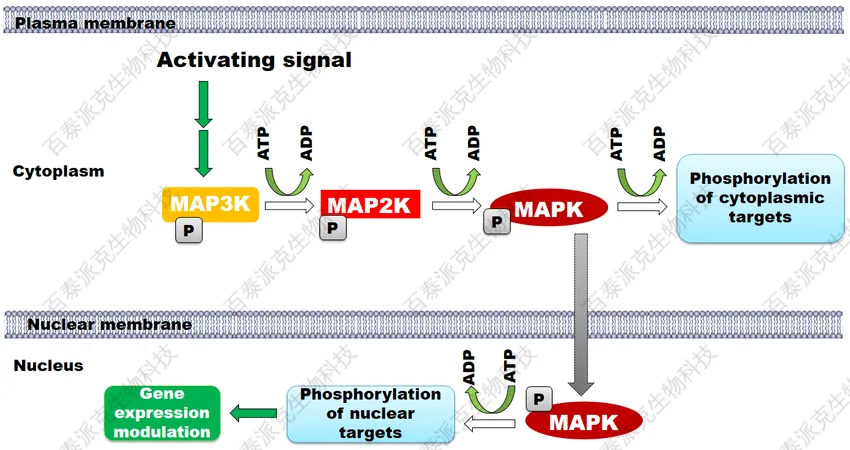
PLoS One. 2016 May 31;11(5)
Illustrative diagram of MAPK cascade and its activation mechanism
In mass spectrometry detection, phosphorylated peptides carry a negative charge and require selective enrichment through IMAC or TiO₂; site localization often relies on neutral loss ions in high-resolution MS/MS data (such as –98 Da) and precise b/y ion matching.
2. Acetylation
Acetylation was first discovered on histones and later confirmed to be widely present in non-histone proteins. Its core function is to regulate the positive charge of lysine residues, thereby altering electrostatic interactions between proteins and DNA, or between proteins. For histones, this modification is directly related to chromatin openness and transcription accessibility, being a fundamental symbol of epigenetic regulation.
In recent years, non-histone acetylation has gradually become a research focus. In metabolic enzymes, signaling molecules, and structural proteins, acetylation participates in multi-level regulation by affecting conformation stability, enzyme activity, and even subcellular localization. For example, multi-site acetylation of p53 not only enhances its DNA binding ability but also regulates its cross-talk with the ubiquitination system, prolonging its half-life and preventing abnormal degradation.
Moreover, the connection between acetylation and energy metabolism is particularly close. The fluctuations in intracellular acetyl-CoA concentration can directly affect acetylation levels, forming a coupled channel from metabolic flux to epigenetic state. Thus, acetylation is no longer just a 'transcription switch' but a 'metabolic-epigenetic information mediator.'
In mass spectrometry detection, acetylated peptides are difficult to identify due to no charge change, requiring enrichment with high-affinity anti-acetyl-Lys antibodies, often using Lys-N or Trypsin digestion to preserve key modification sites. Quantification is recommended using TMT or label-free strategies. Data analysis must pay special attention to qualitative confusion caused by mass drift close to other modifications (such as formylation, succinylation).
3. Methylation
Unlike phosphorylation or acetylation, methylation does not cause charge changes, and its function is more inclined to construct 'stable states.' Histone methylation is the most deeply studied modification type in this category, where different sites and methyl numbers (mono-/di-/tri-methylation) have precise regulatory functions on chromatin structure and gene expression. For example, H3K4me3 is often marked as the promoter activation sign, while H3K27me3 is highly associated with silent regions.
However, the role of methylation goes beyond histones. Non-histone methylation events such as transcription factors, signaling proteins, and RNA-binding proteins are increasingly revealing their regulatory effects in cell development, embryonic differentiation, and stem cell fate determination. A noteworthy issue is that the biological functions of many methylation sites are still unknown, and some methylation may even serve as 'protective closure' markers rather than functional activation, suggesting that our 'functional interpretation' of them is still at a preliminary stage.
In mass spectrometry, the mass change of methylation is small (+14.0157 Da), requiring precise differentiation between mono-/di-/tri-methyl states. Spectrum overlap among modification isomers is severe, usually recommending high-resolution MS and multiple enzyme digestion validation, supplemented by anti-methylation antibody enrichment to improve specificity.
4. Ubiquitination and Ubiquitin-like Modifications
Ubiquitination refers to the covalent attachment of a small molecule protein composed of 76 amino acids—ubiquitin—via isopeptide bonds to lysine residues of target proteins. Ubiquitination is one of the most 'plastic' modification types. It can serve as a direct marker for protein degradation or participate in cellular signal regulation, DNA repair, membrane transport, and even transcription regulation through constructing various chain types (K48, K63, K11, linear chains, etc.).
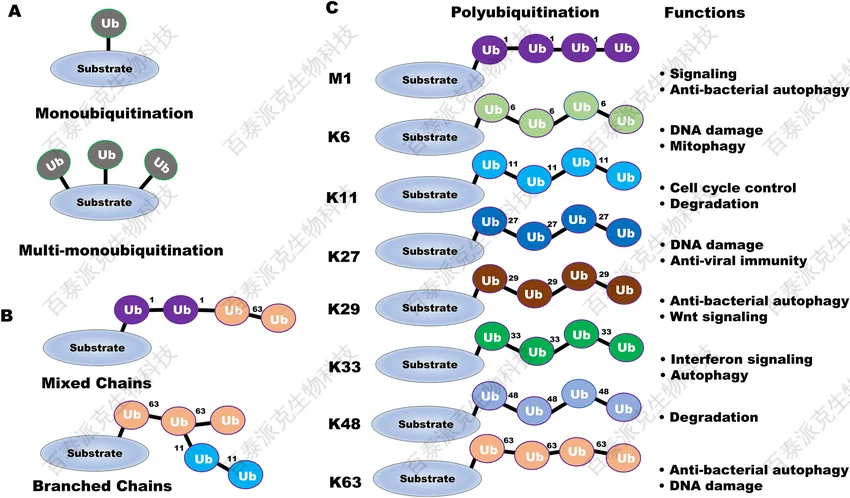
Apoptosis. 2022 Oct; 27(9-10):668-684
Various types of ubiquitin linkage and associated functions
In addition to ubiquitin, cells also contain a class of structurally similar but functionally distinct 'Ubiquitin-like proteins' (Ubls), including:
-
SUMO (Small Ubiquitin-like Modifier): involved in transcription factor regulation, DNA repair, and nuclear-cytoplasmic transport;
-
NEDD8: regulates the activity of the ubiquitin E3 ligase complex (CRL) by modifying Cullin proteins;
-
ISG15: upregulated in antiviral response, affects interferon signal amplification.
Unlike most small molecule modifications, ubiquitin is a complete protein, leaving a typical dipeptide residue (Gly-Gly) on the lysine side chain after sample digestion, resulting in a mass shift of +114.0429 Da. The key to identifying these residues includes:
-
Using K-ε-GG antibodies for enriching specific peptide segments;
-
Combining high-resolution mass spectrometry (MS/MS) to obtain precise b/y ion positioning;
-
Supplementing with multi-enzyme joint digestion (such as Trypsin + Lys-C) to improve modification coverage.
5. Glycosylation
Glycosylation is the only type of post-translational modification based on 'structural diversity' for its function. Unlike 'functional single-point modifications' such as phosphorylation and acetylation, glycosylation's function often relies on changes in its glycan structure, length, branching, and location.
N-glycosylation (Asn) and O-glycosylation (Ser/Thr) are widely present in cell surface proteins, secretory proteins, and receptor proteins, regulating their folding efficiency, membrane localization, and immune evasion capability, etc. For example, N-glycosylation of PD-L1 enhances its stability and membrane expression, being part of tumor immune suppression mechanisms. Changes in glycans are also important markers in the process of tumor transformation, such as elevated expression of Tn antigen (O-GalNAc) in various cancer cells.
The biggest challenge of glycosylation lies in its heterogeneity: the same glycosylation site may have dozens of different glycoforms, which brings enormous pressure on detection and quantification. HILIC, PGC chromatography methods combined with MSn technology are the current mainstream strategies, but complex glycoform analysis still requires multi-platform data integration.
Additionally, glycosylation research heavily relies on bioinformatics annotation, such as glycan structure databases integrated in GlycoWorkbench and Byonic, which are indispensable in non-targeted detection.
6. Novel Modifications
With the development of high-resolution mass spectrometry (HR-MS) and targeted enrichment technologies, many previously difficult-to-capture novel post-translational modifications are gradually coming into view. These modifications are typically directly related to metabolites and feature rapid time scales, wide regulatory ranges, and high sensitivity to environmental changes, becoming crucial hubs connecting cellular metabolic states and epigenetic programs. Below are several representative novel modifications that are current research hotspots:
(1) Lactylation
Lactylation (Kla) is the most representative metabolic modification, first discovered by Zhang et al. in 2019 on histone H3, involving the acyl transfer mechanism from endogenous L-lactate donors to lysine side chains. This modification is significantly upregulated under conditions like hypoxia, enhanced glycolysis (Warburg effect), and immune responses, and has been confirmed to regulate processes such as macrophage polarization (M1→M2), stem cell fate, and oncogene expression.
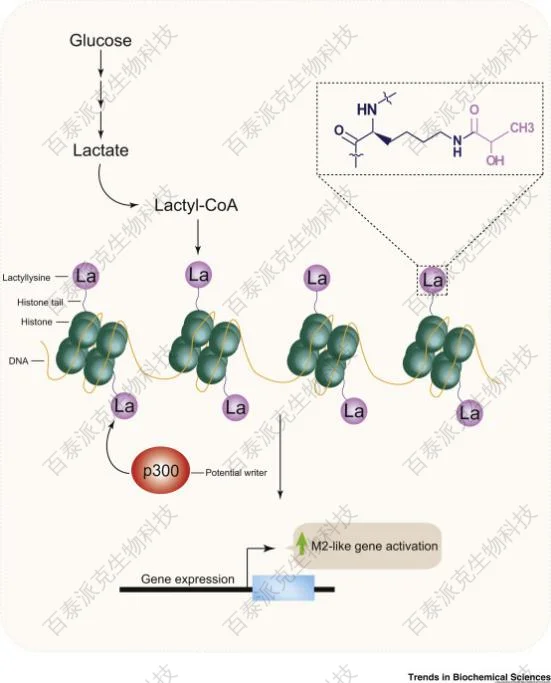
Trends Biochem Sci. 2020 Mar;45(3):179-182.
Histone lactylation mediates gene expression promoting M2-like phenotype
Its mechanism suggests lactate is not just a metabolic byproduct but also a signal molecule directly participating in regulating chromatin activity. Studies have found non-histone targets (such as enzymes and transcription factors) also undergo lactylation, indicating its broad function in transcription regulation and protein interaction networks.
Detection challenges: The mass shift of lactylated peptides (+72.0211 Da) is easily confused with other modifications, and target abundance is extremely low, requiring specific antibody enrichment and nano-scale LC-MS/MS detection.
(2) β-Hydroxybutyrylation
β-hydroxybutyrate (BHB) is the main ketone body generated under conditions of starvation, fasting, or ketogenic diets. It can accumulate at high concentrations in the body and be introduced into lysine side chains as a substrate for β-hydroxybutyrylation modification. This modification is widely present in liver, muscle, and brain tissue and is considered a key marker for epigenetic transcriptional regulation under energy deficiency.
Studies have found Kbhb can compete with acetylation sites, thereby inhibiting the expression of inflammatory genes (such as NF-κB target genes) and enhancing oxidative stress tolerance, making it an important focus in fields such as longevity and metabolic health.
Technical challenges: Kbhb modifications have many isomers, requiring precise identification through high-resolution MS and tandem mass spectrometry fragment information; combining SILAC labeling or PRM/targeted MS aids in modification quantification.
(3) S-glutathionylation
Glutathione (GSH) is the most prominent antioxidant molecule in cells, forming mixed disulfide bonds (S-SG) with protein thiols under oxidative stress, known as S-glutathionylation. This modification is important for protecting key enzymes from irreversible oxidation, regulating enzyme activity, and transmitting ROS signals.
S-glutathionylation usually occurs on Cys residues and is reversible, removable by glutathione reductase (GR) or thioredoxin (Trx) systems.
Mass spectrometry identification key points: The modification mass shift is +305.0682 Da. Due to high reactivity of thiol groups, sample preparation requires rapid low-temperature processing to avoid false positives. Derivatization capture strategies (e.g., Biotin-GSH) have gradually been used to enrich low-abundance modified peptides.
(4) Acetylglutarylation, Propionylation, Butyrylation, etc.: Mitochondrial metabolism-derived modifications
These modification forms derived from fatty acid intermediates occur widely on mitochondrial inner membrane proteins and metabolic enzymes. They reflect the level of cellular lipid metabolic activity and regulate transcription factor activity, chromatin state, and cell fate by competing with lysine acetylation. For example, butyrylation has been reported to regulate p53-dependent apoptosis processes.
These modifications have recognition challenges such as overlapping sites and mass shift overlaps, requiring combined specific enrichment strategies and targeted fragment analysis methods for joint identification.
Biotech Pack Biological Technology — A high-quality service provider for bioproduct characterization and multi-omics mass spectrometry analysis.
Related services:
How to order?




