






From Principle to Application: A Comprehensive Analysis of PRM Technology
In proteomics research, achieving precise, stable, and reproducible quantification of specific proteins or peptides has been a focal point for scientists. Parallel Reaction Monitoring (PRM) technology, a targeted mass spectrometry technique with high specificity, sensitivity, and throughput, is gradually replacing the SRM/MRM method and is widely used in biomarker validation, clinical research, drug development, and other cutting-edge fields. This article will discuss the principles of PRM, systematically analyze its technical advantages, and explore its practical applications in research and clinical settings, while introducing how Biotech Park Biosciences leverages the PRM platform to advance precise protein quantification research.
1. What is PRM technology?
PRM is a targeted quantification technology based on high-resolution mass spectrometers, such as Orbitrap. It is an upgraded version of Selected Reaction Monitoring (SRM)/MRM but employs a completely different detection strategy:
1. Workflow:
(1) In the liquid chromatography-mass spectrometry system, select the target peptide (Precursor Ion).
(2) Use the quadrupole to select precursor ions to enter.
(3) Enter the HCD collision cell to generate fragments.
(4) Use the Orbitrap analyzer to perform high-resolution full scan (Full MS/MS) of all fragment ions.
2. Core Advantages:
(1) No need to preset fragment channels (transitions), resulting in more comprehensive data.
(2) High resolution and high accuracy effectively reduce background interference.
(3) Ability to re-extract other fragment information later, providing data re-mining capabilities.
(4) Supports target detection in more complex sample backgrounds.
2. Comparison of PRM Technology with SRM/MRM
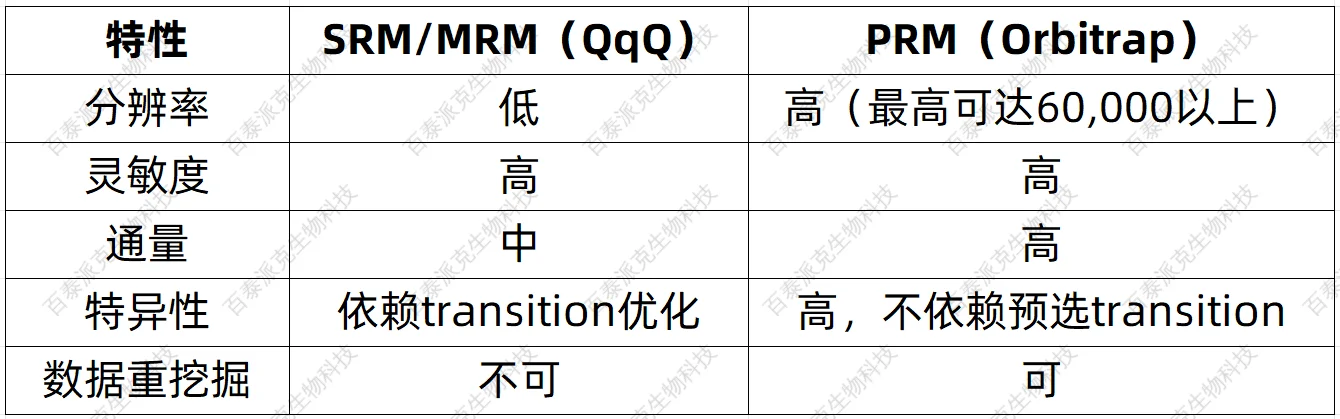
PRM is suitable for precise validation and quantitative analysis of small-scale samples after candidate targets are screened in the early discovery phase (such as DDA or DIA).
3. Core Application Scenarios of PRM Technology
1. Biomarker Validation
After discovering potential differential proteins in untargeted proteomics, PRM can be used for accurate and reliable quantitative validation of these candidate proteins, an indispensable step in translational research. For example:
(1) Quantitative validation of early screening biomarkers for tumors
(2) Protein evaluation for autoimmune disease typing
(3) Validation of drug response-related proteins
2. Quantitative Analysis of Clinical Sample Proteins
PRM technology is applicable for detecting low-abundance proteins and is less affected by matrix effects, especially suitable for:
(1) Analysis of complex fluids such as plasma/serum/cerebrospinal fluid
(2) High confidence quantitative analysis of small-volume clinical samples
(3) Parallel quantification of multiple targets (can simultaneously quantify 10-50 proteins)
3. Functional Validation of Signal Pathways or Protein Networks
By combining protein interaction networks, select multiple key proteins in specific pathways for targeted quantitative tracking to study:
(1) Mechanisms of pathway activation/inhibition
(2) Verification of upstream and downstream regulatory relationships
(3) Effects of interventions on protein expression
4. Protein Validation in Multi-Omics Integration
After discovering potential targets in transcriptomics or metabolomics, use PRM for cross-omics data validation to improve research reliability.
4. Key Points in PRM Experiment Design
1. Peptide Selection: Choose unique, stable, and ionizable specific peptides
2. Internal Standard Selection: Recommend using stable isotope-labeled peptides (SIS) to improve quantification accuracy
3. Mass Spectrometry Parameter Optimization: Set optimal collision energy, ion injection time, and scan range
4. Data Analysis: Common software includes Skyline, SpectroDive, Xcalibur, etc.
Biotech Park provides full-process PRM technical services from target design, method development to data analysis, supporting various sample types and complex backgrounds.
Biotech Park BiosciencesUsing Thermo Orbitrap Fusion Lumos/Exploris 480, achieves high-throughput, high-resolution PRM detection, can quantify 20-100 target proteins, with CV values stably <15%. Provides one-stop services from stable isotope internal standard synthesis, method validation, to data analysis. Short project cycles, suitable for research and clinical validation needs. Offers raw data, visualization reports, and chart support for project publications/patent applications. PRM, with its high specificity, high throughput, and high reproducibility characteristics, is gradually becoming a leading technology in proteomics validation. Whether in basic research, translational medicine, or new drug development, PRM technology demonstrates strong application potential. Biotech Park Biosciences will continue to optimize PRM platform performance to provide more reliable and efficient targeted protein quantification solutions for researchers.
Biotech Park Biosciences - Characterization of biological products, high-quality service provider for multi-omics biological mass spectrometry detection
Related Services:
How to order?




