






What are the differences between PRM and SRM? Understanding the two major quantitative mass spectrometry techniques in one article
In life sciences research such as proteomics and targeted metabolomics, precise quantification of low-abundance molecules is crucial. In mass spectrometry (MS) technology, Selected Reaction Monitoring (SRM) and Parallel Reaction Monitoring (PRM) are two mainstream targeted quantification strategies, widely used in biomarker validation, drug metabolism studies, and clinical translational research. So, what are the differences between PRM and SRM? This article will systematically compare these two technologies in terms of principles, instrument dependency, data characteristics, application scenarios, and more, helping researchers make the best choice based on experimental needs.
1. Core Differences between PRM and SRM
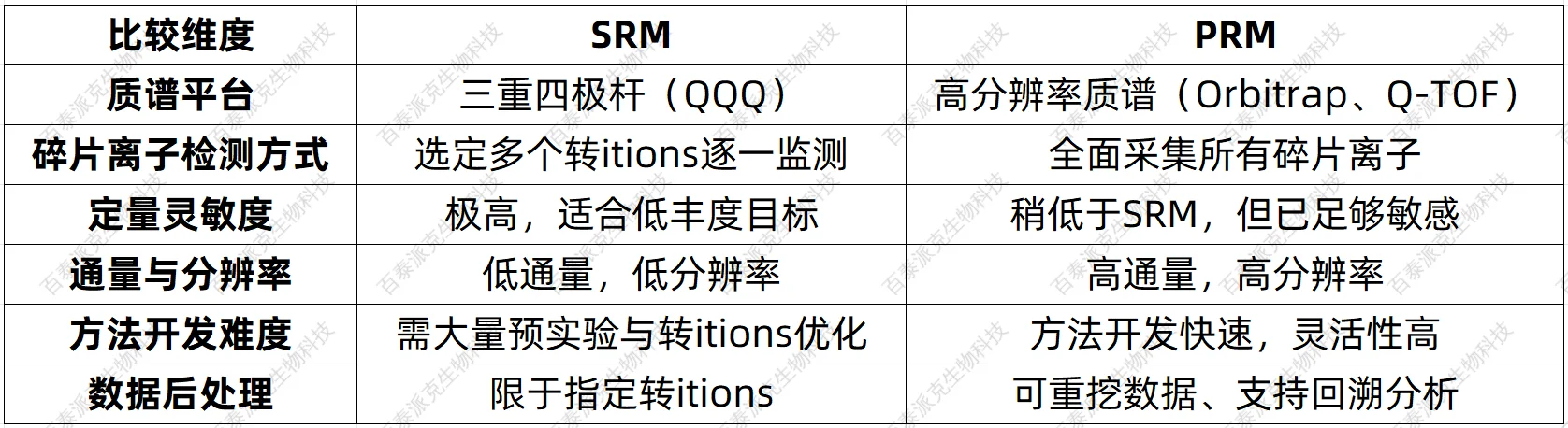
1. Different Mass Spectrometry Platforms
(1)SRM Uses triple quadrupole mass spectrometry, where Q1 selects precursor ions, Q2 performs collision-induced dissociation, and Q3 detects specific product ions.
(2)PRM Uses high-resolution mass spectrometry (e.g., Orbitrap), which, after selecting precursor ions, performs HCD fragmentation and scans all product ions comprehensively.
2. Data Acquisition Methods
(1)SRM Relies on predefined ion pairs (transitions) to detect specific precursor-product ion combinations.
(2)PRM Collects all product ions simultaneously without manual transition selection, providing more comprehensive information.
3. Method Development and Throughput
(1)SRM Method development is complex, requiring optimization of multiple ion pairs for each peptide segment, suitable for known targets but with low throughput.
(2)PRM Method development is simple, collection is more flexible, supporting parallel quantification of multiple targets.
4. Resolution and Specificity
(1)SRM Resolution is relatively low, easily affected by co-eluting substances.
(2)PRM Leveraging Orbitrap's high-resolution capability, can effectively distinguish interference peaks, improving quantification accuracy.
5. Quantification Accuracy and Reproducibility
(1)PRM Shows higher data consistency and stability in multi-center studies and clinical validation.
(2)SRM More suitable for high-throughput, large-scale, repetitive sample quantification in industrial settings.
SRM: Classical Quantification Technology on Triple Quadrupole Platform
SRM is a targeted quantification method based on triple quadrupole mass spectrometry (QQQ). Its workflow includes:
1. Precursor Ion Selection (Q1): The first quadrupole selects the precursor ion of the target peptide segment.
2. Collision-Induced Dissociation (CID): In the collision cell (Q2), precursor ions are fragmented to generate fragment ions.
3. Fragment Ion Selection (Q3): The third quadrupole detects only specific product ions.
Each precursor-fragment combination is called a 'transition', and researchers must optimize the parameters for each transition in advance. Because only one transition can be monitored at a time, SRM has relatively low throughput, but its quantification sensitivity is high and background interference is low, making it one of the 'gold standards' for protein quantification recognized by the FDA.
PRM: High-Resolution Innovation on Orbitrap Platform
PRM is a new generation of targeted quantification method developed based on high-resolution mass spectrometry (such as Orbitrap or Q-TOF). Its workflow is as follows:
1. Precursor Ion Selection: The quadrupole (Q1) selects the target precursor ion to enter the fragmentation chamber.
2. Fragment Ion Detection: All fragment ions are simultaneously sent to the high-resolution analyzer (such as Orbitrap) for comprehensive detection.
Unlike SRM, PRM does not require predefined transitions. A complete fragment ion spectrum can be obtained in one scan cycle, greatly increasing data throughput and post-processing flexibility.
PRM vs SRM: Full Analysis of Core Differences
Which Technology to Choose? Application Scenarios Decide Everything
1. Scenarios Suitable for SRM:
(1) Precise quantification of extremely low-abundance proteins or metabolites in clinical samples
(2) Regulatory experiments requiring FDA or GLP-compliant platforms
(3) Complex sample backgrounds requiring high specificity and low background interference
2. Scenarios Suitable for PRM:
(1) Parallel analysis of multiple targets, such as validating multiple biomarkers
(2) Exploratory experiments requiring data retention for subsequent in-depth mining
(3) Methodological research for rapid development and validation of new targets
Biotech BioTek combines Thermo Orbitrap series mass spectrometry platforms with independently optimized targeted analysis workflows, providing comprehensive quantification services covering PRM and SRM. We support:
-
Quantitative detection of samples from multiple tissue sources (serum, tissue, cells, etc.)
-
Customized target screening and method development
-
Data visualization and bioinformatics interpretation
Whether you need GLP-level standardized quantification or wish to quickly conduct exploratory targeted experiments, we can provide customized services to help you efficiently advance your project progress. Although SRM and PRM have different technical paths, they are both powerful tools for precise quantification. The former is more suitable for standardized, low-throughput scenarios, while the latter has unique advantages in flexibility and data re-mining. Researchers should comprehensively consider research goals, sample types, and budget to choose the most suitable strategy. Biotech BioTek understands that every quantification experiment carries the rigor and innovation of research behind it. Welcome to contact us, let us assist your scientific breakthroughs with professional technology.
Biotech BioTek - Quality Service Provider for Bioproduct Characterization and Multi-omics Mass Spectrometry Detection
Related Services:
How to order?




