






Quantitative Analysis Strategy of Protein Lactylation in Immune Cells by DIA-MS
In complex microenvironments such as inflammation, infection, and tumors,the metabolic state changes of immune cellsare often accompanied by a series of transcriptional and functional reprogramming. Recent studies have shown that lactate, a key metabolite of glycolysis,not only regulates the acidic extracellular environment but also affects protein function and gene expression through lactylation modification.Especially in immune cells such as macrophages, dendritic cells, and T cells, protein lactylation is considered an important metabolic-epigenetic coupling signal. The DIA-MS quantitative analysis of protein lactylation in immune cells reveals its dynamic change mechanisms. This article will detail how to apply the DIA-MS strategy in immune cells to achievehigh-throughput, precise, and reproducible quantitative analysis of lactylation-modified proteins.。
1. Why choose DIA-MS quantitative analysis for protein lactylation?
Compared to DDA (Data Dependent Acquisition), DIA (Data Independent Acquisition) has the following advantages:
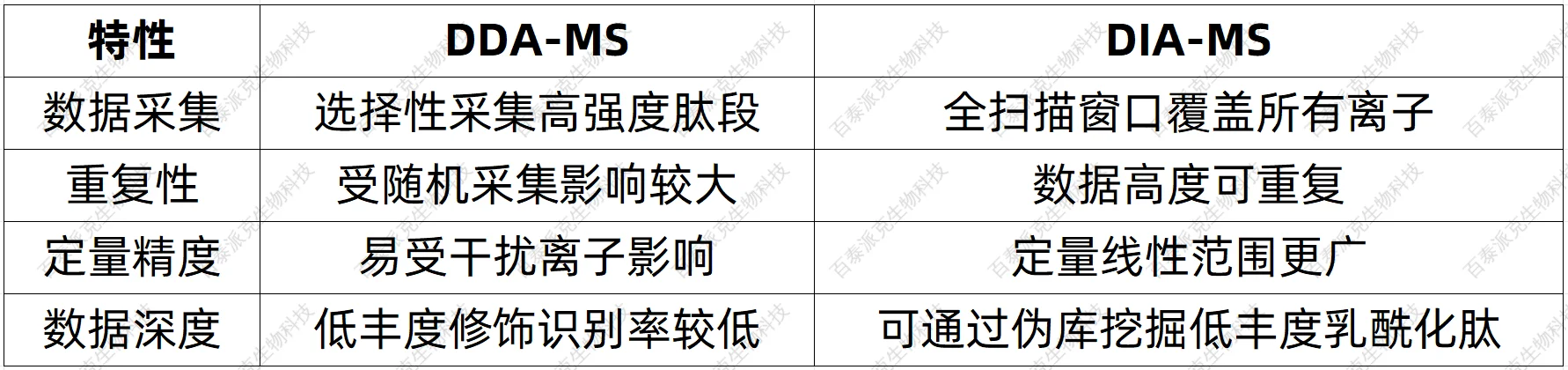
Due to the low abundance and sparse sites of lactylation modification, which can be easily masked by acetylation and other co-modifications,DIA-MS becomes the preferred strategy for lactylation research in immune cells.。
2. DIA-MS Quantitative Analysis of Protein Lactylation
Before conducting DIA-MS lactylation quantitative analysis, the experimental system needs to be carefully designed:
1. Applicable Models
(1) Macrophages (M0, M1, M2 subtypes)
(2) Comparison of activation states of CD4⁺ or CD8⁺ T cells
(3) DC cells before and after pathogen exposure
2. Grouping Recommendations
(1) Baseline vs High Lactate Treatment (sodium lactate/LPS/hypoxia)
(2) M1 vs M2 polarization model
(3) Negative control vs HDAC inhibitor treatment group (such as TSA, NAM)
Biotech Park can assist clientsin setting reasonable doses and time points for metabolic interventionto achieve measurable and reproducible changes in lactylation.
3. Sample Preparation and Lactylation Peptide Enrichment
1. Protein Extraction
(1) Containing RIPA lysis buffer + protease/de-lactylase inhibitors
(2) Low-temperature lysis, ultrasonic treatment to reduce degradation
2. Peptide Digestion
(1) Trypsin/Lys-C dual enzyme system to increase coverage
(2) Peptide desalting treatment to remove ion interference
3. Enrichment Steps
(1) Usinganti-Kla antibody immuno-enrichmentof lactylated peptides
(2) Standardize the amount of magnetic beads and peptide input to ensure batch consistency
(3) It is recommended to combine multiple rounds of enrichment to improve detection rate
Biotech Park has independently optimized theanti-lactylation antibody enrichment system, allowingstable acquisition of hundreds of lactylation sites from less than 1mg of peptides in a single application。
3. DIA-MS Mass Spectrometry Acquisition Parameter Settings
1. Instrument Recommendation
-
Orbitrap Exploris 480 or Fusion Lumos
-
paired with a nano-flow LC system (such as EASY-nLC 1200)
2. DIA Parameter Optimization
-
Number of windows: 24–36 windows (each window width ~20 m/z)
-
MS1 resolution: 60,000; MS2 resolution: 30,000
-
Cycle time controlled within 3 seconds, balancing depth and coverage
-
Dynamic exclusion time: moderately relaxed to avoid losing low-abundance lactylated peptides
3. Pseudo-DDA Library Construction Strategy
-
Construct spectral library using in-project DDA data and Spectronaut's built-in library;
-
Supports library-free DIA analysis (such as directDIA) to identify more unknown sites
Biotech Pack has establishedReference database for human immune cell lactylation modifications, which can improve the matching rate of unknown lactylated peptides.
Section 4: Data Analysis and Lactylation Site Quantification
1. Data Processing Software
-
Spectronaut: Widely used in the industry for DIA analysis
-
DIA-NN: Fast library construction and high identification rate
-
MaxDIA (MaxQuant module): Supports label-free DIA analysis
2. Quantification Strategy
-
Use Top3/TopN peptide intensity for protein-level quantification
-
Utilize fragment ion-level intensity to improve site quantification accuracy
-
Control FDR at 1% to ensure reliable results
3. Bioinformatics Analysis
-
GO/KEGG pathway enrichment → Reveals lactylation regulatory networks
-
Motif analysis → Analyze possible recognition sequences for lactylation enzymes
-
Cross-reference with acetylation/PTM databases → Explore co-regulatory modification modules
-
Protein-protein interaction networks (PPI) → Analyze key lactylation hub proteins
Biotech Pack can provide customers withSite-level quantification matrices + Functional pathway maps + Lactylation regulatory models, aiding in the high-level publication of research papers.
Lactylation modifications in immune cells reveala novel epigenetic regulatory mechanism of metabolism-transcription-function coupling. DIA-MS, with its high reproducibility, high quantitative accuracy, and low sample loss, is becoming the gold standard technology in lactylation research. Biotech Pack has establisheda comprehensive DIA-MS quantitative analysis solution for immune cell protein lactylation, including: standardized sample preparation processes; high-specificity lactylated peptide enrichment systems; high-resolution DIA-MS analysis platforms; site-level quantification and pathway enrichment interpretation.
Biotech Pack - A high-quality service provider for the characterization of biopharmaceuticals and multi-omics mass spectrometry detection
Related services:
How to order?




