






How to detect histone lactylation modification by high-resolution mass spectrometry?
Histone lactylation is a novel post-translational modification that expands the role of metabolites in epigenetic regulation. Due to its low modification abundance and structural confusion with other modifications such as acetylation, high-resolution mass spectrometry (HRMS) is required for precise detection and qualitative and quantitative analysis.
I. Background Introduction: What is histone lactylation?
Histone lactylation is a novel lysine modification first reported by Zhang et al. in Nature in 2019, derived from the lactate metabolite lactyl-CoA. This modification affects chromatin structure and gene expression, especially active in physiological/pathological processes such as hypoxia, inflammation, and tumor metabolic reprogramming.
Lactylation has the following distinct characteristics compared to common modifications such as acetylation:
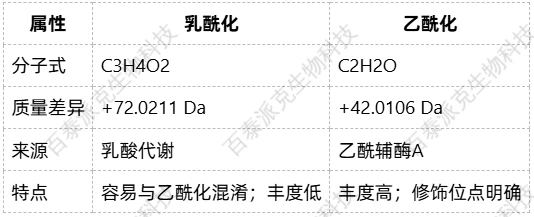
II. Why does detecting lactylation require high-resolution mass spectrometry?
1. Detection challenges of histone lactylation:
(1) Small modification difference: Lactylation (+72.0211 Da) and acetylation (+42.0106 Da) differ by only 30 Da, easily confused by low-resolution mass spectrometry.
(2) Complex modification sites: Histones are rich in lysine residues, with multiple potential modification sites coexisting, requiring high resolution to distinguish isomers.
(3) Extremely low abundance: In natural samples, the abundance of lactylation is much lower than that of acetylation/methylation, requiring a highly sensitive detection platform.
2. High-resolution mass spectrometry (such as Orbitrap Fusion Lumos, timsTOF Pro 2) offers:
(1) ppm-level mass accuracy: Enables precise differentiation of lactylation from other similar modifications;
(2) High scanning speed: Supports strategies such as Data-Independent Acquisition (DIA) or PRM;
(3) High sensitivity: Suitable for detecting low-abundance modification targets.
At Biotech-Pack Biotech, we use the Orbitrap Exploris 480 coupled with a NanoLC system, specially developed enrichment and mass spectrometry methods for low-abundance histone modifications, ensuring data reproducibility and depth.
III. Detailed process of histone lactylation detection
1. Sample preparation
(1) Source: Nuclear extracts, animal tissues, clinical samples, etc.;
(2) Histone extraction: Use acid extraction methods (e.g., 0.4N H2SO4) for specific enrichment of histones;
(3) Reduction/alkylation: Process disulfide bonds;
(4) Enzymatic digestion strategy: Use a combination of enzymes such as Trypsin/LysC to enhance lactylated peptide coverage.
2. Enrichment of modified peptides
(1) Immunoaffinity enrichment: Commercial lactylated lysine antibodies (e.g., PTMScan®) can be used for IP-level enrichment;
(2) Alternative methods: Chemical derivative labeling or HILIC fractionation strategies.
3. LC-MS/MS analysis
(1) Platform recommendation: Orbitrap Exploris, Fusion Lumos, QE HF, etc., are all suitable.
(2) Analysis modes:
-
DDA (Data Dependent Acquisition): Used for exploratory studies;
-
DIA / PRM (Parallel Reaction Monitoring): Used for targeted quantitative analysis.
(3) Key parameters:
- MS1 resolution ≥ 60,000
-
MS2 resolution ≥ 30,000
-
Dynamic exclusion: Over 30s
-
Ion source mode: Positive ion (ESI+)
4. Data analysis
(1) Database search engines: MaxQuant, pFind, MSFragger, etc.
(2) Modification settings:
-
Lactylation modification (Kla): +72.0211 Da
-
Enable multiple variable modification options (acetylation, methylation, etc.) to compare specificity
(3) Quantification methods: LFQ, TMT, or PRM/Parallel Reaction Monitoring
(4) Result validation:
-
Synthetic peptide validation of specificity
-
Western blot / IP-MS validation of antibody specificity
IV. Frequently Asked Questions (FAQ)
Q1: Is lactylation modification easily misidentified as acetylation?
Yes. If the instrument resolution is insufficient or the database does not set the lactylation mass offset, lactylated peptides may be mistakenly identified as acetylation. Therefore, high resolution and precise mass matching are crucial.
Q2: Is enrichment necessary?
Enrichment is recommended. Although high-resolution instruments can detect low-abundance peptides, histone lactylation modification is very rare, and without enrichment, it may be difficult to detect.
Q3: Can lactylation be analyzed using the DIA method?
Yes. DIA offers high throughput and reanalysis capabilities, suitable for systematic studies. We recommend using PRM or DIA for targeted quantification of lactylation modifications.
V. Advantages of Biotech-Pack Biotech's Services
At Biotree Biotech, we offer comprehensive histone lysine lactylation modification detection services based on advanced mass spectrometry platforms and extensive proteomics experience:
-
High-resolution Orbitrap mass spectrometry platform supporting DIA/PRM multi-mode acquisition;
-
High-coverage identification and quantitative analysis at the modification site level;
-
Optimized enrichment schemes + strict quality control standards to ensure data stability;
-
Providing bioinformatics support: enrichment pathways, regulatory networks, cross-modification mapping, etc.
Histone lysine lactylation is becoming a hot topic in epigenetics research, acting as a bridge connecting metabolic states and chromatin structure. It is particularly suitable for studying tumor immunity, chronic inflammation, stem cell fate, and more. Through high-resolution mass spectrometry, researchers can more precisely detect this subtle yet crucial modification. If you are working on related projects, feel free to contact Biotree Biotech. We will tailor a lysine lactylation modification detection solution for you, aiding in scientific discovery!
Related services:
How to order?




