






Comparison of Protein Lactylation Modification Detection Methods: Advantages and Disadvantages at a Glance
In recent years, the research on protein post-translational modifications (PTMs) has continuously expanded, from initial phosphorylation and acetylation to novel modifications such as ubiquitination and crotonylation. Scientists have been revealing their crucial roles in cellular regulation. Lactylation, a novel lysine modification first reported in 2019, has rapidly attracted significant attention in the fields of metabolomics and epigenetics. Lactylation forms a bridge between the metabolic state (especially lactate metabolism) and chromatin function, gene expression, and is widely involved in various biological processes such as inflammation, cancer, and stem cell differentiation. However, due to its low abundance, high dynamic nature, and site heterogeneity, accurately detecting lactylated proteins remains a key challenge in research.
1. Biological Background and Research Value of Lactylation
1. What is Protein Lactylation?
Lactylation refers to the covalent modification of protein lysine residues through enzymatic or non-enzymatic pathways by lactate. This form of modification is considered a new mechanism linking metabolism and epigenetics, particularly evident in histones, such as sites like H3K18la and H3K23la, which have been shown to regulate transcriptional activity.
2. Hot Research Areas
(1) Tumor Metabolism: Aerobic glycolysis in cancer cells produces a large amount of lactate, and lactylation may be an important mechanism for regulating the tumor microenvironment and immune evasion.
(2) Immune Response: Lactylation is involved in the reprogramming of macrophage activation states.
(3) Stem Cell Fate: Epigenetic factors regulating stem cell self-renewal and differentiation.
(4) Metabolic Disorders: Potential biomarkers in metabolic diseases such as diabetes and obesity.
2. Comprehensive Comparison of Main Techniques for Detecting Protein Lactylation
1. Affinity Enrichment Combined with Mass Spectrometry (Affinity Enrichment-MS)
(1) Principle
- Using specific anti-lactylated lysine (Kla) antibodies to enrich lactylated peptides followed by LC-MS/MS analysis.。
(2) Advantages
-
High throughput, site-level qualitative analysis.
-
Can be used for lactylation site mining across the proteome.
-
Compatible with quantitative strategies like TMT/iTRAQ.
(3) Disadvantages
-
Antibody specificity and enrichment efficiency have significant impacts.
-
Prone to background noise and non-specific binding.
-
High cost, requiring optimization of enrichment conditions.
(4) Recommended Applications
-
Suitable for initial lactylation research to construct lactylation modification profiles; appropriate for large-scale site screening.
2. Chemical Labeling-Based Enrichment
(1) Principle
-
Derivatization of lactyl groups by chemical methods, such as hydroxamic acid ester derivatization followed by biotin affinity purification and subsequent mass spectrometry analysis.
(2) Advantages
-
Can enhance the enrichment selectivity of lactylation modifications.
-
Avoids dependency on antibodies.
(3) Disadvantages
-
Stringent reaction conditions, prone to false positives.
-
Difficult to control modification efficiency and site retention rate.
-
Insensitive to low-abundance modification sites.
(4) Recommended Applications
-
Suitable for verifying the existence of specific protein lactylations or as a complementary strategy to antibody methods.
3. Western Blot/Immunohistochemistry (IHC)
(1) Principle
- Using anti-Kla antibodies to detect overall protein lactylation levels or localized expression.
(2) Advantages
-
Simple operation, achievable in regular laboratories.
-
Allows spatial distribution observation at tissue or cellular levels.
-
Suitable for rapid sample status screening.
(3) Disadvantages
-
Cannot provide site-specific information.
-
Specificity and sensitivity affected by antibodies.
-
Poor quantitative precision, difficult for dynamic change analysis.
(4) Recommended Applications
- Used for preliminary screening or validation of whether certain biological treatments induce changes in lactylation levels.
4. Site-Directed Mutagenesis Combined with Functional Experiments
(1) Principle
- Evaluate the impact on protein function by mutating lactylation sites from lysine (K) to arginine (R) or alanine (A).
(2) Advantages
-
Directly verify the functional role of lactylation at specific sites;
-
Suitable for the mechanistic research phase.
(3) Disadvantages
-
Not part of the detection method itself;
-
The modification site needs to be identified first;
-
Long construction period and high validation cost.
(4) Application Recommendations
- Particularly important for functional validation of identified lactylation sites.
III. Summary of Detection Method Comparison
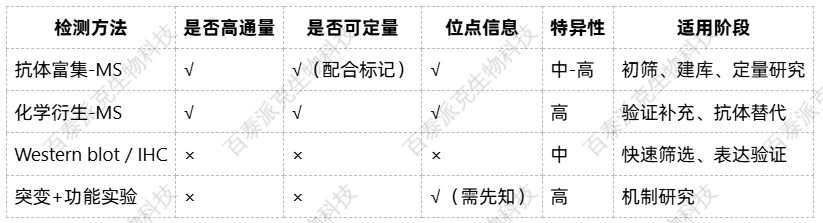
IV. Choosing the Best Strategy: Research Objective-Driven Technical Pathway
The optimal detection method should be selected based on research objectives at different research stages:
- Mechanism Exploration Phase: It is recommended to start with antibody enrichment-MS to broadly identify lactylation sites, then validate with Western blot/IHC;
-
Functional Research Phase: Conduct site-directed mutagenesis analysis on key sites;
-
Large Cohort Studies: A high-throughput, reproducible quantitative lactylomics platform needs to be constructed, recommended to combine with TMT labeling + mass spectrometry technology.
V. BettaKappa BioTech's Advantages in Lactylation Detection
Faced with the challenges of detecting low-abundance novel modifications such as lactylation, BettaKappa BioTech leverages years of experience in proteomics and modification omics to provide the following technical advantages:
-
High-Sensitivity Kla Antibody Enrichment Platform: Independently optimized enrichment process to enhance the recovery rate of modification peptides;
-
Mature Quantitative Modification Omics Solutions: Compatible with multiple strategies such as TMT/iTRAQ/SILAC;
-
One-Stop Lactylation Research Support: Full coverage from sample preprocessing, mass spectrometry analysis to bioinformatics functional annotation;
-
Integrated Research + Service: Provides technical assurance and data support for project applications and SCI paper publications.
As research on lactylation modifications continues to deepen, choosing the appropriate detection method is crucial for revealing its biological functions. Whether starting from basic mechanistic research or providing a basis for disease biomarker screening, constructing high-quality lactylomics data is the key first step. BettaKappa BioTech is committed to helping researchers achieve breakthroughs in this frontier field, and we welcome you to contact us for customized lactylomics service solutions to explore new chapters in epimetabolic regulation together.
BettaKappa BioTech - Characterization of Biological Products, Quality Service Provider for Multi-Omics Mass Spectrometry Detection
Related Services:
How to order?