






Lysine Lactylation Proteomics Analysis: The Entire Process from Enrichment to Identification
Lysine Lactylation (Kla) is an important post-translational modification discovered in recent years, and has been proven to play a key role in gene expression regulation, immune metabolism, tumor biology, among other fields. However, as alow-abundance, challenging-to-detect acylation modification, lactylation research demands higher experimental techniques. How can we accurately capture lactylation sites from a vast pool of proteins? How can we achieve high-throughput, high-resolution qualitative and quantitative analysis? This article systematically reviews the entire workflow of lactylation proteomics, from sample preparation, modification enrichment to mass spectrometry identification, assisting researchers in quickly building robust experimental protocols.
I. Sample Preparation for Lactylation Proteomics
The primary prerequisite for lactylation analysis is to prepare high-quality, reproducible protein samples. The general process includes:
1. Sample Source Selection
Lactylation is widely present in mammalian cells, tissues, and pathological samples. Common processing methods include cell lysis, tissue homogenization, and protein extraction.
2. Protein Quantification and Quality Assessment
Protein concentration is recommended to be >2 mg/mL, and protein integrity must be verified via SDS-PAGE or Coomassie blue staining. Avoid protein degradation or loss of modification.
3. Trypsin Digestion
Utilize efficient digestion methods such as FASP or S-Trap to cleave proteins into peptides and remove impurities (such as salts, lipids) that may interfere with modification enrichment.
II. Enrichment of Lactylated Peptides in Proteomics
The abundance of lactylated peptides in complex samples is extremely low, usually requiringspecific antibody enrichmentmethods for preprocessing.
1. Selection of Kla-Specific Antibodies
Commercial anti-lactylation antibodies are available and can specifically recognize Kla modified peptides. Antibody quality directly influences enrichment efficiency and specificity.
2. Enrichment Process
Immobilized antibodies (on beads or agarose carriers) incubate with peptides to bind lactylated peptides
(1) Washing steps remove nonspecific bindings
(2) Recover target peptides using low pH elution solution
(3) Vacuum dry, resolubilize for mass spectrometry analysis
Enrichment efficiency determines the depth and reliability of downstream detection, it is recommended to perform a total peptide mass spectrometry detection as a control before enrichment.
III. Mass Spectrometry Analysis
1. LC-MS/MS Detection Strategy
(1) Recommended Equipment: Orbitrap Exploris 480, Q Exactive HF-X, and other high-resolution instruments
(2) Acquisition Modes: DDA (Data Dependent Acquisition) for modification site discovery, DIA (Data Independent Acquisition) for global quantification
(3) Resolution Requirements: MS1 ≥ 60,000; MS2 ≥ 15,000 to ensure detection of low-abundance modifications
2. Identification Parameter Settings
(1) Search databases need to add lactylation (+72.021 Da) as a variable modification
(2) Enable site localization algorithms (such as ptmRS, Ascore) to ensure site confidence
(3) It is recommended to use algorithms like Percolator for false positive control (FDR < 1%)
IV. Data Analysis: Constructing the Functional Map of Lactylated Proteins
1. Identification Statistics
-
Number of lactylated peptides, proteins, modification sites
-
Site distribution characteristics (N-terminal enrichment, domain distribution, etc.)
-
Motif Analysis: Identify lactylation-prone sequences
2. Functional Annotation
-
GO Enrichment Analysis: Involved biological processes, molecular functions, cellular components
-
KEGG Pathway Analysis: Associated signaling pathways and metabolic networks
-
Protein Interaction Network (PPI): The role of lactylated proteins in regulatory networks
3. Modification Quantification (Optional)
If the experimental design includes different treatment groups (such as high glucose vs normal glucose), differential lactylated proteins can be identified through label quantification (TMT/iTRAQ) or DIA label-free quantification.
IV. Solutions and Advantages from Biotech Co., Ltd.
As a professional multi-omics service provider,Biotech Co., Ltd.offersone-stop customized analysis services:
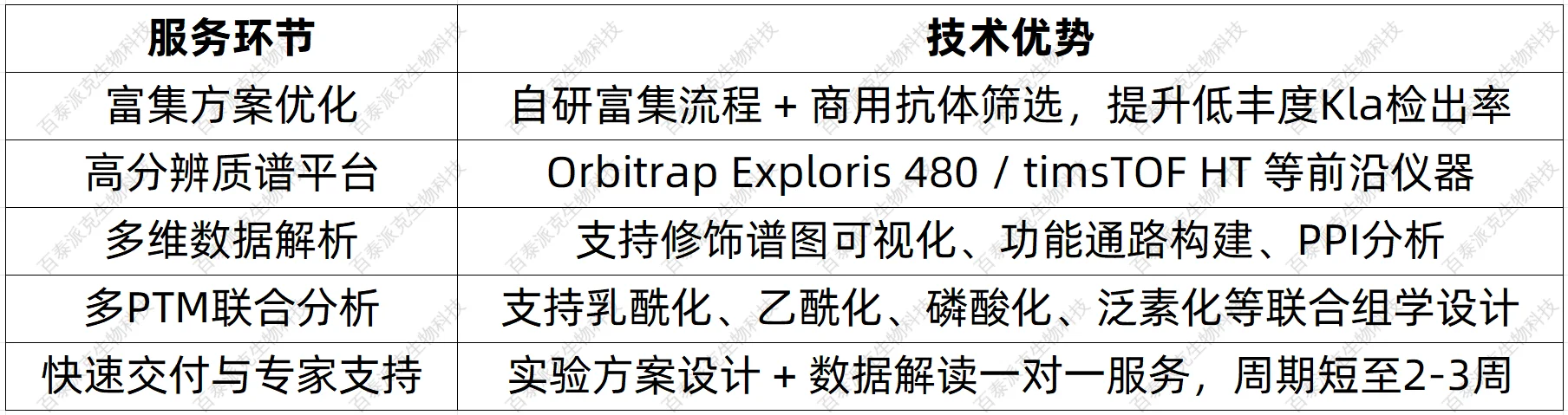
Whether you are exploring the role of lactylation in disease mechanisms or identifying potential drug targets, we can provide full-process support from experiment to interpretation.
Lactylation proteomics is a crucial means for deeply understanding the metabolism-epigenetic regulatory network. From efficient enrichment to high-precision identification, to system-level functional excavation, every step requires the collaboration of professional technology and scientific strategy. Biotech Co., Ltd. will continue to invest in optimizing post-translational modification omics platforms, assisting researchers in decoding the biological significance of lactylation, and promoting its application in basic research and clinical translation.
Biotech Park Biotech Co., Ltd - Characterization of Bioproducts, Premier Service Provider for Multi-Omics Mass Spectrometry Analysis
Related Services:
How to order?




