






Interpreting the Deep Association between Lactylation Modification and Disease Mechanisms using DIA Technology
Lactic acid, once regarded as a 'metabolic waste,' is now considered an important signaling molecule for cell fate. Especially after histone lactylation was first discovered in 2019, lactylation, as a lysine post-translational modification (PTM), has quickly garnered attention in the biomedical community. It plays a crucial role in regulating immune responses, tumor metabolic reprogramming, chronic inflammatory reactions, and more. However, to comprehensively analyze the functional network of lactylation in diseases, researchers need to overcome three technical challenges:
1. Low abundance of lactylation modifications makes stable detection challenging.
2、Functional proteins are widespread, complex in action, and difficult to quantitatively analyze.
3、Subtle changes in disease states require large-scale comparative analysis.
In this context,DIA technology (Data-Independent Acquisition)with itshigh repeatability, high throughput, deep coverage, and comprehensive quantification capabilitieshas become a key tool in lactylation omics research.
I. What is DIA technology? Why is it suitable for studying lactylation?
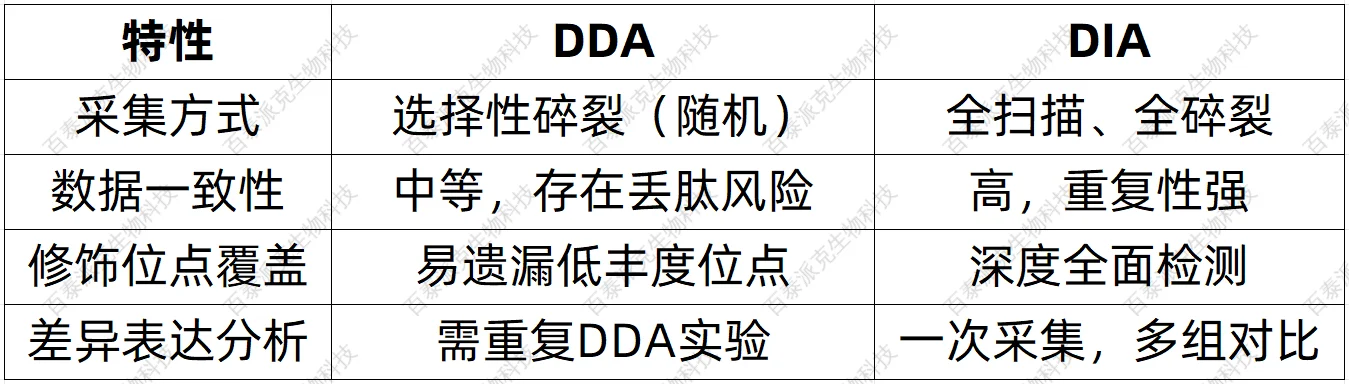
DIA is a full-scan mass spectrometry strategy that systematically segments and scans all peptide segments, rather than selecting only high-abundance signals for fragmentation (like DDA). This means:
1. Every run can comprehensively and stably record all detectable peptide segments, greatly enhancing data consistency and quantitative accuracy.
2. It is particularly suitable for comprehensive detection and quantitative analysis of low-abundance peptide segments in complex PTM samples.
3. It can be used to construct panoramic maps of lactylated proteins in health and disease states.
The advantages of DIA technology compared to DDA are summarized as follows:
II. Key application scenarios of DIA technology in lactylation research
1. Systematic construction of lactylated protein profiles in disease states
By enriching lactylated peptides from disease models (such as tumor tissues, inflammatory cells, hypoxia treatment) and control groups for DIA mass spectrometry analysis, researchers can:
(1) Systematically identify lactylated proteins and modification sites.
(2) Quantify expression changes of each modification site under different treatment conditions.
(3) Construct functional protein networks of lactylation in disease states.
2. Revealing pathways and regulatory axes involving lactylation
DIA data can be combined with bioinformatics tools for GO, KEGG analysis to help researchers identify lactylation-enriched:
(1) Metabolic pathways (glycolysis, lipid metabolism)
(2) Inflammation pathways (NF-κB, JAK-STAT)
(3) Cell cycle/apoptosis pathways
(4) Chromatin remodeling and transcriptional regulation networks
This is of great significance for understanding how lactylation is involved incell phenotype transformation, increased tumor invasiveness, immune imbalanceand other disease mechanisms.
3. Multi-omics integration: Coordinated analysis of lactylation with expression/metabolism/signaling
Integrating lactylation-DIA data with transcriptomics, metabolomics, phosphoproteomics, and other omics data can construct cross-level regulatory models.
III. Technical workflow: DIA lactylation proteomics analysis path
1. Sample preparation and lactylated peptide enrichment
-
Sample sources: cells/tissues/blood, etc.
-
Digestion strategy: FASP/S-Trap
-
Kla enrichment: Specific anti-lactylation antibody coupled magnetic bead enrichment
2. DIA mass spectrometry acquisition
-
Instruments: Orbitrap Exploris 480 / timsTOF Pro
-
Scanning mode: covers 300–1,200 m/z, full segment fragmentation
-
Condition optimization: Window number and collision energy settings are fine-tuned based on lactylated peptide characteristics
3. Data analysis platform
-
Peptide/site identification: Spectronaut / DIA-NN
-
Modification quantification and normalization: MaxLFQ / MSstats
-
Functional annotation and pathway analysis: DAVID, Metascape, Cytoscape, etc.
Biotyper BioTech's technical solutions and advantages
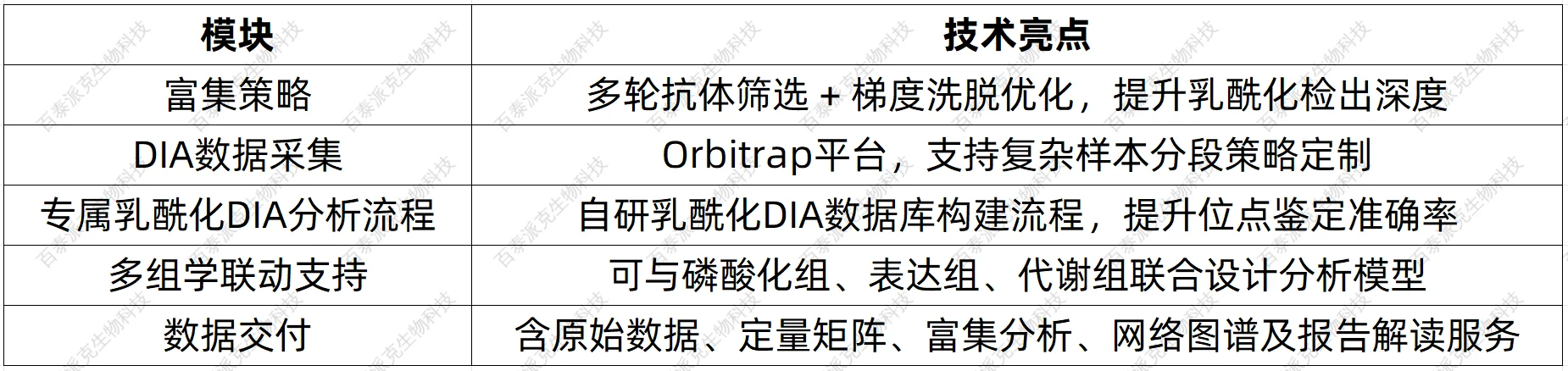
In lactylation DIA omics research,Biotyper BioTechprovides one-stop services from sample processing, lactylation enrichment, DIA mass spectrometry acquisition to systematic bioinformatics analysis:
Lactylation reveals not just a new protein modification tag, but a 'language' for metabolic-epigenetic-signaling network regulation. Through high-resolution, deep coverage, and highly reproducible data acquisition capabilities, DIA technology allows lactylation proteomics to move from 'can detect' to 'can interpret.' In the future, this technology combination will play an irreplaceable role in tumor biomarker discovery, inflammation mechanism research, drug target screening, and other fields.BioTye-Parker BiotechnologyWe will continue to invest in DIA platform optimization and PTM omics expansion to provide researchers with cutting-edge proteomics solutions, accelerating the translation of basic research into disease intervention. If you plan to conduct research on mechanisms of diseases related to lactylation, or require customized DIA omics experimental solutions, please contact BioTye-Parker Biotechnology for free consultation and project support.
BioTye-Parker Biotechnology—Characterization of Biologics, High-quality Mass Spectrometry Services for Multi-omics
Related Services:
How to order?




