






12 Methods for Determining Protein Molecular Weight
The molecular weight of proteins is one of their basic physicochemical properties, which is crucial for the study of protein structure, function, and biological activity. Accurate determination of protein molecular weight is of great significance in fields such as protein purification, proteomics research, drug development, and genetic engineering. Currently, there are various methods for determining protein molecular weight, each with its applicable scope and advantages. This article will provide a detailed introduction to 12 methods for determining protein molecular weight, and analyze their principles, advantages and disadvantages, and application scenarios.
First, let's take a look at these 12 methods for determining protein molecular weight. They include:
(1) SDS-polyacrylamide gel electrophoresis (SDS-PAGE)
(2) Capillary electrophoresis
(3) Gel filtration chromatography
(4) Ultracentrifugation analysis
(5) Osmotic pressure measurement
(6) Static light scattering
(7) Liquid chromatography-mass spectrometry (LC-MS)
(8) Matrix-assisted laser desorption/ionization time-of-flight mass spectrometry (MALDI-TOF MS)
(9) Ion mobility spectrometry
(10) Isoelectric focusing electrophoresis
(11) X-ray crystallography
(12) Nuclear magnetic resonance (NMR) spectroscopy
1. Mass Spectrometry (MS)
(1) Matrix-assisted laser desorption/ionization time-of-flight mass spectrometry (MALDI-TOF-MS)
MALDI-TOF combines matrix-assisted laser desorption/ionization (MALDI) with time-of-flight (TOF) technology. First, the protein sample is mixed with an organic matrix and ionized under laser irradiation to form ions. These ions are then accelerated into a flight tube by an electric field, and different signal peaks are formed on the detector based on their mass-to-charge ratio (m/z).
Advantages
-
Suitable for molecular weight determination of large proteins
-
High sensitivity, capable of detecting low-abundance proteins
-
Fast, suitable for high-throughput analysis
Applications
-
Protein identification
-
Analysis of post-translational modifications
-
Protein complex studies
(2)Electrospray ionization mass spectrometry (ESI-MS)
ESI-MS uses high voltage to nebulize the sample solution, forming charged ions after solvent evaporation, which are then analyzed by the mass spectrometer. Compared to MALDI, ESI is more suitable for coupling with liquid chromatography (LC) and can provide more detailed protein information.
Advantages
-
Suitable for proteins in solution state
-
High resolution, capable of distinguishing protein isotopes
-
Can be used for protein complex studies
Applications
-
Protein-protein interaction studies
-
Analysis of post-translational modifications
-
Biopharmaceutical analysis
2. Electrophoresis
(1)SDS-PAGE (Sodium dodecyl sulfate-polyacrylamide gel electrophoresis)
SDS denatures proteins and imparts a negative charge, allowing them to separate in the gel based solely on molecular weight, thus estimating protein molecular weight.
Advantages
-
Low cost, simple operation
-
Widely applicable to various proteins
-
Can be used for protein purity analysis
Applications
-
Protein purity detection
-
Protein molecular weight estimation
-
Protein component analysis
(2)Two-dimensional gel electrophoresis (2D-GE)
Combining isoelectric focusing (IEF) and SDS-PAGE, proteins are first separated according to their isoelectric point (pI), and then separated a second time based on molecular weight.
Advantages
-
High resolution
-
Suitable for complex protein mixtures
Applications
-
Proteomics research
-
Analysis of protein post-translational modifications
(3)Capillary Electrophoresis (CE)
Proteins migrate in a high-pressure capillary, with different molecular weights migrating at different rates to achieve separation.
Advantages
-
Fast analysis speed
-
Small sample requirement
-
High resolution
Applications
-
Protein separation
-
Protein structural analysis
Chromatography
(1)Size Exclusion Chromatography (SEC)
Utilizes molecular sieving, with larger proteins eluting first and smaller molecules eluting later.
Advantages
-
Suitable for protein complex analysis
-
Can estimate protein molecular weight
Applications
-
Protein aggregate research
-
Protein complex analysis
(2)Reverse Phase High Performance Liquid Chromatography (RP-HPLC)
Separation based on differences in protein hydrophobicity, with retention time used to infer molecular weight.
Advantages
-
High resolution
-
Suitable for protein purity testing
Applications
-
Protein purification
-
Protein molecular weight determination
Physical and Chemical Methods
Ultracentrifugation
Proteins sediment at different rates under high-speed rotation, allowing forSedimentation coefficientto infer protein molecular weight.
Advantages
-
Non-destructive
-
Suitable for large molecular proteins
Applications
-
Protein complex study
-
Protein aggregate analysis
(2)X-ray Small Angle Scattering (SAXS)
X-rays irradiate proteins in solution, with scattering signals used to infer protein molecular weight.
Advantages
-
Suitable for proteins in solution state
-
Can resolve protein shapes
Applications
-
Protein structure research
(3)Surface Plasmon Resonance (SPR)
Detect changes in optical signals as proteins bind to ligands, which can infer protein molecular weight.
Advantages
-
No labeling required
-
Real-time detection of protein binding
Applications
-
Protein interaction studies
-
Drug screening
(4)Gas-phase Electrophoretic Mobility Molecular Analysis (GEMMA)
Measure protein gas-phase mobility to infer molecular weight.
Advantages
-
Suitable for non-denatured proteins
-
High precision measurement
Applications
-
Protein complex studies
(5)Light Scattering (LS)
Measure changes in scattering intensity under light exposure to calculate protein molecular weight.
Advantages
-
Suitable for large protein molecules
-
Can determine protein aggregation state
Applications
-
Protein drug research
-
Protein complex analysis
Summary
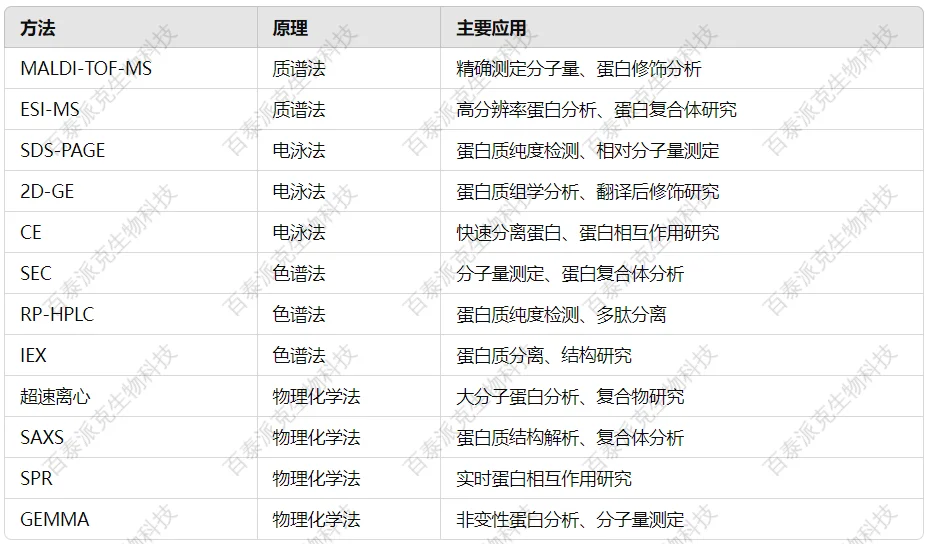
By understanding and applying these methods, researchers can choose the most suitable method in experiments to obtain reliable data. When selecting methods to determine protein molecular weight, it is necessary to consider sample characteristics, specific experimental requirements, and laboratory equipment conditions. These methods have different advantages, disadvantages, and applicable scopes, and researchers should choose according to specific experimental needs. Baitaipike Biotechnology providesHigh-precision protein molecular weight measurement services, helping researchers quickly obtain accurate data and providing one-stop solutions for fields such as biomedicine and protein research.
Baitaipike Biotechnology - High-quality service provider for biological product characterization and multi-group mass spectrometry detection
Related services:
How to order?




