






Application and Advantages of Mass Spectrometry in the Analysis of Protein Post-Translational Modifications
Post-translational Modifications (PTMs) are a series of enzyme-catalyzed covalent modifications that occur after protein translation is completed, such as phosphorylation, acetylation, ubiquitination, and methylation. These modifications regulate protein activity, localization, interaction, and degradation, serving as critical molecular mechanisms for maintaining cellular homeostasis and responding to environmental stimuli. However, the complexity and dynamic nature of PTMs pose significant challenges to detection methods:
-
Modification sites are often low in abundance and prone to degradation;
-
Multiple modifications coexist with diverse structures;
-
It is necessary to distinguish the precise location and type of modifications.
Among numerous analytical techniques,Mass spectrometry (MS), due to its high sensitivity, high throughput, and high resolution, has become a core tool for studying PTMs.Especially when combined with efficient peptide modification enrichment strategies, mass spectrometry technology can almost fully meet the comprehensive analysis needs of mainstream modification types.
1. Why choose mass spectrometry for PTM analysis?
1. Ionization and fragmentation: Achieving peptide-level modification identification
Mass spectrometry identifies modifications by ionizing peptide segments from the sample.Ionization, followed bymass analysis and fragmentation scanning (MS/MS), allows precise identification of peptide mass composition and modification differences.
(1) Precursor ion (MS1): Can determine if the peptide segment is modified (mass increase);
(2) Fragment ions (MS2): Can locate the specific amino acid site of the modification.
2. Advantages of high-resolution mass spectrometry platforms
Current mainstream high-resolution mass spectrometry platforms, such as Orbitrap, timsTOF, and Q-TOF systems, possess the following characteristics:
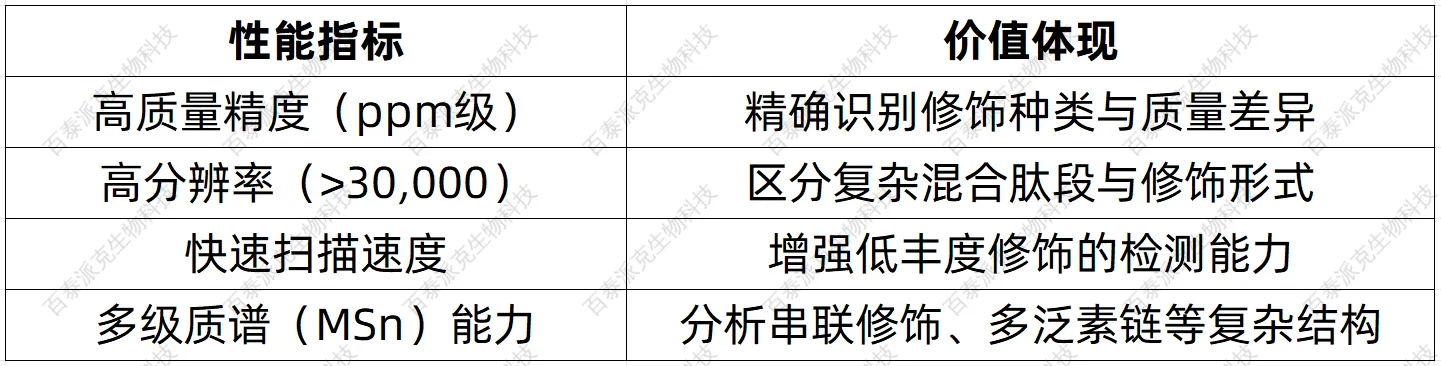
Baitai Parker Biotech is equipped with Orbitrap Exploris 480 and Bruker timsTOF Pro systems, which can meet the full-spectrum detection needs from common modifications to specific low-abundance modifications, such as SUMOylation and hydroxylation.
II. Application of Mass Spectrometry Technology in Mainstream PTM Types
1. Phosphorylation
(1) Enrichment Strategies: TiO₂, IMAC, and Fe³⁺ magnetic bead enrichment;
(2)Challenges in Mass Spectrometry Detection: Modifications are unstable and prone to losing phosphate during ionization;
(3)Solution: Use HCD or ETD fragmentation techniques to stably retain modifications;
By optimizing the TiO₂ + DDA/DIA combined platform, Biotage can stably quantify and identify over 10,000 phosphorylation sites in typical tumor cell samples.
2. Acetylation & Methylation
(1)Enrichment Strategy: Modification-specific antibody enrichment (anti-AcK, anti-MeR);
(2)Quantification Method: TMT labeling or Label-free;
(3)Biological Significance: Mainly used in the study of chromatin structure, transcriptional regulation, and histone modifications;
3. Ubiquitination
(1)Identification Marker: Specific enrichment of K-ε-GG residues;
(2)Mass Spectrometry Characteristics: Identification of characteristic ions in MS2 fragmentation spectra, which can identify ubiquitin chain linkage types (K48, K63, etc.);
(3)Research Applications: Degradation signal recognition, study of E3 ligase function.
III. Summary of the Unique Advantages of Mass Spectrometry in PTM Research
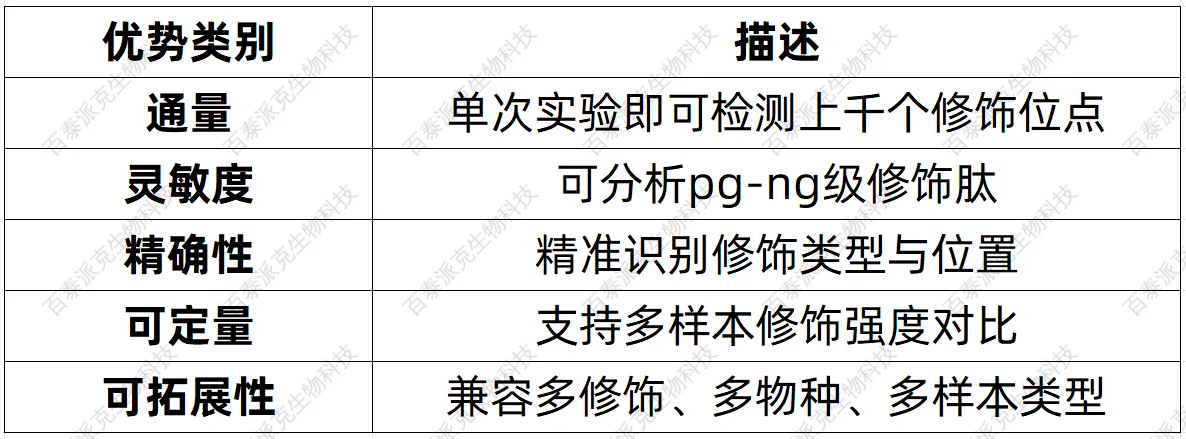
4. Betterscope Biotech's Service Capabilities in PTM Mass Spectrometry Research
Betterscope Biotech has deeply engaged in the fields of mass spectrometry and proteomics, establishing a comprehensive PTM analysis technology platform with the following capabilities:
-
Multi-type modification enrichment workflow library: supports phosphorylation, acetylation, ubiquitination, methylation, glycosylation, SUMOylation, etc.;
-
High-resolution mass spectrometry platform matrix: supports various detection modes including DDA, DIA, PRM, MS³, etc.;
-
Large-scale project support capabilities: suitable for clinical cohorts, multi-omics integration, big data mining projects;
-
One-stop delivery content: including modification site data, protein quantification results, pathway enrichment analysis, chart output;
-
Customized scientific research support: support for SCI-level data delivery, project design advice, and technical collaboration.
Post-translational modifications, as a core aspect of protein function regulation, are an essential window for understanding complex biological systems. The introduction of mass spectrometry has brought unprecedented resolution and systematics to this field. It not only captures the presence of trace modifications but also reveals their dynamic changes in spatial and temporal dimensions, becoming a key driving force for PTM research from 'point' to 'surface', from 'identification' to 'quantification'. Biotree Biotech will continue to focus on mass spectrometry platform construction, optimization of modification enrichment, and standardization of data analysis, assisting researchers in deeply revealing the protein post-translational modification network, and promoting the development of precision medicine and translational research.
Biotree Biotech -- Characterization of biological products, a high-quality service provider for multi-omics mass spectrometry testing
Related services:
How to order?




