






From Qualitative to Quantitative: The Versatile Performance of Mass Spectrometry in PTM Research
Post-Translational Modifications (PTMs) are critical in the regulation of life activities, extensively involved in biological processes such as signal transduction, metabolic regulation, epigenetics, and immune response. With the continuous evolution of proteomics technology, mass spectrometry (MS) has evolved from initial qualitative detection to today's high-throughput, reproducible quantitative analysis, demonstrating unprecedented versatility in deciphering PTMs.
1. Why is mass spectrometry indispensable for PTM research?
The core challenge in PTM research lies inits diversity, low abundance, and high dynamics.Common modifications such as phosphorylation, acetylation, ubiquitination, methylation, and glycosylation usually appear in trace amounts at specific sites and can rapidly change in response to external stimuli. Conventional protein detection methods have limitations in throughput and site resolution, making it difficult to meet the demands for systematic, high-resolution modification research. Mass spectrometry offers the following advantages, making it irreplaceable in PTM research:
-
High sensitivity: Capable of detecting low-abundance modified peptides
-
High specificity: Can pinpoint specific modification sites
-
High throughput: Can analyze thousands of modification events in parallel
-
High dynamic range: Suitable for various sample backgrounds and conditions
2. From Qualitative to Quantitative: The Triple Capability of Mass Spectrometry in PTM Research
1. Accurate Identification: High-confidence determination of modification sites
In the initial stages of PTM research, scientists often focus on whether modifications occur and where. Mass spectrometry plays a crucial role in identifying modified peptides and locating modification sites. By using digestion, enrichment, and high-resolution mass spectrometry scanning, multiple types of modifications can be identified, and their exact locations can be determined using database search tools. Optimized enrichment strategies (such as TiO₂ or antibody enrichment) combined with tandem mass spectrometry (MS/MS) significantly improve the detection efficiency of modified peptides, showing remarkable advantages especially in studying low-abundance modifications like phosphorylation and acetylation.
2. Relative Quantification: Comparing modification levels under different conditions
In PTM research, not only is the presence of modifications important, but their abundance is also crucial. In-depth mechanistic studies, drug screening, or disease model construction rely on relative quantification to reveal the dynamic changes in PTMs. Common relative quantification strategies include:
-
Labeling methods (such as TMT/iTRAQ): Suitable for systematic studies with parallel multi-sample analysis and good reproducibility
-
Label-Free methods: Simple experimental procedures, lower cost, suitable for exploratory analysis
By statistically analyzing the intensity of modified peptides under different conditions, scientists can accurately map the fluctuation trajectories of PTMs during signal pathway activation, transcription factor regulation, or epigenetic state transitions.
3. Absolute Quantification: Building a quantitative standard map for PTMs
In scenarios like drug development and biomarker validation, relative comparisons alone may not suffice for precise requirements,absolute quantificationis gradually becoming a key direction in PTM research. This analysis typically involves synthetic peptide standards and employs targeted mass spectrometry strategies such as Parallel Reaction Monitoring (PRM) or Multiple Reaction Monitoring (MRM) to obtain the true content of specific modified peptides.
3. Mass Spectrometry Strategies for Common PTM Types
Different types of modifications have unique characteristics in terms of chemical structure, abundance levels, and enrichment methods, requiring tailored mass spectrometry approaches.
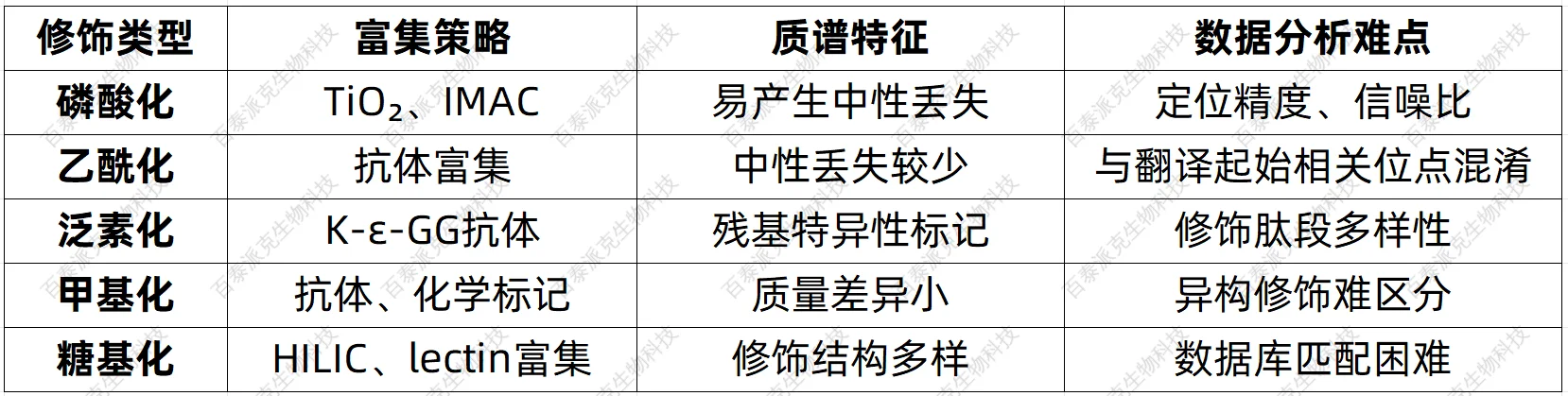
Through optimized sample preprocessing, controlled enrichment conditions, adjusted scanning methods, and professional data analysis, mass spectrometry can accurately meet the demands of various PTM research needs.
4. Bridging Data Silos: The Trend of Integrated PTM Omics Analysis
With the rapid development of systems biology, a single PTM dimension is insufficient to fully capture the complexity of life processes. Increasingly, research teams are adopting multi-PTM collaborative analysisstrategies, integrating data from multiple modifications like phosphorylation, acetylation, and ubiquitination to explore their coordinated regulatory networks. Furthermore, linking PTM omics withproteome expression, interactome, transcriptome, metabolomeand other omics data can further enhance biological interpretability and accelerate the discovery of functional mechanisms.
Throughout the entire process of protein post-translational modification research—from early modification identification to differential comparison between conditions, and target quantitative validation—mass spectrometry consistently plays a core role. Its sensitivity, throughput, and quantification capabilities make it the 'gold standard' tool in basic research and precision medicine. Biotech company Bio-Techne focuses on the deep application of mass spectrometry in PTM research, providing comprehensive solutions including modification type screening, sample preprocessing, quantification strategy selection, data mining, and biological annotation to assist researchers in fully exploring PTM regulatory mechanisms and accelerating scientific breakthroughs.
Bio-Techne—A leading service provider in the characterization of biological products and multi-omics mass spectrometry detection
Related Services:
How to order?




