


How to perform high-throughput protein interaction detection using AP-MS technology?
High-throughput protein interaction detection is a key step in systematically analyzing cellular signaling pathways and understanding protein functions and biological network mechanisms. Among these techniques, Affinity Purification-Mass Spectrometry (AP-MS) is one of the most reliable and physiologically relevant methods in protein interaction research, and it has been widely applied in various systems including mammalian cells, model organisms, and disease models.
I. What is AP-MS? Principle and Advantage Analysis
1. Principles of AP-MS Technology
AP-MS is a method based on antibody recognition or tag affinity purification, used to enrich target proteins (bait) and their interacting partners (prey) from complex samples, followed by mass spectrometry analysis to identify the protein complexes involved in interactions.
The basic procedure is as follows:
(1) Express tagged target proteins (such as Flag, HA, Strep, BioTag, etc.);
(2) Perform cell lysis and affinity purification to retain interacting proteins forming complexes with the target protein;
(3) Elute the complexes and perform proteolysis (usually with trypsin);
(4) Use LC-MS/MS for mass spectrometry analysis to identify peptides and proteins;
(5) Conduct bioinformatics analysis to filter out non-specific binders and construct high-confidence interaction networks.
2. Advantages of AP-MS Compared to Traditional Methods
(1) High specificity: Purification of target proteins through tags or antibodies significantly reduces background signals;
(2) High throughput: Combining automated platforms with mass spectrometry allows simultaneous processing of hundreds of samples;
(3) Close to physiological state: Complex assembly occurs within cells, minimizing false positives caused by artificial intervention;
(4) Strong quantitative capability: Can implement tag-based quantification strategies (such as TMT/iTRAQ) or label-free quantification (LFQ).
II. How to Design an Efficient AP-MS Interaction Detection Experiment?
1. Selection of Target Protein (Bait) and Tagging Strategy
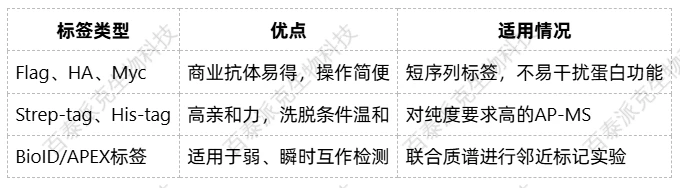
The selection of target proteins should consider factors such as expression level, structural characteristics, and subcellular localization. The choice of tag is particularly crucial, and common strategies include:
2. Experimental System and Protein Expression Method
(1) For low-expression endogenous proteins, it is recommended to use an overexpression system combined with tag purification;
(2) For endogenous interaction studies, CRISPR knock-in tagging is recommended to preserve natural regulatory mechanisms;
(3) The choice of cell model (HEK293, HeLa, tumor cell lines, stem cells, etc.) should align with research objectives.
3. Optimization of Purification System
The core of affinity purification is to maximally retain true interactions while clearing non-specific binding proteins. Key parameters include:
(1) Buffer composition: Physiological salt concentration/detergent concentration (such as NP-40, Triton X-100) affects complex stability;
(2) Elution methods: Competitive elution vs. acid elution vs. enzymatic cleavage elution.
III. Mass Spectrometry Analysis Strategy: Qualitative + Quantitative + Data Filtering
1. LC-MS/MS Platform Selection
(1) High-resolution mass spectrometry (such as Orbitrap Exploris 480, QE HF-X) is suitable for complex sample analysis;
(2) It is recommended to use nanoLC-MS systems to enhance sensitivity, especially suitable for detecting low-abundance interacting proteins.
2. Quantification Strategy: LFQ vs. TMT

3. How to Identify True Interactions vs. Non-specific Background?
(1) Set appropriate control groups (such as empty vectors, unrelated proteins);
(2) Introduce algorithms like SAINT, MiST, CompPASS to calculate interaction confidence;
(3) Utilize the CRAPome database to filter known background proteins;
(4) Validate interaction stability through biological replicates.
IV. Data Interpretation and Interaction Network Construction
1. Enrichment Analysis and Network Visualization
(1) Use GO/KEGG pathway analysis to predict the functions of interaction complexes;
(2) Construct PPI networks (such as Cytoscape) to identify key hub proteins;
(3) Integrate other omics (such as transcriptomics, phosphoproteomics) to deepen mechanism analysis.
2. Validation of Key Interactions
(1) Co-IP, Western blot validation of core interactions;
(2) Use CRISPR knockdown to observe functional changes after interaction disruption;
(3) Drug intervention or mutant functional experiments to support the biological significance of the interaction.
V. Technical Advantages of Biotech Pacific in the Field of AP-MS
As a leading omics research service brand in China, Biotech Pacific has completed hundreds of AP-MS projects in the field of protein interaction detection, covering:
-
Mapping interaction groups in tumor signaling pathways
-
Identification of complexes of epigenetic modification enzymes
-
Screening interaction targets of drug action
-
Stem Cell Fate Regulatory Network Analysis
We offer a one-stop service from experimental design → protein expression → affinity purification → mass spectrometry analysis → bioinformatics interpretation, assisting clients in conducting efficient protein interaction research.
Using AP-MS for high-throughput protein interaction detection requires meticulous optimization at various stages, including experimental design, purification strategy, mass spectrometry platform, and data analysis. Through a scientific process and professional technical support, a highly reliable protein interaction network map can be obtained, revealing the dynamic regulatory mechanisms in life processes. If you are exploring the interaction network of a particular protein, mapping signaling pathways, or searching for potential drug targets, feel free to consult with Baite Parker Biotechnology. We will safeguard your research project with our high-standard experimental platform and professional technical team.
Baite Parker Biotechnology--Characterization of Bioproducts, High-Quality Mass Spectrometry Services for Multi-Omics
Related Services:
How to order?