






How to choose the right PPI detection technology?
Protein-Protein Interactions (PPI) form the foundation for most cellular life activities. From signal transduction and transcriptional regulation to metabolic networks, PPI networks reveal the dynamic regulatory mechanisms of protein functions and biological pathways. Therefore, accurately detecting and analyzing PPI is of great significance for disease mechanism research, new target discovery, and drug development. However, PPI detection methods are diverse, ranging from yeast two-hybrid to modern high-throughput mass spectrometry platforms, each with its own advantages and disadvantages. This article systematically reviews the principles and application scenarios of mainstream PPI detection technologies to assist researchers in selecting the most appropriate strategy based on experimental objectives.
1. What is PPI detection and why is it critical?
PPI detection refers to the experimental identification and validation of whether there are physical or functional interactions between proteins. In disease research, abnormal protein interactions often indicate potential pathogenic mechanisms; in drug development, PPI sites are gradually becoming new targets for small molecule or macromolecular intervention. Particularly in today's rise of systems and structural biology, PPI represents not only whether proteins interact but also a dynamic regulatory network. Choosing the appropriate PPI detection method is a prerequisite for advancing scientific questions.
2. Comprehensive Analysis of Mainstream PPI Detection Technologies
The following categorizes PPI detection technologies into three main types: reporter system-based technologies, immuno-enrichment-based technologies, and mass spectrometry-based high-throughput methods.
1. Classic methods based on reporter systems
(1) Yeast Two-Hybrid (Y2H)
- Principle: Two proteins of interest are fused to the DNA binding domain and activation domain of a transcription factor, respectively. If they interact, the downstream reporter gene is activated.
- Advantages: High throughput, easy to perform, suitable for screening unknown interactions.
- Limitations: High false positive rate, limited to nuclear proteins, unable to detect interactions of transmembrane or membrane proteins.
(2)BiFC(Bimolecular Fluorescence Complementation)
- Principle: The fluorescent protein is split into two parts and fused with the proteins of interest. Interaction restores fluorescence.
- Advantages: Visualization, intracellular localization, suitable for membrane proteins.
- Limitations: Irreversible, signal accumulation affects quantification.
2. Co-immunoprecipitation-based technologies
(1)Co-IP(Co-Immunoprecipitation)
- Principle: Use specific antibodies to enrich target proteins and their binding partners, followed by WB or mass spectrometry to analyze companion proteins.
- Advantages: High specificity, suitable for validating known interactions.
- Limitations: Requires high-quality antibodies, weak interactions may be lost.
(2)GST Pull-Down
- Principle: Fusion proteins are tagged with GST and immobilized on beads, and after binding interacting proteins, they are eluted for detection.
- Advantages: Suitable for verifying interactions of recombinant proteins in vitro.
- Limitations: Non-native state, does not reflect intracellular environment.
3. Mass spectrometry-based high-throughput PPI detection methods
(1)AP-MS(Affinity Purification coupled with Mass Spectrometry)
- Principle: Use tags or antibodies to enrich target protein complexes, followed by LC-MS/MS to identify interacting proteins.
- Advantages: High throughput, quantitative, applicable at endogenous levels.
- Limitations: Complex background, requires optimization of elution conditions.
(2)BioID / TurboID
- Principle: Target protein is fused with a biotin ligase, which upon activation labels nearby proteins, followed by LC-MS detection of biotinylated proteins.
- Advantages: Captures weak and transient interactions, suitable for membrane proteins.
- Limitations: Requires fusion protein expression, labeling range does not equate to true interactions.
(3)Cross-linking MS(XL-MS)
- Principle: Use cross-linkers to fix protein complexes, then perform enzymatic digestion and mass spectrometry analysis of cross-linked peptides to obtain interaction site information.
- Advantages: Provides spatial information about interaction sites, suitable for structural interaction studies.
- Limitations: Data analysis is challenging, low cross-linking efficiency.
3. How to choose the appropriate PPI detection method?
Based on experimental goals, sample sources, and interaction types, refer to the table below for preliminary selection:
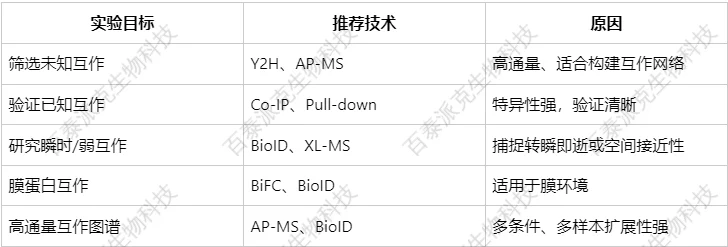
Of course, the best strategy is often to use a combination of techniques to balance sensitivity, specificity, and spatial information. For example, use AP-MS to screen candidate interacting proteins, then validate their authenticity with Co-IP, and finally confirm interaction sites with XL-MS.
4. Biotech Pioneer Biotechnology: A Powerful Platform for PPI Research
In actual research, PPI studies often involve complex sample preparation and high-precision analysis platforms. Biotech Pioneer Biotechnology, based on advanced Orbitrap Exploris high-resolution mass spectrometry, provides clients with comprehensive services from interacting protein screening and interaction network construction to site analysis.
Our advantages include:
- Extensive experience in membrane protein/signal pathway research
- Support for BioID, AP-MS, XL-MS, and other strategies
- Highly reproducible and low-background immuno-enrichment solutions
- Professional data analysis team supports interaction mapping and visualization
PPI research is an indispensable tool in modern life sciences, and the key lies in matching technology with scientific questions. No single method can solve all problems, but by scientifically evaluating research objectives, sample conditions, and technical limitations, choosing the appropriate interaction detection strategy will greatly enhance research efficiency and discovery value. If you encounter challenges in PPI experimental design or data analysis, feel free to contact Biotech Pioneer Biotechnology. We will assist you in constructing high-quality protein interaction maps with a rigorous scientific approach and advanced mass spectrometry platform.
Biotech Pioneer Biotechnology—A premium service provider for bioproduct characterization and multi-omics mass spectrometry detection
Related services:
How to order?




