






Comparison of the Advantages and Disadvantages of Three Common Protein Structure Analysis Methods
Proteins, as the core executors of life activities, have their functionality directly determined by their three-dimensional structures. Accurate determination of protein structures not only aids in revealing biological mechanisms but also provides important clues for new drug development and disease mechanism research. Currently, the main techniques for protein structure determination include X-ray crystallography, nuclear magnetic resonance (NMR) spectroscopy, and cryo-electron microscopy (Cryo-EM).
1. X-ray Crystallography: The 'Gold Standard' for High-Resolution Structure Determination
X-ray crystallography deduces the atomic-level three-dimensional structure of proteins by analyzing the diffraction patterns of protein crystals. Its advantages mainly lie in its high resolution (up to below 1.0Å) and suitability for high-throughput analysis of numerous samples. Currently, about 80% of the structures in the global Protein Data Bank (PDB) are obtained by this method.
✅ Advantages:
-
Ultra-high resolution: It can clearly reveal the precise arrangement of amino acid side chains, metal ions, and water molecules in proteins.
-
Mature technical system: The experimental protocols and data processing software (such as Phenix, CCP4) are relatively mature and well-developed.
-
Wide applicability: Suitable for most crystallizable proteins, including enzymes, receptors, antibodies, etc.
⚠️ Disadvantages:
-
High crystallization difficulty: Many proteins are difficult to crystallize, especially membrane proteins and those rich in flexible regions.
-
Static structure: The crystal environment may restrict the protein's natural conformation and dynamic features.
-
Time-consuming preparation: From crystallization screening to data analysis, it often takes weeks to months.
2. Nuclear Magnetic Resonance (NMR) Spectroscopy: Revealing Solution-State Protein Structures and Dynamics
NMR relies on the resonance signals of nuclear spins in solution, reconstructing protein structures by analyzing a series of multidimensional spectra. It is particularly important for studying the flexible structure and dynamics of proteins.
✅ Advantages:
-
Near-natural state analysis: NMR provides protein structure information under near-physiological conditions, closer to its true state within cells.
-
Captures dynamic characteristics: It not only reveals static structures but also resolves protein conformational changes and dynamics.
-
No need for crystallization: Especially suitable for proteins that are difficult to crystallize, such as certain membrane protein intracellular regions.
⚠️ Disadvantages:
-
Molecular weight limitation: Suitable for studying proteins smaller than 50 kDa, with greater difficulty in analyzing larger complexes.
-
Complex signal overlap: High requirements for sample concentration and purity, and complex signal analysis requires extensive experience.
-
Relatively lower resolution: Difficult to achieve the atomic-level resolution of X-ray crystallography.
3. Cryo-Electron Microscopy (Cryo-EM): A Tool for Studying Large Complexes and Dynamic Structures
Cryo-EM involves rapidly freezing samples and using low-temperature electron beams for imaging and three-dimensional density map reconstruction, suitable for analyzing the structures of large molecular complexes. In recent years, with advancements in single-particle imaging technology and resolution improvements (up to about 2Å), Cryo-EM has become a popular technique in structural biology.
✅ Advantages:
-
No need for crystallization: Suitable for studying large complexes that are difficult to crystallize, such as viral particles, ribosomes, and membrane protein complexes.
-
Applicable to large molecules: Can handle ultra-large complexes with molecular weights exceeding one million Daltons.
-
Multi-conformation analysis: Can capture different conformational states within the same system, revealing function-related dynamic changes.
-
Significant resolution improvement: The recent 'resolution revolution' in Cryo-EM technology has brought its resolution capabilities close to that of X-ray crystallography.
⚠️ Disadvantages:
-
Sample preparation challenges: Requires highly pure and uniformly dispersed samples, with high demands on sample preparation and ice layer thickness control techniques.
-
Expensive equipment: High-end cryo-electron microscopes (such as Titan Krios) and their maintenance are extremely costly.
-
Complex data processing: Image alignment, three-dimensional reconstruction, and heterogeneity classification all require strong computational power and algorithm support.
4. Comparison and Combined Application of the Three Methods
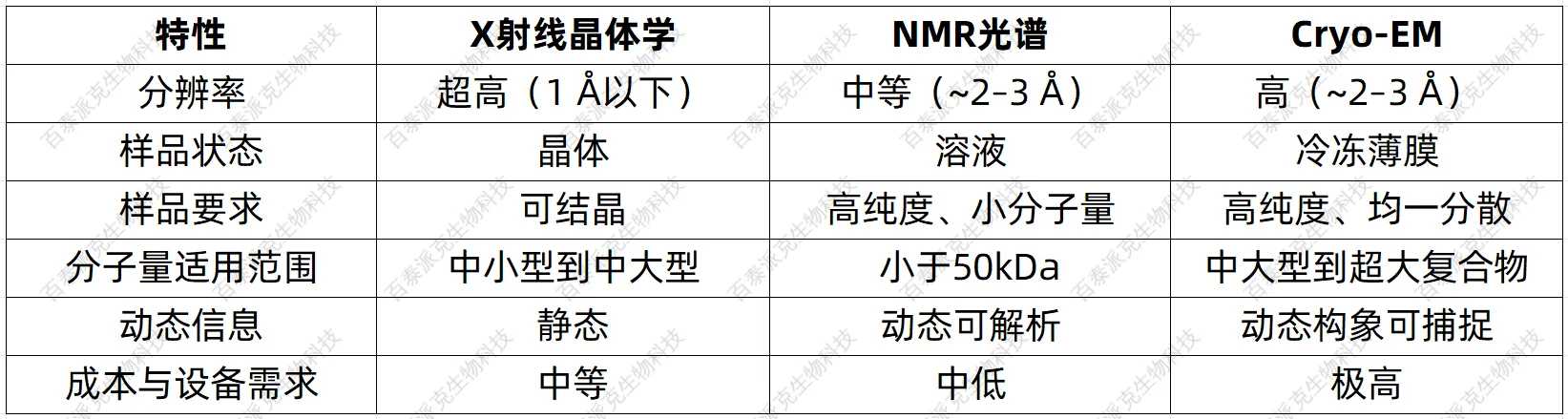
In practical applications, these three techniques are not mutually exclusive but rather complement each other. X-ray crystallography is best for obtaining high-resolution static structures, NMR reveals solution-state conformations and dynamic information, while Cryo-EM shows unique advantages in studying large molecular complexes and multiple conformations. Researchers often employ a multi-technique strategy: for example, using Cryo-EM to resolve the overall structure of membrane protein complexes, obtaining high-resolution domains with X-ray crystallography, and finally analyzing dynamic characteristics of flexible regions with NMR.
From resolution accuracy and applicability to experimental conditions, X-ray crystallography, NMR spectroscopy, and Cryo-EM each have their own strengths and limitations. Researchers should consider the molecular characteristics of the target protein (such as molecular weight, flexibility, crystallization ability), research needs (high-resolution static structure, dynamic conformation, complex analysis), and experimental resources (equipment conditions, time cost) when choosing techniques. BioTechPack provides high-quality protein structure identification services, assisting researchers in comprehensively revealing the relationship between protein structure and function, thereby accelerating scientific breakthroughs and innovative discoveries.
BioTechPack—A Premium Service Provider for Bioproduct Characterization and Multi-Omics Mass Spectrometry Analysis
Related services:
How to order?




