






Analysis of Post-Translational Modifications of Protein Drugs
Post-translational modifications (PTMs) play a crucial role in protein processing and maturation. They can alter the physical and chemical properties of proteins and affect their spatial conformation, steric hindrance, and stability. In turn, this influences the biological activity of proteins, leading to changes in protein function. Research in proteomics of post-translational modifications helps reveal the molecular mechanisms of life processes, screen biomarkers, and identify drug targets.
Post-translational modifications of protein drugs
Regulatory enzymes responsible for protein post-translational modifications have become a forefront and hotspot target in the field of new drug research. The integrity of protein drugs refers not only to the complete amino acid sequence but also to the specific biological activity and function achieved through a series of post-translational modification processes. There are various characteristics of protein drug modification and processing methods, including but not limited to glycosylation, phosphorylation, ubiquitination, acetylation, and methylation. Therefore, the analysis of post-translational modifications in protein drugs plays a vital role in the development and production of protein drugs. Meanwhile, naturally modified protein drugs have significant roles in determining modification types, sites, and structures to enhance their modification or processing efficiency, which can be used in the R&D or production processes of biopharmaceutical companies to improve production technology and ultimately enhance the development efficiency of biopharmaceuticals.
Core histone post-translational modifications
Post-translational modifications of core histones are among the most studied in drug research and development. Histone modifications mainly include acetylation, methylation, phosphorylation, and ubiquitination. These modifications can recruit recognition proteins that identify modification sites, which then recruit other transcription factors or form complexes with various physiological functions, and subsequently regulate transcription. Therefore, researchers vividly define them as 'writers', 'erasers', and 'readers' based on different regulatory factor mechanisms. 'Writers' add modifying enzymes to DNA or proteins. These modifications include methylation, acetylation, glycosylation, ubiquitination, phosphorylation, and (for proteins) oxidation. 'Erasers' remove acetyl groups from histone lysine residues, altering charge, tightening chromatin structure, and inhibiting gene transcription expression. 'Readers' can recognize these modified proteins. Once these modifications are recognized by recognizing factors, they can recruit other transcription factors or proteins to jointly regulate the physiological functions of the body.
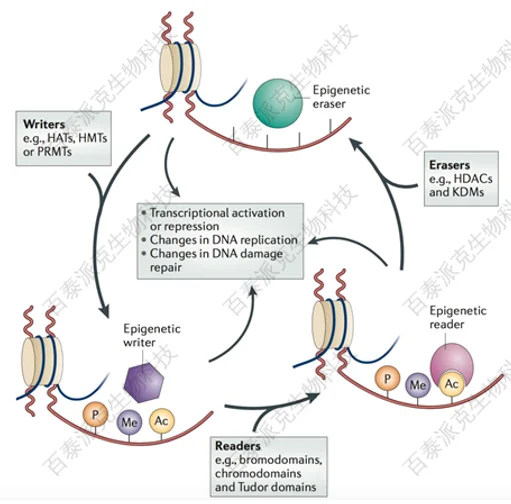
Histone translation and modification (Feinberg AP, 2018)
Glycosylation of antibody drugs
In post-translational modifications of proteins, glycosylation is one of the most important and complex modifications and is a key quality attribute in evaluating antibodies. The realization of the function of monoclonal antibody drugs is closely related to their glycosylation, which affects protein performance such as conformation, stability, solubility, pharmacokinetics, activity, and immunogenicity. The most apparent role of protein glycosylation is that it can increase the stability and solubility of proteins. Different glycosylation modifications have varying effects on the stability, half-life, safety, and biological activity of antibodies. Studies have shown that glycosylation can protect proteins by hiding the binding sites of proteins with proteases. Glycosylation modifications can also hinder the binding of proteases to antibodies, thereby increasing antibody stability.
Analysis methods for protein post-translational modifications
Mass Spectrometry
Mass spectrometry is an important method for identifying protein PTMs. Its principle is to identify post-translational modification sites using the mass differences of modified proteins. Biopharmaceutical products may contain various variants or derivatives derived from functional post-translational modifications, such as glycosylated variants of mAbs or ADCs. Therefore, we need an appropriate technique to characterize and quantify substances with such complexity. Liquid Chromatography-Mass Spectrometry (LC-MS) is an established biopharmaceutical characterization technique because it can perform qualitative and quantitative measurements directly at the molecular level. This technology is also increasingly used in other fields, including macromolecular drug metabolism and pharmacokinetic studies, process development, production, quality control, post-marketing regulation, and therapeutic drug monitoring.
PTMScan
PTMScan is a proteomics technique specifically used for protein PTM studies. It utilizes antibodies targeting motifs of protein post-translational modifications to immunoaffinity enrich peptides with different post-translational modifications at the peptide level, and uses liquid chromatography-tandem mass spectrometry to quantify the peptides, enabling rapid, accurate, and high-throughput analysis of phosphorylation, acetylation, methylation, and ubiquitin modification changes of key node proteins. This meets the needs of innovative research, biomarker identification, drug target screening, and evaluation. PTMScan technology can identify new protein modification sites and open up new directions for protein function research, making it an important branch and trend in next-generation proteomics research.
References
1. Feinberg AP. The Key Role of Epigenetics in Human Disease Prevention and Mitigation. N Engl J Med, 2018, 378, 1323-1334.
2. Fazel R, Guan Y, et al. Structural and In Vitro Functional Comparability Analysis of Altebrel™, a Proposed Etanercept Biosimilar: Focus on Primary Sequence and Glycosylation. Pharmaceuticals, 2019, 12(1).
Related Services
Biopharmaceutical Glycan Analysis
Biopharmaceutical Glycosylation Site Detection
Biopharmaceutical Disulfide Bond/Free Cysteine Detection
Post-translational Modification Proteome Analysis
How to order?




