






Q Exactive Hybrid Quadrupole Orbitrap Mass Spectrometer
The Thermo Scientific Q Exactive hybrid quadrupole Orbitrap mass spectrometer is equipped with a high-performance quadrupole and a high-resolution, accurate mass (HRAM) Orbitrap detector.
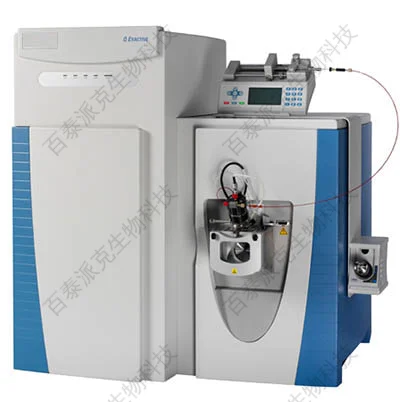
Q Exactive hybrid quadrupole Orbitrap mass spectrometer
Structure of the Q Exactive hybrid quadrupole Orbitrap mass spectrometer
The Q Exactive hybrid quadrupole Orbitrap mass spectrometer mainly consists of an ion source, stacked ring ion guide (S-lens), quadrupole mass filter, curved linear trap (C-trap), high-energy collision dissociation (HCD) cell, and Orbitrap mass analyzer. Samples can be introduced to the ion source through various methods. The flatapole injects ions from the ion source to the quadrupole. The quadrupole assembly acts as an ion transmission device that can filter transmitted ions based on their mass-to-charge ratios. Ions are transferred to the C-Trap and then injected into the Orbitrap mass analyzer to obtain mass spectra. Additionally, ions can enter the HCD cell through the C-Trap and undergo MS/MS experiments in combination with the quadrupole mass filter.
In the Q Exactive, the atmospheric pressure ionization (API) source forms gas-phase sample ions and serves as a connection between liquid chromatography (LC) and MS. The API ion source comprises a maximum ion source and an ion source interface. The maximum ion source can be configured for different API modes, including atmospheric pressure chemical ionization (APCI), atmospheric pressure photoionization (APPI), and electrospray ionization (ESI). The NSI model is obtained using a separate nano-spray ionization (NSI) probe. By front-mounting the ion source holder, ESI, APCI, and APPI probes can be interchanged without tools. The ion source interface includes an ion transfer capillary (aids in ion desolvation), two tube heaters, a heater block, a platinum probe sensor, an anti-exhaust balloon (prevents air from entering the vacuum manifold), an ion sweep cone (directs sweep gas to the tube entrance), a tube lens, and a skimmer.
Ion optics
Ion optical devices focus ions generated in the ion source and transport them to the C-trap. The injected flatapole consists of a square array of flat metal electrodes and serves as an ion focusing device. The curved flatapole transfers ions from the injected flatapole to the quadrupole through a 90-degree arc, removing neutral gas jets and solvent droplets. A combination of inner and outer Turner-Kruger (TK) lenses focuses the ion beam into the quadrupole and acts as a vacuum baffle between the curved flatapole and the quadrupole. The four-exit lens focuses ions from the quadrupole into the transfer multipole, which acts as another transmission device. The separation lens is used to start and stop the injection of ions into the mass analyzer. The S-lens in the source region increases ion transmission to the Q Exactive instrument, improving scan rates by reducing ion injection time or increasing sensitivity by injecting more ions when ion injection time reaches its maximum (maximum ion time).
Quadrupole mass filter
The quadrupole is a square array composed of rods with a hyperbolic profile, located between the TK lens and the transfer multipole. In the quadrupole, two opposite rods in the array are electrically connected. RF and DC voltages are applied to the rods. The same magnitude and sign of voltage are applied to each pair of rods, but the voltages applied to different pairs of rods have the same magnitude but opposite signs. The RF to DC voltage ratio and its values determine the range of mass-to-charge ratios (m/z) transmitted by the quadrupole mass filter. For each injection controlled by the separation lens, the quadrupole RF amplitude and DC voltage are set to fixed values. Under these conditions, only ions with a certain range of m/z ratios remain in bounded oscillation as they pass through the mass filter.
Curved linear trap
Ions entering the C-trap may collide with nitrogen collision gas (bath gas) and lose kinetic energy to prevent them from leaving the C-trap through the gate. Nitrogen collision gas is used to dissipate the kinetic energy of injected ions and cool them to the axis of the C-Trap. Voltages on the end holes (entrance and exit holes) of the C-Trap are raised to provide a potential trap along its axis. These voltages may then be gradually increased to squeeze the ions into a shorter line along this axis.
HCD cell
Sample ions can enter the HCD collision cell through the C-trap, which consists of a straight multipole rod installed inside a metal tube. The front part of the tube is equipped with a lens for adjusting the transmission and ejection from the C-Trap. A potential gradient is applied to the collision cell to rapidly extract ions. The fragment spectra generated in the HCD cell and detected in the Orbitrap show fragmentation patterns comparable to typical triple quadrupole mass spectra.
Orbitrap mass analyzer
The core of the Orbitrap mass analyzer is an axially symmetric mass analyzer consisting of a spindle-shaped central electrode surrounded by a pair of bell-shaped outer electrodes. In the Orbitrap mass analyzer, stable ion trajectories combine rotation around the axial central electrode with harmonic oscillations produced along the axis. The frequencies of these harmonic oscillations along the z-axis depend only on the ion's m/z and the instrument. Ions of all m/z are extracted into the mass analyzer for image current detection. The two halves of the outer electrode detect the image current generated by oscillating ions. The instrument uses Fourier transform to obtain the frequencies of these axial oscillations, thereby determining the ion's m/z.
Functions of the Q Exactive hybrid quadrupole Orbitrap mass spectrometer
1. Resolution up to 140,000 allows more peaks to be seen in samples, enhancing the reliability of results when analyzing samples in complex matrices.
2. Rapid scan-to-scan polarity switching in MS and MS/MS enables the discovery of more compounds in a single run.
3. The S-Lens in the source region can improve sensitivity by injecting more ions into the instrument.
4. Spectrum multiplexing and advanced signal processing ensure UHPLC-compatible data acquisition speeds, thereby increasing throughput.
5. Applications of the Q Exactive hybrid quadrupole Orbitrap mass spectrometer
Applications of the Q Exactive hybrid quadrupole Orbitrap mass spectrometer
Metabolite research
The Q Exactive mass spectrometer, with the accuracy and reliability of Orbitrap technology, can also eliminate interference. It is an excellent choice for metabolite structural identification, providing MS/MS sensitivity and higher confidence. Additionally, the Q Exactive features fast scan-to-scan polarity switching, maximizing the detection and identification of metabolites from a single chromatographic run. With high mass resolution and fast polarity switching, the Q Exactive mass spectrometer is ideal for large-scale metabolomics analysis, capable of finding more endogenous metabolites.
Related services
Proteomics research
Compared to CID used in proteomics research, the Q Exactive mass spectrometer with HCD produces more fragments and higher quality mass spectra for improved identification. The Q Exactive mass spectrometer provides powerful and easy-to-use HRAM capabilities for quantitative and qualitative proteomics applications. Furthermore, there is a range of software, such as Thermo Scientific Proteome Discoverer, SIEVE software, and Pinpoint software, to support proteomics research.
Related services
Clinical research and forensic toxicology
The Q Exactive LC-MS/MS combines SRM and HRAM Orbitrap technology and can be used in clinical research and forensic toxicology. The Q Exactive mass spectrometer can be used for targeted quantitative analysis of testosterone in plasma, urine, and oral fluids. Additionally, the Q Exactive mass spectrometer can be used for the quantitative analysis of endogenous steroids or similar molecules in body fluids. The Q Exactive mass spectrometer, combining high-performance quadrupole precursor selection and HRAM Orbitrap detection, can be widely used in metabolomics, proteomics, environmental and food safety, clinical research, and forensic toxicology.
How to order?




