






Q Exactive Plus Hybrid Quadrupole Orbitrap Mass Spectrometer
The Thermo Scientific Q Exactive hybrid quadrupole Orbitrap mass spectrometer introduces the concept of Quanfirmation, which allows for routine and confident identification, quantification, and confirmation using a single mass spectrometer in one analysis. The Q Exactive Plus hybrid quadrupole Orbitrap mass spectrometer takes Quanfirmation a step further with enhanced performance and new options.
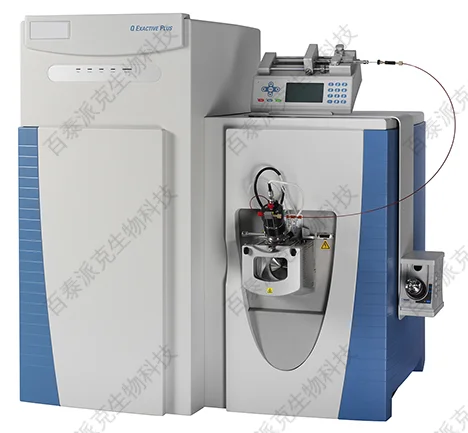
Q Exactive Plus hybrid quadrupole Orbitrap mass spectrometer
Structure of the Q Exactive Plus mass spectrometer
Like the Q Exactive mass spectrometer, the Q Exactive Plus consists of six main components, including an ion source, flatapole technology with mass resolving capability, a quadrupole mass filter for precursor ion selection, a curved linear trap (C-trap) for short selections, a collision cell, and an Orbitrap analyzer for Fourier-transform mass analysis.
Flatapole serves as both an ion focusing device and an ion pre-filtering device. To focus ions along the axis of the lens, an RF voltage is applied to the electrodes. Additionally, a DC voltage is applied to the flatapole. In positive ion mode, this voltage creates a negative potential difference relative to the S-lens exit lens. In negative ion mode, this voltage difference is reversed. In ion pre-filtering mode, an additional DC voltage (opposite in sign but equal in magnitude) is applied to the opposing electrode sets to coarsely filter out ions outside the narrow window around the wide window of ions passing through the quadrupole. For the quadrupole mass filter, Q Exactive Plus MS uses advanced quadrupole technology (AQT), which includes a segmented hyperbolic quadrupole for greater transmission efficiency and optimized transmission window shape.
In the Q Exactive Plus mass spectrometer, after the sample is introduced into the API ion source, the flatapole transfers ions to the quadrupole. Additionally, based on the mass-to-charge ratio (m/z) of the ions, the flatapole can also function as a coarse pre-filter for ions. The quadrupole can transmit and filter ions based on their m/z ratio. Ions are then transferred to the C-trap, where they are accumulated, and their energy is reduced by bath gas. The ions are then injected into the Orbitrap analyzer to obtain a mass spectrum. Furthermore, for MS/MS experiments or All Ion Fragmentation (AIF), ions are passed through the C-Trap into the HCD chamber for fragmentation. After fragmentation, ions are transferred back to the C-Trap and injected into the Orbitrap analyzer for detection.
Features of the Q Exactive Plus mass spectrometer
Several methods are used for quantification, including Selected Ion Monitoring (SIM), Parallel Reaction Monitoring (PRM), and Data-Independent Acquisition (DIA). In SIM, ions with one or more specific m/z values can be detected, providing high specificity and sensitivity. In PRM, predefined precursor ions are selected in the quadrupole and transferred through the C-trap to the HCD chamber for fragmentation. After fragmentation, fragment ions are transferred back to the C-trap and finally injected into the Orbitrap mass analyzer for analysis. In DIA, all ions within a selected m/z range are fragmented and analyzed in the second stage of MS/MS, after which the data can be studied using an enhanced library for better data generation.
Advanced Axial Beam Guide (AABG) offers higher sensitivity and maximum robustness. AABG, with a pre-filtering second-generation axial field curved flatapole ion guide, reduces noise by preventing neutral particles and high-velocity clusters from entering the quadrupole.
Advanced Quadrupole Technology (AQT) enables excellent precursor separation. AQT with a segmented quadrupole mass filter provides higher ion transmission rates and excellent separation window shapes. The range for variable precursor isolation width selection is from 0.4D to the entire mass range. AQT optimizes precursor ion selection and transmission, improving quantification of low-abundance ions in the most complex matrices.
Optional intact protein mode. It offers excellent capture capability for large molecules to improve the analysis of intact proteins and protein complexes.
Applications of the Q Exactive Plus mass spectrometer
1. Protein Identification. Q Exactive Plus MS can enhance the sensitivity and accuracy of protein identification. AABG and AQT improve the identification of low-abundance proteins in complex matrices while providing maximum reliability and credibility.
2. Intact Protein Characterization. With the new intact protein and enhanced resolution modes, the Q Exactive Plus system can reliably analyze intact proteins and isotopically resolve subunits up to 50 kDa with excellent sensitivity. This may be a good choice for therapeutic protein and monoclonal antibody (mAb) analysis.
3. High Confidence Quantification. The Q Exactive Plus mass spectrometer with AQT optimizes ion selection and transmission, improving quantification of low-abundance ions within a narrow separation window, and can be used for isobaric mass tagging (such as Tandem Mass Tags, TMT). The Q Exactive Plus system with PRM and High-Resolution Accurate Mass Selected Ion Monitoring (HRAM-SIM) can quantify peptides and small molecules with excellent sensitivity and unparalleled selectivity. Additionally, DIA can provide high-throughput protein quantification and qualitative confirmation.
The Q Exactive Plus mass spectrometer combines quadrupole precursor ion selection with HRAM Orbitrap, enabling more reliable identification and quantification of a wider range of compounds.
How to order?




