






How can I tell if desalting is done properly?
Whether desalting is thorough directly affects subsequent electrospray efficiency, peak shape, ion suppression, and other issues.The following explains step-by-step from an experimental perspective how to determine if desalting is clean.
I. Conventional Methods to Determine Whether Desalting is Complete
1、Mass spectrometry detection (most direct and effective)
Directly analyze samples before and after desalting using mass spectrometry and observe the following points:
(1) Whether there is a large area of strong ion suppression(such as weak signals and only baseline);
(2)Whether there area large number of low molecular weight ion clusters(m/z ~100–300), commonly seen with residues of Na⁺, K⁺, TFA, etc.;
(3)Whether the target peaks are clearand whether the mass spectrum is 'clean.'
Judgment criteria:
- If desalting is thorough, background ion interference significantly reduces, target signals enhance, and ion peaks are sharp and clear;
- If desalting is incomplete, many small ion clusters, serious tailing, and decreased signal-to-noise ratio will be observed.
2. UV detection or nano titration method for detecting salt ions
Suitable for labs with conditions, though not conventional, can be used in specific situations for quantitative residual salt detection.
(1) Useconductivity detection: Compare conductivity changes before and after desalting;
(2) UseAgNO₃ for Cl⁻ detection, K₂CrO₄ for Na⁺ detection, and other classic titrations;
If using C18 columns for desalting, you can collect flow-through to check if salt is completely washed out.
3. MALDI-TOF Pre-check
If subsequent analysis involves MALDI, you can first spot-test:
(1) When components are complex or salt residues are high, crystal quality is poor, and after spotting, it appearsas uneven granular;
(2) After clean desalting, crystals are more uniform, and spectrum signals significantly enhance.
4. Observe the physical properties of the concentrated sample
If using SpeedVac for concentration:
(1) If there is salt residue in the concentrated sample, it often forms crystalline particles;
(2) If desalting is thorough, the concentrated sample appears uniform and transparent, with no visible crystals;
(3) A small amount of water can be used to redissolve, observing if it dissolves easily.
II. Practical Suggestions (Reducing Salt Contamination from the Source)
- Uselow-salt/no-salt lysis bufferfor protein processing (such as avoiding high-salt PBS as much as possible);
- PreferC18 columns, Ziptip, HILIC microcolumns, etc.as suitable carriers for desalting;
- Use 50% ACN + 0.1% FA for elution, which can carry out peptides while suppressing salt;
- Elution should be concentrated to a small volume (e.g., <10 μL) to avoid salt overload in subsequent injections.
III. Summary of Experience-based Judgment
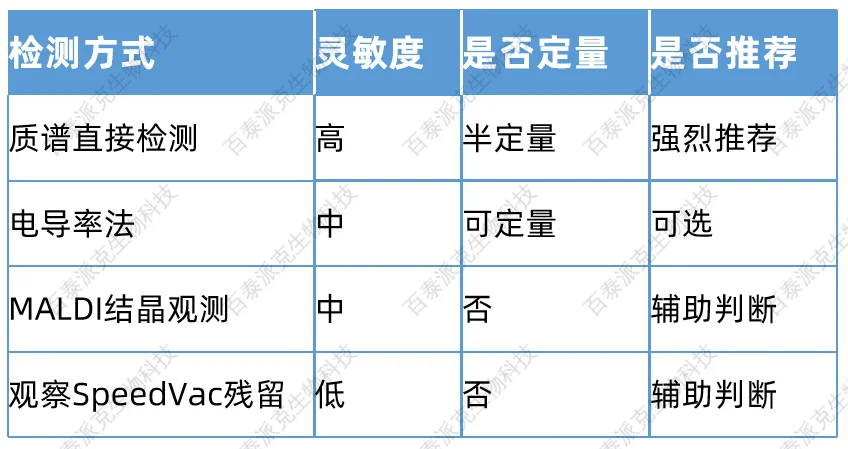
The most reliable method is to observe signal changes and background interference by mass spectrometry for samples before and after desalting; whether desalting is complete can be comprehensively judged from ion suppression, low molecular ion residue, and signal-to-noise ratio changes.
Bio-Techne -- Characterization of bioproducts, a high-quality service provider for multi-group biomass spectrometry detection
Related services:
How to order?




