






How to obtain RMSECV based on OPLS?
First, let's understand the concepts of OPLS (Orthogonal Projections to Latent Structures) and RMSECV (Root Mean Squared Error of Cross Validation).
OPLS is a type of partial least squares regression analysis (PLS) method. Its main feature is to divide the X variable space into a part that is related to the Y variable and another that is unrelated to Y through orthogonal decomposition. This method can enhance the interpretability of the model, helping us better understand the main influencing factors related to the response variable.
RMSECV is an indicator used to evaluate the performance of regression models. It measures the predictive ability of the model by calculating the root mean squared error of the predictions for each observation during cross-validation. A smaller RMSECV value indicates better predictive performance of the model.
The general steps to calculate RMSECV using the OPLS model are as follows:
1. Data Preparation:
Divide the dataset into X (predictor variables) and Y (response variables) matrices.
2. Data Preprocessing:
Preprocess the X and Y matrices, such as mean centering, scaling, etc.
3. Model Construction:
Apply the OPLS algorithm to construct a regression model. During this process, cross-validation (such as K-fold cross-validation) can be used to determine the optimal number of principal components for the OPLS model.
4. Cross-Validation:
Divide the dataset into K subsets, sequentially using each subset as the test set and the remaining subsets as the training set. Build the OPLS model using the training set and then predict the test set.
5. Calculate RMSECV:
For each observation in the test set, calculate the square of the difference between the predicted and actual values, sum all the squared differences and divide by the total number of observations, then take the square root of the result.
In Python, you can use libraries such as scikit-learn and pyopls to implement this process:
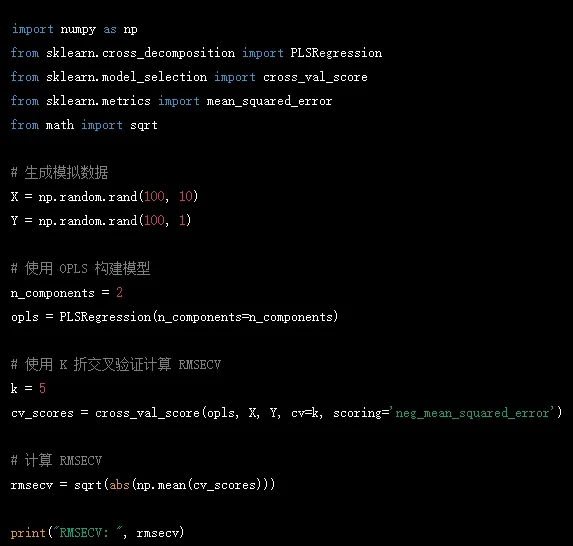
This example uses scikit-learn to construct a PLS model and calculate RMSECV. Please note that the PLSRegression class in scikit-learn actually implements PLS, not OPLS, but in many cases, PLS and OPLS have similar performance. If you want to use the OPLS algorithm, you can use other libraries, such as pyopls. Here is an example using pyopls:
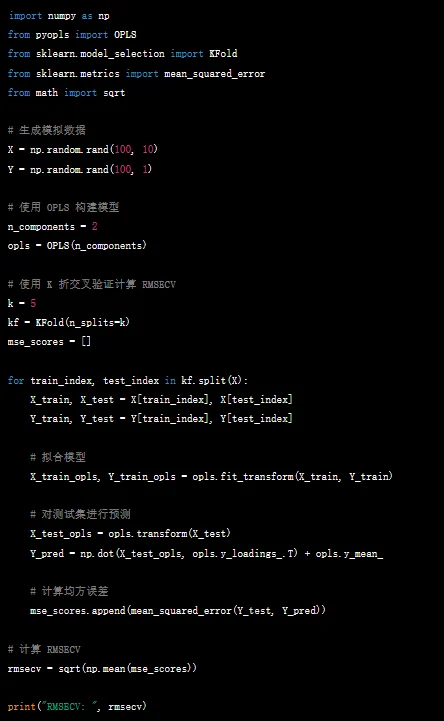
This code example uses the pyopls library to construct an OPLS model and calculate RMSECV using K-fold cross-validation. In practice, you may need to preprocess the data and adjust model parameters.
BiotechPack, A Biopharmaceutical Characterization and Multi-Omics Mass Spectrometry (MS) Services Provider
Related Services:
Proteomics Bioinformatics Analysis
How to order?




