






Application of DIA technology in ubiquitinated proteomics
Ubiquitination is an important post-translational modification (PTM) that regulates processes such as protein stability, signal transduction, and DNA repair by attaching a 76-amino acid ubiquitin molecule to lysine residues on substrate proteins. Traditional mass spectrometry methods such as DDA (Data-Dependent Acquisition) have made some progress in capturing ubiquitinated peptides, but issues of signal bias and data loss remain. In recent years, Data-Independent Acquisition (DIA) technology with diGly specific antibody enrichment has enabled high-throughput quantitative analysis of ubiquitinated proteomes.DIA technology has become an indispensable tool in ubiquitinomics research.It is particularly suitable for analyzing low-abundance ubiquitination modifications, improving cross-sample comparability, and supporting large-scale functional screening experiments.
I. Reasons for Combining Ubiquitination with Data-Independent Acquisition (DIA) Technology
1. Full-spectrum unbiased acquisition enhances data integrity
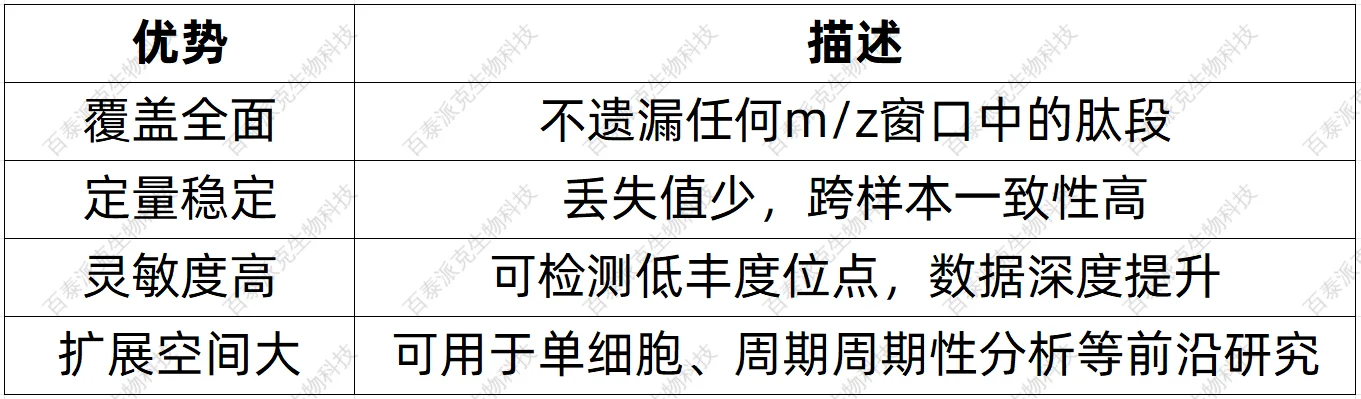
(1) DIA fragments all precursor ions through pre-set m/z windows to achieve "no-miss" acquisition.
(2) Compared to DDA, which only selects high-abundance peptides, DIA significantly reduces acquisition bias, effectively capturing low-abundance ubiquitinated peptides and improving experimental reproducibility.
2. Enhanced reproducibility and quantitative accuracy
(1) The quantitative coverage of DIA is more stable, with fewer missing values across samples, and the quantitative CV value is usually lower than DDA.
(2) This is particularly crucial for comparing pathological and normal states and screening potential DUB/E3 targets.
II. Experimental Workflow of DIA-Ubiquitinomics
1. Sample Preparation
(1) After cell or tissue lysis, digest with trypsin.
(2) Then use anti-diGly antibodies to selectively enrich ubiquitinated peptides containing residual glycine-lysine, which is the core step of the DIA ubiquitinomics experiment.
2. Spectral Library Building
(1) To improve matching efficiency, a large peptide spectral library is usually generated by DDA or in silico.
(2) For example, Hansen et al. established a library with over 90,000 diGly peptides, identifying up to 35,000 diGly sites in a single DIA run.
3. DIA-MS Acquisition
(1) Based on high-resolution mass spectrometers like Orbitrap, DIA acquisition is performed using a variable window mechanism.
(2) Ensures comprehensive coverage of ubiquitination signals and enhances quantitative linearity.
(3) Coupled with software like Spectronaut and DIA-NN for analysis, achieving high-throughput results output.
4. Data Processing and Quantitative Analysis
(1) In addition to traditional library-based matching, a library-free mode (directDIA) can also be used.
(2) This is particularly advantageous when sample quantity is limited or the spectral library is incomplete, as reported in single-cell DIA studies.
III. Showcase of Typical Research Cases
1. Applications in Environmental Response and Signal Pathways
(1) Hansen et al. detected ubiquitination sites in the TNF signaling pathway using DIA, discovering many new targets.
(2) It revealed the intrinsic circadian rhythm regulation of ubiquitination in clock proteins.
2. Exploration of Drug Mechanisms of Action
(1) Researchers like Steger used DIA to quantify over 70,000 ubiquitination sites.
(2) They identified immediate targets of USP7 inhibitors, with significant ubiquitination changes occurring within 2 minutes.
3. Single-Cell Level Ubiquitinomics
(1) Recent single-cell DIA studies have been able to identify hundreds or thousands of ubiquitinated peptides in single or small numbers of cells.
(2) This advancement will promote deeper applications of ubiquitinomics in fields like cellular heterogeneity and cancer microenvironments.
IV. Summary of Advantages of DIA-Ubiquitinomics
V. Challenges of Combining DIA Technology with Ubiquitin Proteomics
1. Cost and Quality Control of Spectral Library Construction
(1) Large spectral libraries rely on DDA runs, which are costly and require significant lab resources.
(2) The quality of the library directly affects the level of DIA results.
2. Difficulty in Chain Type Recognition
Although DIA enhances site capture, parallel methods (such as neutral loss detection and chemical probes) are still needed for qualitative and quantitative analysis of multiple ubiquitin chain types.
3. High Threshold for Data Analysis
(1) DIA data is complex, requiring reliance on algorithm platforms like Spectronaut and DIA-NN.
(2) High-performance computing resources and expertise are crucial for reliable output.
VI. Prospects for Combining DIA Technology with Ubiquitin Proteomics
1. Further Popularization of Single-Cell Ubiquitinomics
2. Joint Quantitative Analysis of Dual Modifications (such as Co-existing PTM)
3. Deep Integration of Artificial Intelligence Algorithms and In-Silico Libraries
4. General Adaptation to Clinical Samples and Scalable Platform Applications
VII. Advantages of DIA Ubiquitinomics by Biotech Company Biopticon
BaiTai Parker Biotechnology has a mature DIA-Ubiquitinomics technology platform:
1. Independently optimized antibody enrichment process:Efficient extraction of target diGly peptides from cell and tissue samples
2. Customized spectral library construction:Combining DDA and in-silico library strategies to support project-level spectral library generation
3. Professional data analysis team:Utilizing tools like Spectronaut and DIA-NN to provide integrated data interpretation reports
4. Specific research domain services:Including circadian rhythm, biopharmaceutical development, single-cell analysis, and drug mechanism research
DIA technologyhas becomean important technological pathwayin ubiquitin-proteomics research. If you are also planning to apply DIA technology to explore cell cycle regulation, disease mechanisms, or drug action mechanisms, BaiTai Parker Biotechnology looks forward to providing you with end-to-end customized services—from sample processing to data analysis—to help achieve outstanding research results! For more details on our services, technological roadmaps, and collaboration plans, please contact the BaiTai Parker Biotechnology expert team. We will safeguard your research projects.
BaiTai Parker Biotechnology—A premier service provider for biopharmaceutical characterization and multi-omics mass spectrometry detection
Related services:
How to order?




