






iTRAQ, TMT and SILAC: Comparison and Analysis of Three Major Protein Quantification Techniques
Overview of Technical Principles
1、SILAC(Stable Isotope Labeling by Amino acids in Cell culture)
SILAC is based on the incorporation of stable isotope-labeled amino acids (such as 13C6-Lys, 13C6-Arg) into protein structures through cellular metabolism during cell culture, achieving 'in vivo' labeling. By culturing two groups of cell samples with amino acids containing light and heavy isotopes, respectively, and allowing cells to grow over multiple generations (usually 5-7 generations), their proteins are fully labeled. Subsequently, the two samples are mixed in equal amounts during protein extraction, digested, and analyzed by LC-MS/MS. The origin of peptides is distinguished by mass differences in the MS1 level, and the ratio of heavy to light signals is calculated for quantification. SILAC is a 'metabolic labeling' method that naturally avoids sample handling errors during experiments. Its greatest advantage is that sample mixing occurs before cell lysis, greatly reducing technical repeat errors.
2、iTRAQ(Isobaric Tags for Relative and Absolute Quantitation)
iTRAQ is a 'chemical isobaric tagging' technology applicable to peptides post-protease digestion. Its principle involves chemically labeling the N-terminus and lysine side chains of peptides with iTRAQ reagents. iTRAQ reagents consist of a reporter group (quantitative part), a balance group (mass balance), and a peptide reactive group. Different tags are identical in overall mass, indistinguishable at the MS1 stage, but release reporter ions of different masses at the MS2 stage, enabling sample differentiation and quantification. iTRAQ currently supports 4-plex and 8-plex parallel quantification for multiple samples and is widely used in proteomic studies of tissues, serum, and other sample types.
3、TMT(Tandem Mass Tags)
TMT technology is similar in principle to iTRAQ and also belongs to isobaric tagging, with quantitative information dependent on the MS2 stage. Due to improved tag structure design, TMT now supports higher multiplex capabilities, including TMT 10-plex, 11-plex, 16-plex, and even 18-plex. TMT tags also consist of reporter, balance, and reactive parts, with relative quantification achieved by reporter ion intensity in MS2. The advantage of TMT lies in its higher throughput and stronger sample differentiation capability, particularly suitable for large-scale clinical cohorts and single-cell proteomics research, making it one of the most widely used quantitative tagging technologies today.
Comparison of Main Advantages and Disadvantages

Interpretation of Technical Comparison
1. Multiplex Capability
(1) TMT supports up to 16-18 samples for parallel analysis
(2) iTRAQ supports 4 or 8 plex
(3) SILAC is 2-3 fold, NeuCode has expandability
2. Quantitative Accuracy
(1) SILAC relies on mass differences in MS¹ for quantification, with fewer technical errors
(2) iTRAQ/TMT use reporter ions in the MS² stage, susceptible to ratio compression
3. Sample Applicability
(1) SILAC is suitable only for cell culture models
(2) iTRAQ/TMT are suitable for cells, tissues, fluids, etc.
4. Cost and Process
(1) SILAC has a long labeling time, with heavy isotopes significantly increasing costs
(2) iTRAQ/TMT tags are costly, requiring experience in channel adjustment
Recommendations for Technology Selection
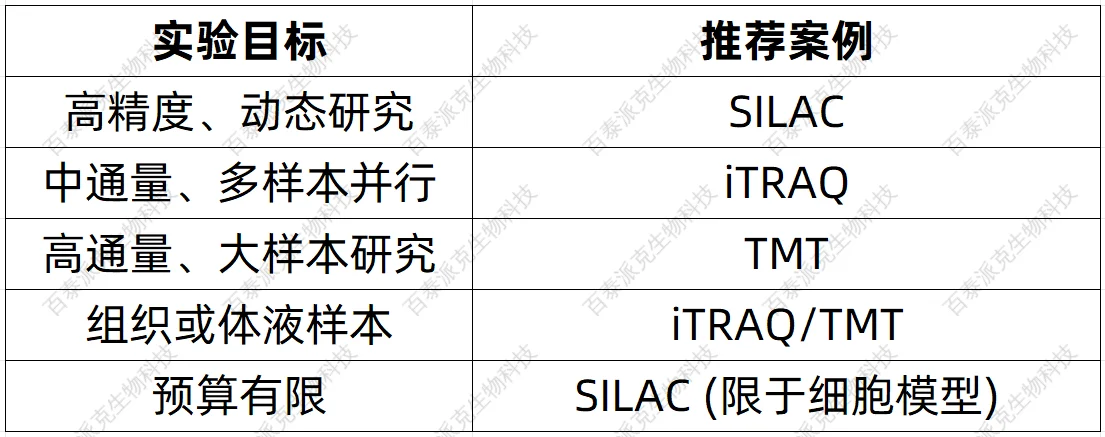
SILAC is a highly accurate, reproducible protein quantification technology suitable for dynamic studies in cell models; iTRAQ is suitable for medium-throughput parallel analysis; TMT is currently the highest-throughput technology, ideal for specialized studies and expert adjustment investments. Given the distinct differences in labeling methods, quantitative economy, and sample applicability, researchers should choose wisely based on experimental needs, budget, and sample conditions.
As a long-standing proteomics service provider, Biotech Pack Bio offers comprehensive labeling quantification solutions, including SILAC, iTRAQ, and TMT:
1. High-resolution Orbitrap mass spectrometry platform
2. Mature labeling and classical process flow, achieving repeat CV < 15%
3. Comprehensive application cases, adapting to various research needs
4. User training and standardized process assistance
We welcome you to learn more, and we hope to contribute our expertise to your proteomics research. In actual projects, technology selection depends not only on the essence of scientific questions but also on the capabilities of the experimental platform. Biotech Pack Bio possesseshigh-throughput TMT/iTRAQ quantification platforms and optimized SILAC systems, combined with one-stop mass spectrometry analysis services, can provide personalized solutions for different research needs, assisting in efficient scientific advancement.
Biotech Pack Bio - Quality Service Provider for Biological Product Characterization and Multi-Omics Biological Mass Spectrometry Detection
Related Services:
Quantitative Proteomics Analysis based on SILAC/Dimethyl Labeling
How to order?




