






MRM Targeted Quantitative Proteomics for Evaluating PROTAC Efficacy
1. PROTAC: A New Paradigm of Drug Development from 'Inhibition' to 'Degradation'
Unlike traditional small molecule inhibitors, PROTAC (Proteolysis Targeting Chimera) recruits E3 ubiquitin ligases to induce ubiquitination of target proteins, leading to their degradation by the proteasome within cells. This 'removal rather than inhibition' mechanism offers a novel drug development strategy for 'undruggable' targets such as transcription factors and scaffold proteins.
During the development of PROTAC molecules, accurately assessing their ability to degrade target proteins is critical for optimizing efficacy and structural iteration. This is where targeted proteomics, particularly MRM (Multiple Reaction Monitoring) quantitative technology, demonstrates great value.
2. Why is MRM Suitable for Evaluating PROTAC?
MRM is a targeted protein quantification method based on Triple Quadrupole (QqQ) mass spectrometry, known for its outstanding sensitivity, specificity, and reproducibility. It is widely used in biomarker validation and clinical sample analysis. In PROTAC research, MRM's quantitative precision and high throughput capacity have gradually made it the standard tool for efficacy evaluation.
3. Three Core Advantages of MRM in Evaluating PROTAC Potency
1. Accurate Quantification of Target Protein Degradation
By designing specific peptide segments of the target protein and their corresponding MRM transitions (the parent ion-fragment ion pair monitored in Triple Quadrupole mass spectrometry), fmol-level quantification sensitivity can be achieved, enabling precise capture of protein dynamic changes before and after PROTAC treatment.
2. Parallel Analysis of Degradation Efficiency Under Various Conditions
MRM efficiently supports parallel detection of multiple time points, dose gradients, and candidate PROTAC molecules in the same batch, suitable for quickly constructing degradation curves and screening structure optimization directions.
3. Combined Detection of Downstream Signaling Proteins to Assess Functional Impact
In addition to the target protein itself, MRM can also cover key pathway proteins (such as transcription regulators and phosphorylated proteins), helping researchers comprehensively evaluate the impact of protein degradation on cellular functions and signaling pathways.
4. Advantages of MRM Compared to Western Blot
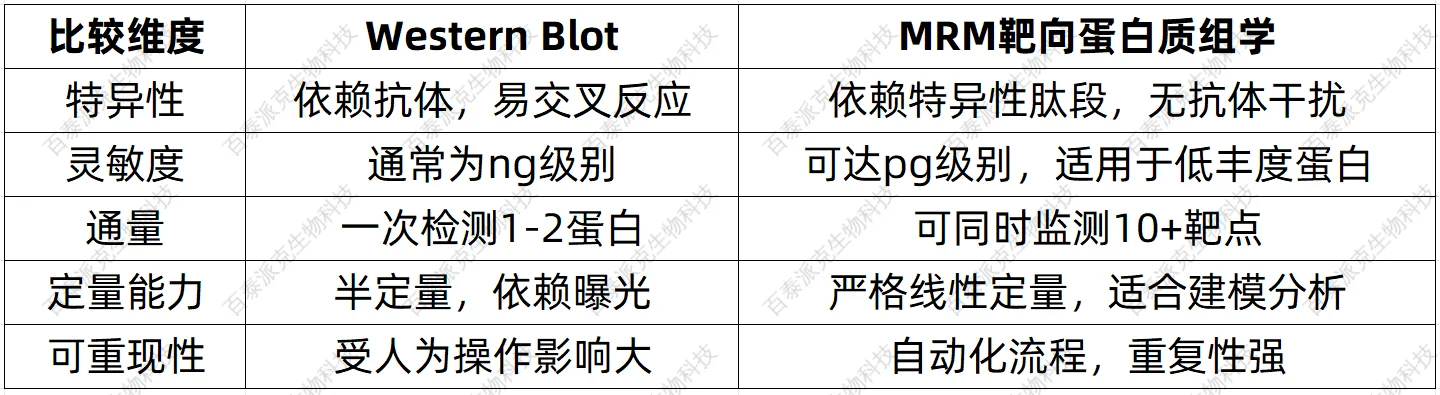
MRM surpasses Western blot in accuracy, scalability, and experimental efficiency, particularly meeting the demands of high-throughput target evaluation in drug development.
Conclusion: MRM Makes PROTAC Development More Quantifiable and Controllable
In the emerging drug strategy of PROTAC, accurately assessing protein degradation efficacy is the key link between 'structure' and 'function'. Targeted quantitative proteomics through MRM, with its excellent sensitivity, throughput, and reproducibility, is becoming the standard tool for efficacy evaluation and candidate molecule screening. Bio-Techne has a mature MRM quantitative platform and extensive PROTAC project experience, offering 'one-stop' customized services from peptide screening, method development to sample detection, supporting faster and more stable new drug development.
Bio-Techne - Characterization of Biological Products, High-Quality Service Provider in Multi-Omics Mass Spectrometry Detection
Related Services:
How to order?




