






Advantages and Limitations of PRM and MRM in Targeted Proteomics
Targeted Proteomics, as a quantitative and precise strategy with strong repeatability, is increasingly becoming a core tool in biomarker validation, clinical translational research, and drug mechanism exploration. Currently, two main targeted techniques based on mass spectrometry—Multiple Reaction Monitoring (MRM) and Parallel Reaction Monitoring (PRM)—each exhibit different technical characteristics and application advantages. This article will deeply analyze the similarities and differences between PRM and MRM from the aspects of principles, performance comparison, application scenarios, and limitations, helping researchers make the best choice based on their research goals.
I. Brief Introduction to the Principles of MRM and PRM
1. Multiple Reaction Monitoring (MRM)
MRM is typically based on the Triple Quadrupole (QqQ) platform, achieving highly specific quantitative analysis by selecting specific precursor ion-fragment ion pairs (transitions). Its advantages are fast detection speed and high sensitivity, especially suitable for quantitative validation of known proteins or peptides.
2. Parallel Reaction Monitoring (PRM)
PRM technology is based on high-resolution mass spectrometry platforms such as Orbitrap or Q-TOF. Unlike MRM, PRM does not predefine specific fragment ions but performs a full scan (Full MS/MS) of the target precursor ion, obtaining all fragment ion information at once, thus achieving higher selectivity and flexibility in data post-processing.
II. Performance Comparison between MRM and PRM
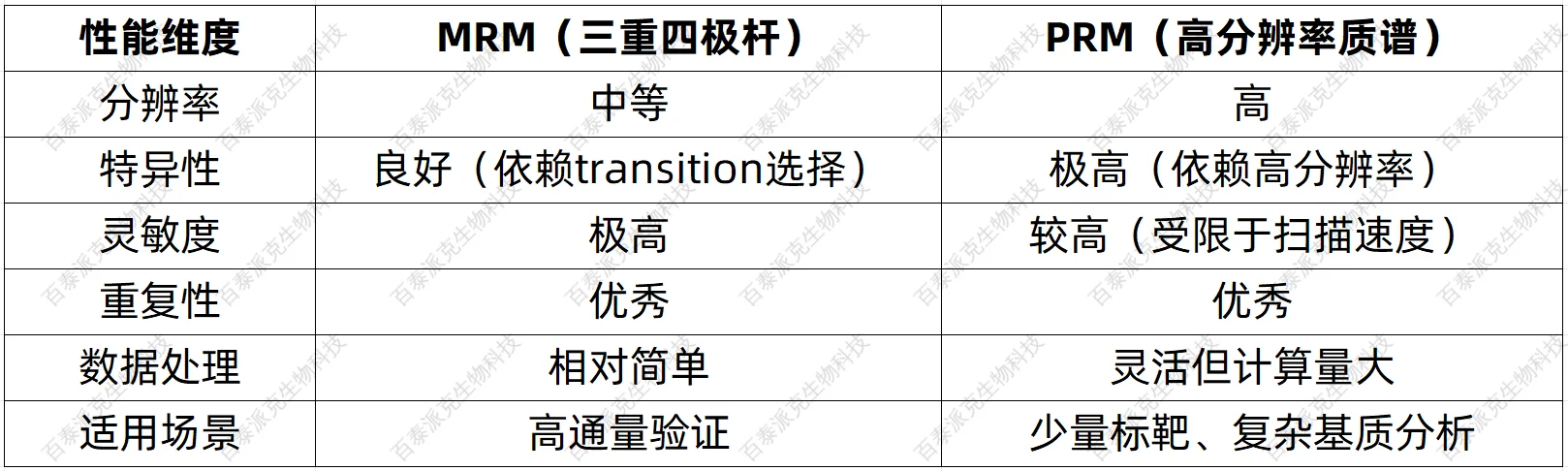
III. Technical Choices: Depends on Research Purpose and Sample Complexity
High-throughput validation and clinical large sample analysis: MRM, with its excellent throughput and quantitative linear range, is suitable for constructing multi-target quantitative panels, widely used in the validation stage of candidate biomarkers.
Low-abundance protein detection and complex matrix samples: The high-resolution characteristics of PRM are more suitable for precise quantification of trace proteins in complex backgrounds such as plasma and cerebrospinal fluid, especially advantageous in early discovery and mechanism research.
IV. Technical Limitations Need to be Balanced
Although MRM and PRM exhibit outstanding performance in targeted proteomics, each has certain limitations:
-
MRM: Requires pre-optimization of each transition, not flexible enough for non-model organisms or modified proteins.
-
PRM: Due to the broader MS/MS scan range, the cycle time becomes longer, affecting peptide coverage; additionally, high-resolution mass spectrometry equipment is costly and requires more complex operation and maintenance.
MRM and PRM, as two mainstream strategies of targeted proteomics, are respectively suitable for multi-target high-throughput screening and target validation with strong specificity and high resolution. Biotech-Pack Bio provides customized services covering target design, peptide synthesis, method development, and sample quantification based on high-end mass spectrometry platforms like Thermo Q Exactive™ and Sciex Triple Quad™. Whether it's precise quantification of a single target or large-scale biomarker detection, we can flexibly configure solutions according to experimental needs to help customers obtain high-quality, repeatable quantitative results.
Biotech-Pack Bio--Characterization of Biological Products, High-quality Service Provider for Multi-omics Mass Spectrometry Detection
Related Services:
How to order?




