






LC-MS/MS Mass Spectrometry Analysis
LC-MS/MS (liquid chromatography tandem mass spectrometry) combines the separation capability of liquid chromatography and the analytical capability of mass spectrometry, enabling highly sensitive and selective compound analysis. Biotech company Biotree provides LC-MS/MS-based protein analysis, proteomics, and metabolomics services.
LC-MS/MS
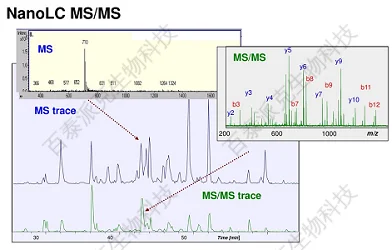
LC-MS/MS, the combination of liquid chromatography (LC) and tandem mass spectrometry (MS/MS), is an analytical chemistry technique that integrates the physical separation capabilities of LC with the mass analysis capabilities of MS. Compared with LC-MS, LC-MS/MS integrates the analytical capabilities of two mass spectrometers: the first mass spectrometer (MS1) analyzes and filters precursor ions, and the second mass spectrometer (MS2) analyzes fragment ions produced from the precursor ion, improving detection sensitivity and providing more structural information about the analytes from the fragmentation pattern.
LC-MS/MS mass spectrometry analysis
LC-MS/MS mass spectrometry analysis
LC-MS/MS mass spectrometry analysis can be used to detect residual compounds, identify small organic molecules, and confirm and quantify contaminants and adulterants in pharmaceutical and food samples. Additionally, it can be used to analyze macromolecules such as proteins, including protein sequencing, analysis of post-translational modification sites, and quantitative proteomics.
In LC-MS/MS analysis, the sample solution first enters the chromatograph, where different substances interact differently with the stationary and mobile phases, leading to different migration rates and thus achieving separation of sample components. The separated components are ionized to form charged ions, which are filtered by MS1. Selected precursor ions collide with inert gas to fragment into product ions, which are then analyzed by MS2. This series of separation, ionization, and selective fragmentation provides highly sensitive detection results.
Related services
Protein mass spectrometry identification
Quantitative protein group analysis
Mass spectrometry-based sequence analysis
Post-translational modification proteomics analysis
Metabolomics
How to order?




