






Mass Spectrometry Analysis of Protein Post-Translational Modifications
Mass spectrometry analysis of post-translational modifications can analyze modification types, modification sites, and quantitatively analyze post-translationally modified proteins. Biotech company BGI-Park provides such services.Mass spectrometry analysis of protein post-translational modificationsservices.
Mass spectrometry analysis of protein post-translational modifications
Compared to techniques like Western blot, mass spectrometry technology can more effectively analyze protein post-translational modifications and complement conventional Western blot identification of modified proteins. Mass spectrometry analysis of protein post-translational modifications generally uses a bottom-up peptide-based approach. However, the bottom-up mass spectrometry method cannot guarantee the complete identification of specific post-translational modifications of target proteins because mass spectrometry identifies proteins through multiple peptides within a sequence, significantly reducing the chance of identifying modified peptides. A strategy to increase the number of modified peptides detected by mass spectrometry is to use PTM affinity reagents for peptide enrichment rather than protein enrichment, which will reduce the number of unmodified peptides enriched.
Principle of mass spectrometry analysis of protein post-translational modifications
Compared to proteins without post-translational modifications, proteins with such modifications have an increase in molecular weight at specific peptide sequences. In the mass spectrometry analysis of protein post-translational modifications, proteins are first enzymatically cleaved into peptides, which are then analyzed by mass spectrometry. The result is a series of relative molecular mass information for the peptides. For a specific peptide, its sequence information and molecular weight are fixed if no post-translational modification occurs. If a modification occurs, such as phosphorylation, since the molecular weight of the phosphate group is also known, if during mass spectrometry analysis a peptide is found to have increased by the molecular weight of a phosphate group, it can be assumed that the peptide has undergone phosphorylation. Further confirmation can be achieved through secondary or multi-stage mass spectrometry, allowing for the identification of the modification type and analysis of modification sites.
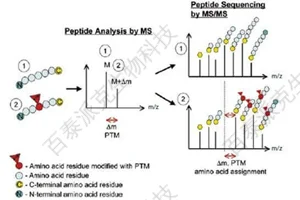
Mass spectrometry analysis of protein post-translational modifications
Related services:
Post-translational modification proteome analysis
Glycoprotein analysis
How to order?




