






Mass Spectrometry Detection of Histone Modifications
Mass spectrometry is a powerful tool for global, unbiased, and quantitative analysis of histone post-translational modifications. It allows for qualitative, quantitative, and site-specific identification of histone modifications. Biotech company PTM Biolabs offers mass spectrometry-based histone post-translational modification analysis services.
Histone modification detection
The nucleosome is the smallest structural unit of chromatin, consisting of a histone octamer wrapped with 147 base pairs of DNA. The function of histones is mediated by extensive post-translational modifications (PTMs), which are crucial for nuclear integrity as they regulate chromatin structure and recruit enzymes involved in gene regulation, DNA repair, and chromosomal condensation. Antibody-based techniques, such as western blotting, can characterize the abundance of histone modifications, but these methods have low throughput and cannot identify unknown PTMs. Mass spectrometry is a powerful tool for global, unbiased, and quantitative analysis of histone modifications. Mass spectrometry methods can quantify over 60 modification states in a single sample, far exceeding the capabilities of traditional protein blotting (western blot). Consequently, mass spectrometry-based histone analysis has become an increasingly popular tool for understanding how genetic and environmental factors affect epigenetic states.
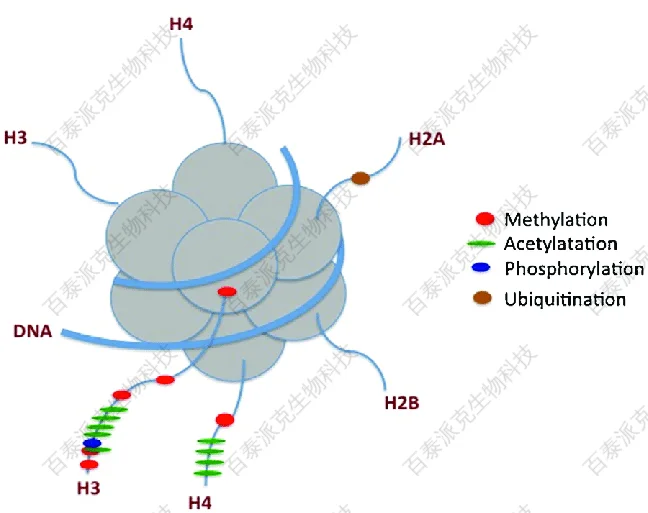
Mass spectrometry detection of histone modifications
Mass spectrometry detection of histone modifications
Mass spectrometry detection of histone modifications often employs a bottom-up strategy, where intact histones are enzymatically digested into short peptides. Since histones are rich in arginine and lysine residues, trypsin digestion can result in peptides that are too small. Therefore, histone lysine residues that are unmodified or monomethylated can be derivatized with propionic anhydride prior to digestion to prevent trypsin cleavage of lysine. During liquid chromatography-mass spectrometry (LC-MS), this produces peptides of appropriate size to achieve optimal ionization. Histone modification mass spectrometry detection not only allows for qualitative and quantitative analysis but also enables site-specific identification of histone modifications.
Related services
How to order?




