






Isotope Labeling Quantitative Proteomics
Labeled quantitative proteomics refers to the quantitative analysis of the proteome using isotopic labeling. BGI-GBI Biotech offers mass spectrometry-basedlabeled quantitative proteomics analysisservices.
labeled quantitative proteomics
The dynamic changes in the content of various intracellular proteins have significant impacts on various life processes. For example, the occurrence and development of many diseases are often accompanied by abnormal protein expression. Therefore, to study the impact of changes in protein abundance on biological activities, quantitative proteomics has emerged. Currently, quantitative proteomics techniques are mainly divided into labeled (Label) and label-free (Label-Free) quantitative strategies. The labeled strategies are further subdivided into in vivo labeling (such as SILAC, 15^N labeling) and in vitro labeling (such as iTRAQ, TMT labeling). As the name implies, labeled quantitative proteomics involves labeling proteins using labeling techniques and then performing quantitative proteome analysis.
Introduction to labeled quantitative proteomics technology
SILAC technology: This is an in vivo labeling technique that involves adding light, medium, or heavy stable isotope-labeled essential amino acids lysine (Lys) and arginine (Arg) in the cell culture medium to achieve protein labeling. The samples are then analyzed by LC-MS for relative quantification.
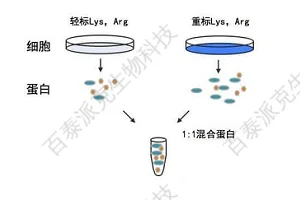
labeled quantitative proteomics
TMT and iTRAQ technologies: Both are in vitro labeling techniques developed by Thermo and Sigma, respectively. Their quantitative principles are similar, involving the specific labeling of peptide amino groups with multiple (2-10) stable isotope tags, followed by tandem mass spectrometry analysis to measure the relative protein content in different samples.
Related services:
How to order?




