






Multinotch Proteomics
Multinotch proteomics is quantitative proteomics combined with TMT/iTRAQ. Biotech company Biotree offers this serviceMultinotch analysis based on TMT/iTRAQ quantitative proteomicsService.
Multinotch MS
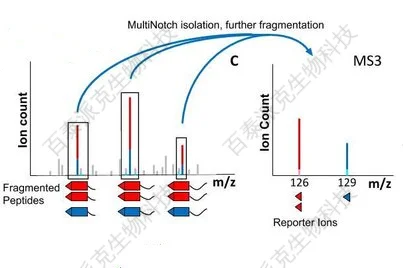
The Multinotch MS analysis technique is developed based on TMT and iTRAQ quantitative proteomics technologies. In TMT or iTRAQ technologies, precursor ions corresponding to the expected or known peptide's specific mass-to-charge ratio (m/z) are first isolated. These precursor ions are then fragmented through collision-induced dissociation, breaking both the peptide backbone and the tag. Sequence information can be obtained by analyzing fragments resulting from backbone cleavage, and source identification can be achieved by analyzing reporter ions from tag fragments. However, this method for quantifying peptides and proteins is affected by inherent interference falling within the initial m/z isolation window. This interference is caused by unrelated co-eluting peptides entering the target precursor's isolation window. Since the vast majority of peptides show no change in ratio between control and experimental conditions, the interference tends to drag all ratios toward unity, affecting the accuracy of the quantitative values obtained. To eliminate these interfering signals, the Multinotch MS analysis technique was developed. Multinotch MS analysis is an MS/MS/MS analysis technique that achieves higher quality quantitative measurement results.
Multinotch proteomics
Multinotch proteomics, based on traditional TMT/iTRAQ analysis techniques, provides Multinotch MS analysis using tertiary fragment reporter ions for quantification. This improves the dynamic range of reporter ion quantification and reduces the variance of reporter ion signals, further enhancing the accuracy of TMT/iTRAQ quantitative proteomics analysis.
Related services:
TMT/iTRAQ/MultiNotch quantitative proteomics analysis
Multinotch proteomics
How to order?




