






Absolute Quantification of Proteins
Absolute quantification of the proteome refers to determining the absolute concentration of different proteins at the omics level. Biotech company Biotype providesabsolute quantification of the proteomeservices.
quantitative proteomics
Quantitative proteomics involves measuring the content of proteins in samples such as cells or tissues at a global level, which can be divided into relative and absolute quantification. The methods for protein identification in quantitative proteomics are the same as those used in qualitative proteomics, but with the addition of a quantitative dimension. Quantitative proteomics not only provides a list of proteins identified in the samples but also offers information on physiological differences between two biological samples. It is mainly conducted through two-dimensional gel electrophoresis (2-DE) or mass spectrometry (MS), with 2-DE often requiring downstream MS for protein identification. MS can both identify and quantify proteins.
absolute quantification of the proteome
Mass spectrometry-based absolute quantification of the proteome can be divided into internal standard-based absolute quantification and label-free absolute quantification. Internal standard-based methods include isotope-tagged peptide labeling for absolute quantification, non-isotope labeled peptides for absolute quantification, and isotope-labeled peptides as internal standards for absolute quantification. Common techniques like iTRAQ and TMT fall under isotope-tagged peptide labeling for absolute quantification, while isotope-labeled peptides as internal standards combined with MRM and SWATH allow for more sensitive and accurate absolute quantification of the proteome.
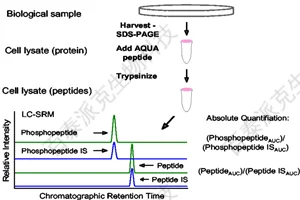
absolute quantification of the proteome
related services:
How to order?




