






What is untargeted metabolomics?
Untargeted MetabolomicsUntargeted Metabolomics is a strategy aimed at comprehensively scanning samplesfor as many metabolites as possible,emphasizing broad coverage, unbiasedness, and exploratory characteristics. It is mainly used forthe discovery of unknown metabolites, metabolic pathway screening,anddisease mechanism researchand has extensive application value in fields such as life sciences, medicine, nutrition, and drug development. In terms of technical implementation, untargeted metabolomics typically relies on high-resolution mass spectrometry (HRMS) platforms, such asOrbitraporQ-TOFcombined with gas chromatography (GC) or liquid chromatography (LC) to comprehensively detect small molecular metabolites in samples.
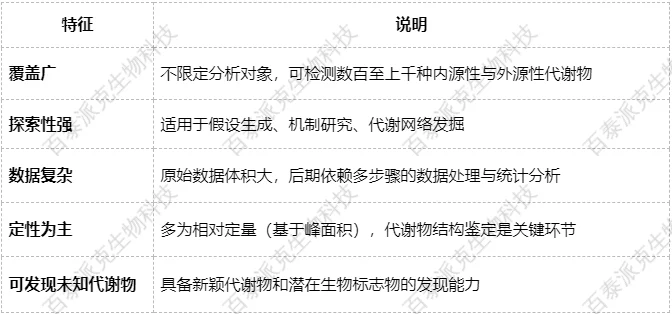
I. Core Features of Untargeted Metabolomics
II. Technical Workflow of Untargeted Metabolomics
Untargeted metabolomics typically includes the following key steps:
1. Sample Preparation
Different sample types (plasma, urine, tissue, cells, etc.) require specific pretreatment, such as protein precipitation, liquid-liquid extraction, and derivatization, to remove interferences and preserve metabolites.
2. Chromatographic Separation
Select the appropriate separation method based on the properties of the metabolites:
(1) Liquid Chromatography (LC): Suitable for polar metabolites, such as amino acids, organic acids, and nucleotides;
(2) Gas Chromatography (GC): Suitable for volatile or derivatizable metabolites, such as fatty acids and organic acids.
3、Mass Spectrometry Detection
Using high-resolution mass spectrometry (such as Orbitrap, Q-TOF), infull scan (Full Scan) + data-dependent acquisition (DDA) or data-independent acquisition (DIA)mode, obtainprimary mass spectrometry data (MS1) and secondary fragment information (MS/MS)。
4、Data Preprocessing
Includes:
(1) Peak extraction and alignment
(2) Noise and background removal
(3) Batch effect correction and normalization
(4) Metabolite annotation (based on m/z, retention time, MS/MS spectral matching)
5、Statistical and Bioinformatics Analysis
Common methods include:
(1)PCA/PLS-DAto reveal differences between samples
(2) Differential metabolite screening (VIP value, p-value, FC)
(3) Metabolic pathway enrichment analysis (KEGG, MetaboAnalyst, etc.)
III. Application Scenarios of Untargeted Metabolomics
1. Disease Mechanism Research
By comparing the metabolic profile differences between healthy and disease groups, key metabolic pathways and pathological associations can be explored, helping to reveal the molecular mechanisms of disease occurrence and development.
2. Biomarker Discovery
In large sample cohorts, screen for metabolites significantly associated with disease, drug response, or nutritional status, providing clues for subsequent targeted validation and clinical testing.
3. Drug Mechanism and Side Effect Evaluation
Used to analyze the overall regulatory effects of drugs on metabolic networks, assess potential targets, toxicity pathways, and off-target effects.
4. Nutrition and Food Science Research
Reveal the impact of specific nutritional interventions on metabolic status, such as metabolic changes induced by high-fat diets, functional foods, and probiotic intake.
5. Plant and Microbial Metabolism Research
Significant value in plant metabolic regulation, discovery of microbial secondary metabolites, and evaluation of microbial metabolic functions.
IV. Advantages and Challenges of Untargeted Metabolomics
1. Advantages
(1) Unbiased Scanning: No prior knowledge needed, suitable for exploring unknown mechanisms
(2)Information Rich: Covers multiple metabolite categories (amino acids, sugars, lipids, organic acids, etc.)
(3)Strong Discovery Capability: Can uncover novel metabolites and potential biomarkers
2. Limitations
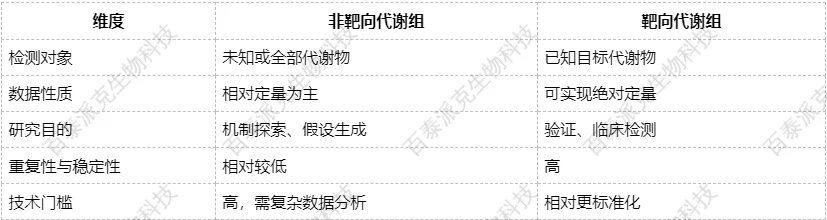
(1)Inaccurate Quantification: Mostly relative quantification, significantly affected by batch effects and instrument drift
(2) High Data Complexity: Long data processing workflows requiring professional analytical skills
(3) Difficulty in Metabolite Identification: Difficult to confirm structure with m/z and retention time alone, needs MS/MS spectra or reference standards for validation
(4) General Reproducibility: Low degree of method standardization, not conducive to large-scale validation
V. Non-Targeted Metabolomics vs. Targeted Metabolomics
Biotech Pack Bio Tech provides high coverage, high confidence, and translatable non-targeted metabolomics services to research clients based on internationally leading high-resolution mass spectrometry platforms (Thermo Orbitrap/Q-TOF) and automated bioinformatics workflowsHigh Coverage, High Confidence, Translatablenon-targeted metabolomics services:
(1) Comprehensive Metabolite Annotation System: Integrates databases like MS-DIAL, GNPS, HMDB, LipidBlast
(2) Professional Data Analysis Support: From differential analysis, pathway enrichment to multi-omics integration
(3) Multi-Sample Adaptability: Covers various sample types such as serum, urine, cerebrospinal fluid, tissue, feces, etc.
(4) Standardized Quality Control System: Includes QC samples, blank samples, internal standards, batch correction, etc.
Non-targeted metabolomics not only opens the 'metabolic window' for researchers into biological systems but also provides a solid foundation for subsequent targeted research and clinical translation. Biotech Pack Bio Tech is committed to being your long-term partner in the field of metabolomics, empowering every scientific discovery with high-quality data.
Biotech Pack Bio Tech - Characterization of Biological Products, Premium Provider of Multi-Omics Mass Spectrometry Testing Services
Related Services:
How to order?




