






Untargeted Metabolomics
1. Untargeted Metabolomics
Untargeted metabolomics is a comprehensive and unbiased analytical strategy aiming to perform full-spectrum detection of all detectable small molecule metabolites in biological samples without pre-setting analytical targets. This technology, combined with high-resolution mass spectrometry platforms (such as liquid chromatography-mass spectrometry and gas chromatography-mass spectrometry) and various chromatographic separation methods (such as reversed-phase chromatography and hydrophilic interaction chromatography), enables qualitative and semi-quantitative analysis of both known and unknown metabolites.
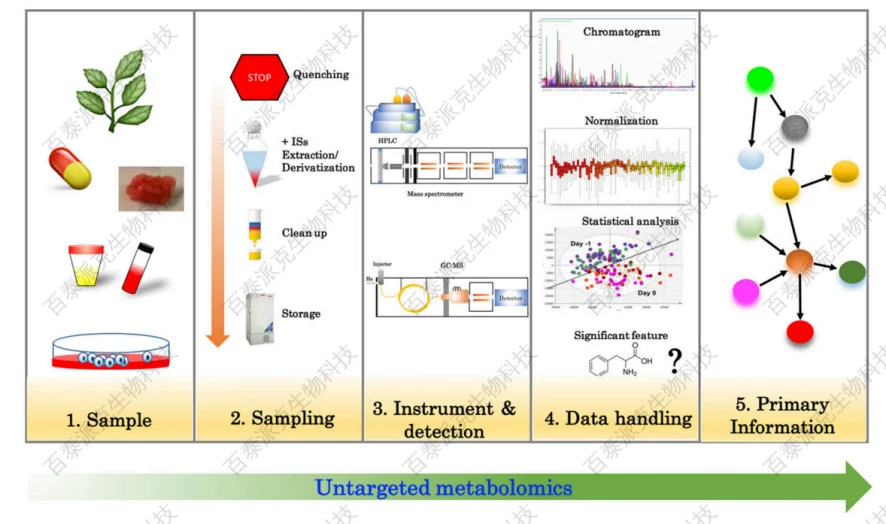
Khoomrung, S. et al. Front Pharmacol. 2017.
Figure 1. Workflow of Untargeted Metabolomics Analysis
Untargeted metabolomics can cover multiple key metabolites such as amino acids, organic acids, lipids, cholesterol, fatty acids, carbohydrates, and nucleotides. Through efficient sample processing and precise instrumentation platforms, untargeted metabolomics is used to comprehensively monitor the changes in metabolites under different physiological or pathological states and is widely applied in basic medical research, clinical research, microbiology, and nutritional science.
2. Plasma Metabolomics
Plasma is one of the most commonly used sample types in metabolomics, capable of reflecting the overall metabolic state of multiple organs and systems. Due to the high abundance of proteins and lipids in plasma, the key to sample pretreatment is to efficiently extract low-abundance metabolites and remove interfering components. Common strategies include protein precipitation with organic solvents (such as methanol and acetonitrile), supplemented by solid-phase extraction (SPE), membrane filtration, or online protein removal systems to improve the signal-to-noise ratio. For metabolites with significant polarity differences, biphasic extraction can be used to separate polar and non-polar metabolites, facilitating parallel analysis of lipid-like and hydrophilic small molecules.

Wawrzyniak, R. et al. Sci Rep. 2018.
Figure 2. Plasma Metabolomics Sample Processing Workflow
In terms of separation and detection, untargeted metabolomics utilizes high-resolution liquid chromatography-mass spectrometry (LC-HRMS) for metabolite analysis. By employing multiple separation strategies such as reversed-phase and hydrophilic interaction chromatography, it maximizes the coverage of various metabolites, ensuring comprehensive detection of low-abundance metabolites. The mass spectrometry part usually adopts high-resolution mass spectrometers such as Orbitrap or Q-TOF, capable of accurately determining the mass-to-charge ratio (m/z) of metabolites and conducting preliminary structure identification. Combined with data-independent acquisition (DIA) and data-dependent acquisition (DDA) modes, this method further enhances the identification capability of unknown metabolites, ensuring data integrity and accuracy.
3. Fecal Metabolomics
Fecal metabolomics is widely used in the study of inflammatory bowel disease, metabolic syndrome, liver-gut axis research, etc., and serves as an important research tool connecting the gut microbiome and host metabolism. The processing workflow usually includes freeze-grinding, homogenization, and extraction of metabolites with polar or mixed organic solvents (such as methanol, water, isopropanol). Depending on research needs, single-phase or biphasic extraction strategies may be chosen. High-throughput centrifugation and filtration are used to remove particulates, sometimes combined with freeze-drying to concentrate samples and enhance detection sensitivity.
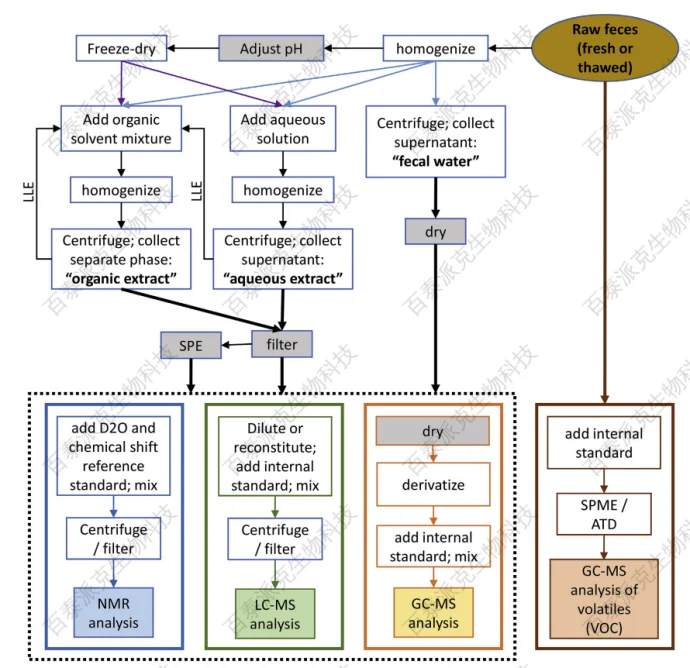
Karu, N. et al. Anal Chim Acta. 2018.
Figure 3. Fecal Metabolomics Sample Processing Workflow
In terms of separation and detection, fecal metabolomics usually combines reversed-phase chromatography with hydrophilic interaction chromatography, coupled with high-resolution mass spectrometry (such as Orbitrap or Q-TOF) for full-scan analysis. This method can cover various types of metabolites, including short-chain fatty acids, bile acids, indole compounds, lipids, phenylpropanoids, and microbe-specific metabolic products. Due to the complex matrix of fecal samples and the significant individual differences, data analysis usually requires the introduction of stable internal standards, batch effect correction, and multivariate statistical methods to ensure the comparability of results and the accuracy of biological interpretation.
4. Bacterial Metabolomics
Bacterial metabolomics is used to explore microbial metabolic pathways, strain functions, and their responses to external stimuli (such as drugs, environment), divided into intracellular and extracellular metabolite analyses. Intracellular metabolite processing includes rapidly terminating metabolism (such as using cold solvents) and lysing cells through glass bead disruption or freeze-thaw methods. Extracellular metabolites are extracted from the culture supernatant after cell removal by centrifugation, often combined with solid-phase extraction purification.

Mohd, Kamal, K. et al. Biochem Res Int. 2022.
Figure 4. Bacterial Metabolomics Sample Processing Workflow
For the detection of metabolites in plasma, fecal, and bacterial samples, untargeted metabolomics employs high-resolution mass spectrometry (such as Orbitrap or Q-TOF) combined with multimode chromatography for full-scan detection. To ensure data comparability and biological interpretation, it is usually necessary to combine internal standard correction, batch effect processing, and multivariate statistical analysis.
5. Metabolite Analysis
1. Lipid Analysis
In untargeted metabolomics, lipidomics reveals the critical roles of lipids in disease progression by comprehensively analyzing lipid diversity and dynamic changes. Sample extraction is a key step in lipidomics, with common extraction methods including the Folch method and Bligh-Dyer method, which effectively extract lipids from cell or tissue samples. Additionally, supercritical fluid extraction (SFE) is an emerging technique that efficiently extracts low-abundance lipids, reduces the use of traditional solvents, and improves lipid recovery rates. In lipid identification methods, besides the common mass spectrometry technology, liquid chromatography-microfluidic chip technology (LC-MC) enhances lipid separation efficiency through the combination of microfluidic chips and liquid chromatography, especially suitable for high-throughput screening of complex samples. Two-dimensional liquid chromatography (2D-LC) combines different separation mechanisms, significantly improving lipid resolution for more precise analysis of complex lipid samples. Nuclear magnetic resonance (NMR) technology is also applied in lipidomics, providing spatial structure information of lipid molecules, especially suitable for qualitative analysis of complex lipids. These novel techniques in lipidomics make lipid detection more precise, advancing the application of lipids in disease research and biomarker discovery.
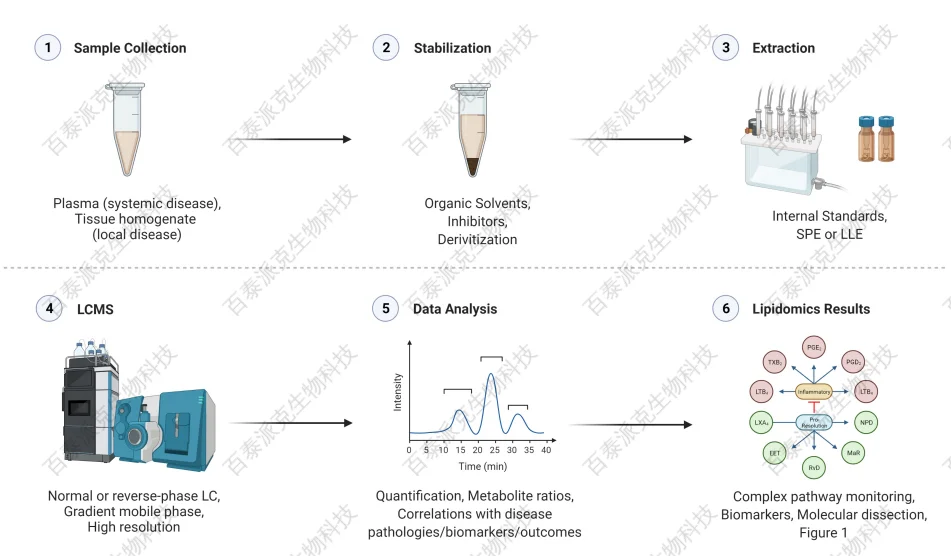
Ahluwalia, K. et al. Metabolites. 2022.
Figure 5. Lipidomics Analysis Workflow
2. Amino Acid Analysis
The challenges of untargeted amino acid analysis mainly lie in the difficulty of distinguishing structural isomers (such as isomers), the poor retention performance of some highly polar amino acids, and the susceptibility to matrix interference affecting quantification accuracy. To ensure analytical quality, it is necessary to optimize protein precipitation and derivatization strategies during the pretreatment stage to improve the extraction efficiency and signal response of target compounds; during the chromatographic separation stage, select appropriate reversed-phase or hydrophilic interaction chromatography columns to enhance resolution; in mass spectrometry detection, high-resolution and high-precision instruments should be used, combined with multi-stage mass spectrometry information to enhance structural discrimination ability. Additionally, during data processing, it is essential to strictly filter background noise and mismatched results to ensure accurate identification of differential amino acids and metabolic pathway annotation.
3. Bile Acid Analysis
Bile acids are important metabolites in untargeted metabolomics analysis, often detected using liquid chromatography-mass spectrometry (LC-MS) technology. LC-MS can efficiently separate various isomers of bile acids, such as cholic acid, deoxycholic acid, and their derivatives, providing qualitative and quantitative analysis. Through untargeted analysis, researchers can identify metabolic changes of bile acids under different pathological conditions, revealing their potential role in metabolic disorders or disease progression. Compared to targeted analysis, untargeted analysis has a wider coverage, allowing the discovery of new bile acid metabolites without preset targets, enhancing the comprehensiveness of the research. This provides robust data support for the application of bile acids in disease diagnosis, particularly in the discovery of potential biomarkers in liver diseases and metabolic disorders.
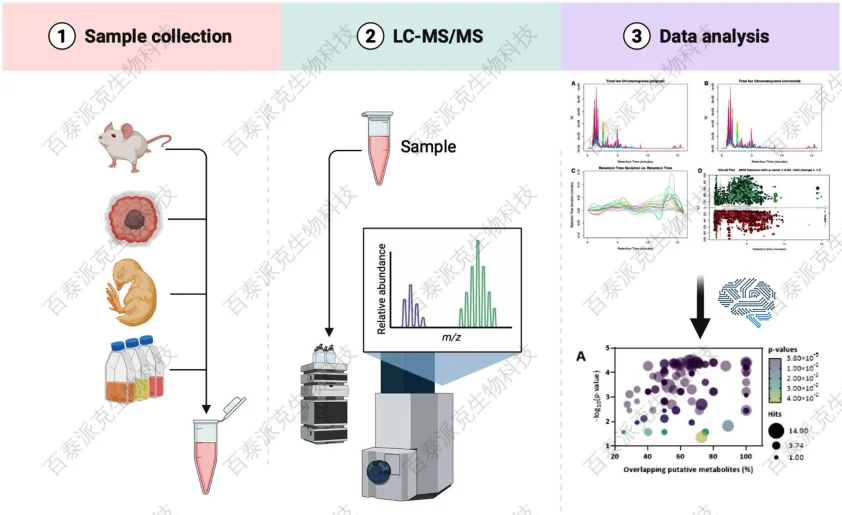
Marques, CF. et al. Separations. 2023.
Figure 6. Untargeted Metabolomics Analysis Workflow
6. Metabolic Pathway Analysis
Metabolic pathway analysis is a crucial part of untargeted metabolomics, aiming to map detected metabolites onto known biological metabolic pathways and identify significantly perturbed metabolic networks under specific conditions. The analysis process includes metabolite annotation, pathway matching, enrichment analysis, and impact factor assessment. By integrating metabolite changes, pathway topology, and key network nodes, it reveals potential biological mechanisms, providing deep insights for disease research, drug development, and nutritional intervention.

Han, J. et al. Front Mol Biosci. 2021.
Figure 7. Metabolic Pathway Analysis Workflow
Biotech Pack Biotechnology — Characterization of Biologics, Quality Service Provider of Multi-omics Biological Mass Spectrometry Detection
Related Services:
Untargeted Metabolomics Analysis
How to order?




