






How to detect protein acetylation modifications by mass spectrometry?
Protein acetylation is one of the earliest discovered and most extensively studied types of acylation modifications, especially lysine acetylation (Kac). It is widely present in nuclear, cytoplasmic, and mitochondrial proteins, playing a crucial role in biological processes such as transcriptional regulation, chromatin remodeling, and metabolic regulation. With the advancement of mass spectrometry (MS) technology, researchers can conduct high-throughput, quantitative, and site-specific analyses of acetylation modifications at the omics level.
I. Characteristics and Detection Challenges of Lysine Acetylation Modifications
1. Diverse Modification Sites: Widely distributed on transcription factors, histones, metabolic enzymes, and other proteins;
2. Low Abundance and High Dynamics: Kac modifications have extremely low abundance in total proteins (<0.1%);
3. Clear Mass Shift: +42.0106 Da, can be clearly captured by high-resolution mass spectrometry;
4. High Positional Specificity Requirement: Requires precise location at specific lysine sites.
Therefore, detection strategies with high sensitivity and specificity are key to successful Kac research.
II. Standard Workflow for Mass Spectrometry Detection of Acetylation Modifications
1. Protein Extraction and Digestion
-
Use lysis buffer containing deacetylase inhibitors (such as Trichostatin A, Nicotinamide) to protect endogenous modifications;
-
It is recommended to use 8 M Urea or SDS lysis systems for protein extraction;
-
Trypsin is commonly used for protein digestion, generating peptides for enrichment and detection.
2. Enrichment of Acetylated Peptides (Key Step)
Due to the low abundance of acetylation modifications, enrichment before detection is necessary:
Common method: Anti-acetyl lysine antibody enrichment (Anti-Kac IP)
-
Use antibodies to specifically recognize the covalent structure of acetylated lysine;
-
Suitable for various sample types (cells, tissues, clinical samples);
-
Can be used for tandem enrichment of different subcellular components or modification types (such as combined with TMT labeling).
3. LC-MS/MS Mass Spectrometry Detection
(1) Liquid Chromatography Separation: NanoLC system improves resolution, recommended to use C18 reverse-phase column;
(2) Recommended Mass Spectrometry Platform:
-
High-resolution Orbitrap series (QE HF-X, Exploris 480);
-
timsTOF Pro 2 suitable for DIA acquisition mode;
(3) Acquisition Mode:
-
DDA (Data-Dependent Acquisition): Suitable for modification site mapping;
-
DIA (Data-Independent Acquisition): Suitable for large sample quantitative analysis;
(4) Mass Spectrometry Parameter Settings:
-
Preset acetylation modification as a variable modification (K+42.0106);
-
MS/MS level scanning to confirm modification location;
-
Dynamic exclusion to avoid repeated scanning of high-abundance peptides.
4. Data Analysis and Modification Localization
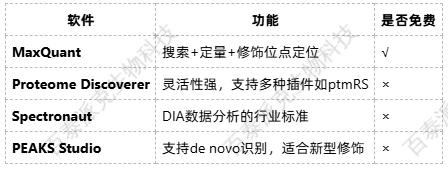
Data Analysis Workflow:
(1) Database Search: UniProt species database, set Kac as a variable modification;
(2) Site Localization: Use ptmRS or Ascore algorithms to evaluate modification confidence (typically requires confidence ≥ 0.75);
(3) Quantitative Analysis:
-
Label-based quantification: TMT, iTRAQ, etc.;
-
Label-free quantification: LFQ, MS1 peak area.
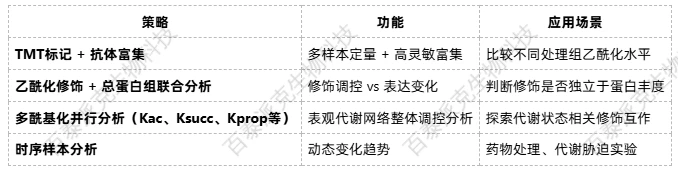
III. Advanced Strategies: Enhancing the Depth and Throughput of Acetylation Modification Omics Analysis
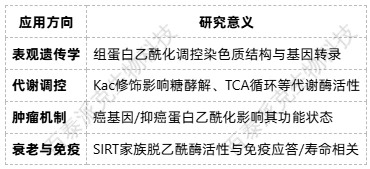
IV. Popular Application Areas of Protein Acetylation Research
Mass spectrometry technology has become the core method for protein acetylation modification research. Through scientific sample preparation, specific antibody enrichment, high-resolution mass spectrometry detection, and rigorous data analysis processes, researchers can achieve comprehensive analysis of acetylation modifications in terms of high throughput, site specificity, and dynamic quantification. Biotech Pack has established a mature protein acetylation omics analysis platform, optimizing from sample processing, antibody screening to quantification strategies, supporting various model animals and cell lines, and widely applied in areas such as metabolic regulation, drug target discovery, and disease mechanism research. If you are interested in protein acetylation modification research, please contact us to obtain a complete experimental protocol or case report. We will provide one-on-one technical support and free evaluation services!
Biotech Pack - Characterization of Biological Products, High-Quality Service Provider for Multi-Omics Mass Spectrometry Detection
Related Services:
How to order?




